


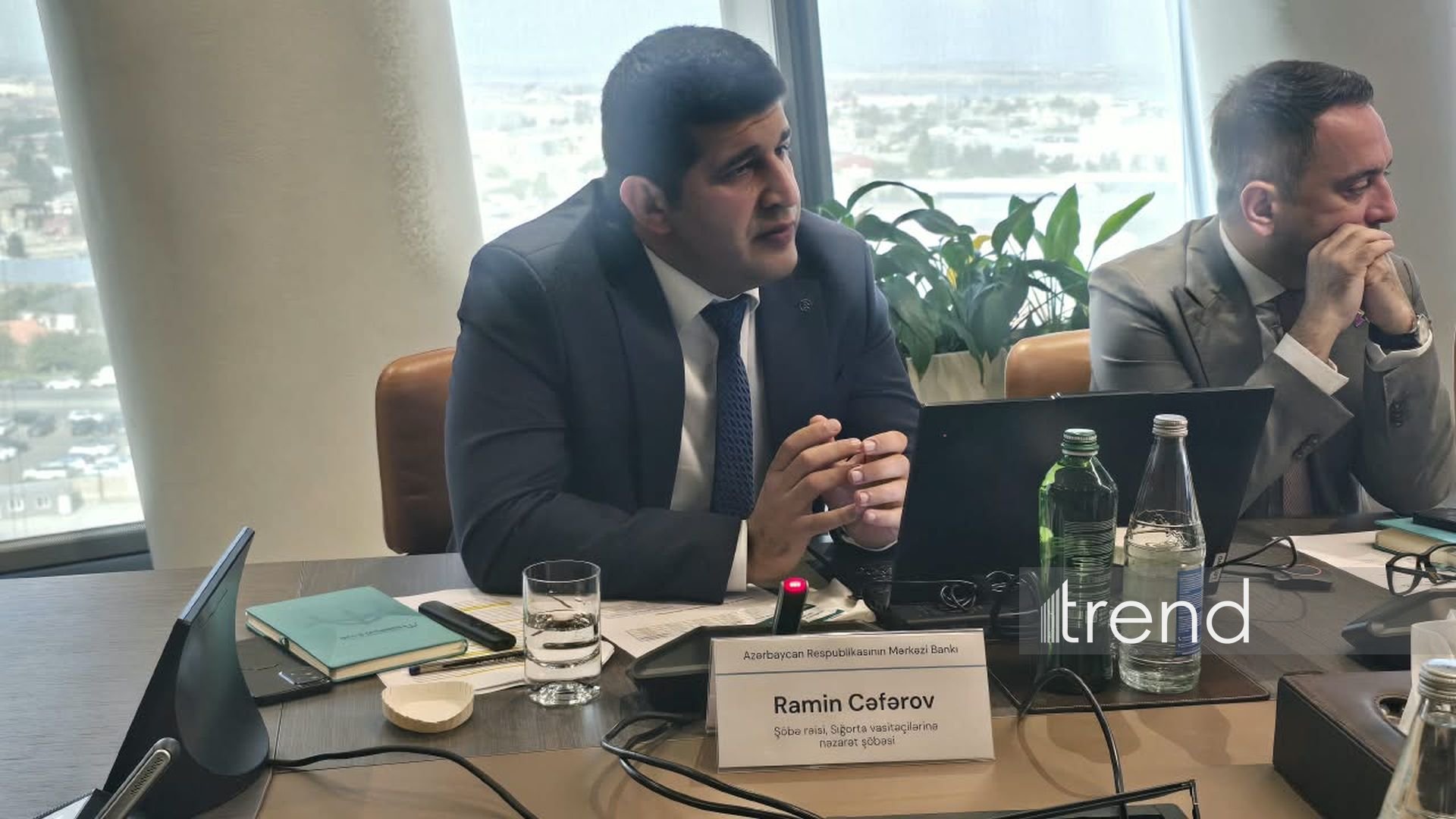

BAKU, Azerbaijan, October 21.The role of reinsurance in sharing cyber insurance risks is growing in Azerbaijan, Head of the Insurance Intermediaries Supervision Department at the Central Bank of Azerbaijan, Ramin Jafarov, said during a training titled "Role of the insurance sector in financial stability” in Baku on Wednesday, Trend’s correspondent reports from the event.
According to him, in the traditional insurance model, risk assessment is primarily based on general indicators, while the processes of documentation and loss assessment following an insured event are time-consuming.
"The application of modern technologies, insurtech solutions, and artificial intelligence enables the acceleration of these processes and allows for a more precise determination of customers' risk profiles," he noted.
Jafarov pointed out that, through the use of analytical tools, insurance companies can assess the risks of potential clients in greater detail and develop personalized products tailored to their specific needs. Furthermore, mobile applications and online resources facilitate the sale of insurance products and expedite the processes of claims handling and payouts.
The department head also emphasized that cyber risks have become increasingly significant alongside the advancement of technology. According to him, assessing damages resulting from cyberattacks can be more complex than evaluating traditional insured events, often requiring the involvement of information technology experts.
"Cyber risks possess characteristics such that a single incident could significantly impact an insurance company's financial position. Consequently, insurance companies do not retain the entirety of such risks; instead, they distribute a portion of them through reinsurance," he remarked.
According to Jafarov, the volume of risk that insurance companies assume is limited by their financial capacity and legislative requirements. He mentioned that there is a 10% limit regarding the ratio of the risk retained by an insurer under a single contract to its aggregate capital.
He explained this with an example.
"If an insurance company has an aggregate capital of 30 million manat ($17.6 million) and enters into a contract involving a risk of 10 million manat ($5.9 million), the amount of risk it retains is determined within the scope of this limit, while the remainder can be ceded through reinsurance," he clarified.
The department head added that insurance products in Azerbaijan are categorized into two main groups: compulsory and voluntary. Compulsory insurance products are defined by legislation and are based on requirements applicable to all market participants. The terms and conditions for voluntary insurance products are developed by the insurance companies themselves.
He noted that, previously, because each company had its own distinct rules for various types of voluntary insurance, customers found it difficult to compare contract terms. Within the framework of the financial sector development strategy, work was undertaken to establish unified rules in this area, and a standardized approach has now been introduced for CASCO insurance.
"The implementation of unified rules allows customers to compare insurance terms more easily and fosters a consistent approach across the market. Nevertheless, since each insurance company has its own specific risk appetite and capacity to assume risks, a certain degree of flexibility is maintained regarding the determination of insurance premiums," Jafarov stressed.


