


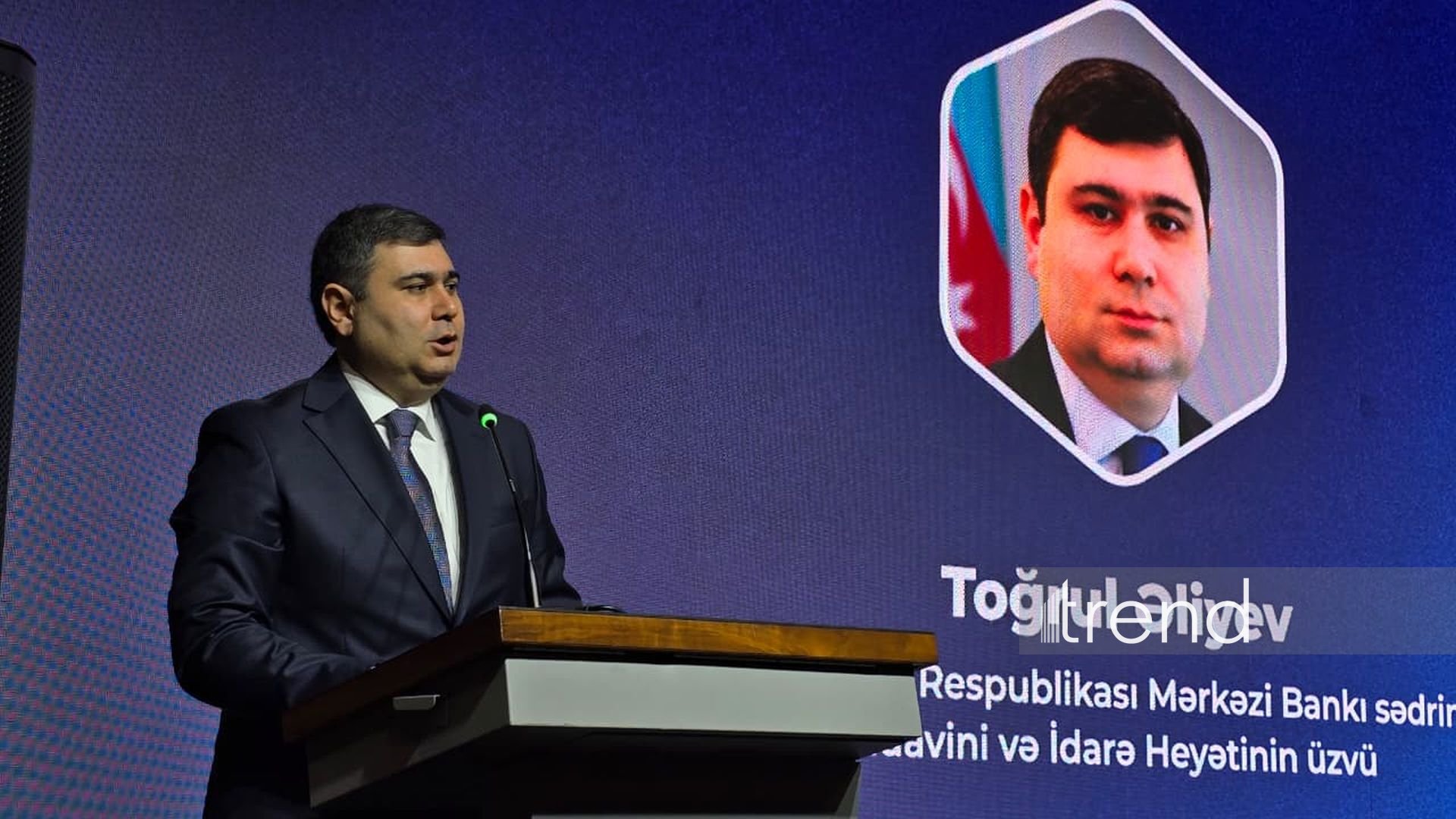

BAKU, Azerbaijan, October 20. Risk management in the financial sector is no longer limited solely to financial risks; risks related to information security, cyber threats, environmental and social factors, as well as corporate governance, are becoming increasingly significant, Deputy Chairman of the Central Bank of Azerbaijan (CBA) and member of the Management Board, Toghrul Aliyev, said at a conference on Sustainable Business, Corporate Governance, Risk, and Compliance (GRC) in Baku on Tuesday, Trend’s correspondent reports from the event.
According to Aliyev, in the operations of organizations, risk management and decision-making are defined not only by financial outcomes but also by the approach taken toward risks, the principles underlying decisions, and the preservation of stakeholder trust.
He pointed out that the GRC framework, which integrates corporate governance, risk management, and compliance, is an important institutional mechanism that supports the long-term development of organizations, as well as the stability of the financial system in the context of the CBA’s operational focus areas.
He remarked that shifts in the global economic environment further underscore the importance of this approach. Accurately assessing the impact of economic, geopolitical, technological, and environmental factors on the business landscape is essential for the timely identification of risks, the making of well-founded decisions, and agile adaptation to changing conditions.
The deputy chairman of the CBA emphasized that the Central Bank has identified the GRC framework as a core priority within its financial sector development strategy for 2024–2026.
According to him, banks, insurance companies, and investment firms are among the key sectors where corporate governance, risk management, and compliance standards are systematically applied. The requirements established for financial institutions serve to enhance their resilience and strengthen overall confidence in the sector.
"Strong corporate governance and effective risk management not only bolster the resilience of individual financial institutions but also contribute significantly to strengthening confidence in the financial sector as a whole. The resilience of individual financial institutions and the stability of the financial sector at large are closely interconnected," he explained.
Aliyev mentioned that the CBA, while basing its approach on international standards, adapts regulatory requirements to align with the development level, needs, and specific characteristics of the local market.
He also highlighted that the Central Bank has transitioned to a risk-based supervisory approach, underpinned by the Azerbaijan Risk Assessment System (ARAS). He noted that GRC principles constitute one of the core components of this approach.
"In this context, our objective is to ensure the agile development of risk management systems, compliance mechanisms, and internal controls, aligned with the level of risk," the CBA’s deputy chairman emphasized.
According to him, the scope of the concept of compliance today extends beyond mere adherence to legal and regulatory requirements or efforts to combat money laundering and the financing of terrorism.
Aliyev noted that compliance serves as a vital mechanism within organizations, guiding the development of a risk culture, the application of responsible governance principles, and the making of sound decisions. Integrating compliance into the decision-making process not only enhances the quality of governance but also fosters institutional trust.
The deputy chairman of the CBA added that the development of artificial intelligence, tokenization, and new digital services makes the presence of robust governance mechanisms even more critical. These technologies can only generate sustainable value if the associated risks are managed effectively.
He stressed that the Central Bank has established requirements for the management of various financial risks, including credit and liquidity risks:
"Furthermore, within the framework of modern risk management, the comprehensive assessment and management of non-financial risks, alongside financial risks, are becoming increasingly important," he added.


