



BAKU, Azerbaijan, October 21. Interest in the Middle Corridor’s future use remains significant, reads the EU Business Climate Report Azerbaijan 2025/26.
The report reveals that around 25.4% of respondents report that they have already used the corridor for trade or logistics and plan to continue using it. A further 23.9% of respondents have not yet used the Middle Corridor but are considering doing so within the next two to three years, indicating potential for future growth in demand. At the same time, 32.8% have not used the corridor and currently have no plans to do so, while 17.9% remain unsure or have no opinion.
“The comparison with the 2024 results suggests that actual use of the Middle Corridor increased between the two survey rounds, while interest in its future use remains significant. At the same time, both the 2024 and 2025/26 survey results indicate that further improvements in efficiency, capacity, connectivity and coordination remain important for strengthening the corridor's competitiveness,” reads the report.
The authors of the report note that the transport sector plays an increasingly important role in the Azerbaijani economy, with a 7.1% share of GDP in 2025.
“The country expanded its role as a growing transit hub between Europe and Asia due to its important position at the Trans-Caspian (Middle) Corridor. Transit cargo makes up nearly half of the rail and road freight and over 95% of maritime cargo in Azerbaijan. Advancing the Zangezur (TRIPP) route will further enhance the сapacity of the Middle Corridor. Recent geopolitical dynamics and the infrastructure advancements triggered the growth of cargo transit through Azerbaijan. The border capacity of the country expanded to 4,100 vehicles/day in each direction,” says the report.
The authors point out that with a capacity of 15 million tons and 150,000 TEUs in 2025, the Middle Corridor plays a vital role in supporting regional trade.
“The target capacity for the Corridor in 2030 is 18.8 million tons. The infrastructure enhancements in the rail, ports, roads, airports, and digital systems enabled the Middle Corridor to offer a faster transit option between Europe and China/Central Asia. As a result, the China-Europe transit has been completed in as little as 11 days. The sustained momentum underlines the need for new terminals, more wagons, and improved Caspian ferry capacity to prevent bottlenecks on the Middle Corridor. Interviewees emphasize the need for the EU to take a more proactive role in supporting the development of the Middle Corridor, drawing on the freight-transit expertise and experience of its member states, particularly the newer members,” the report says.
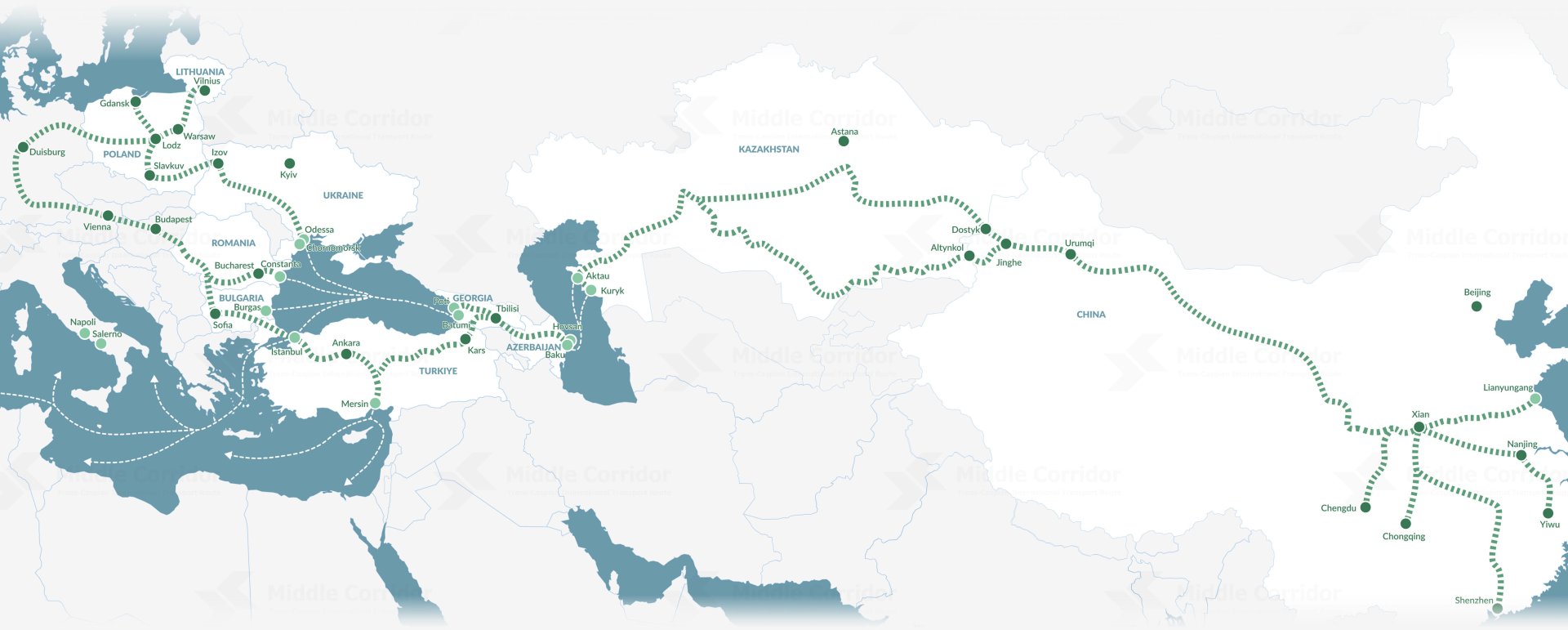
The Middle Corridor is a multimodal trade and transport route connecting Asia and Europe through Central Asia, the Caspian Sea, Azerbaijan, Georgia and Türkiye. The route begins in China and runs through Central Asia before crossing the Caspian Sea and continuing through Azerbaijan, Georgia and Türkiye to European markets.
The Middle Corridor is being developed as an alternative to traditional northern and southern transport routes, providing connectivity between Asian markets, including China, and Europe. The World Bank says targeted investments and reforms along the corridor could significantly increase trade volumes and reduce travel times by 2040.


