


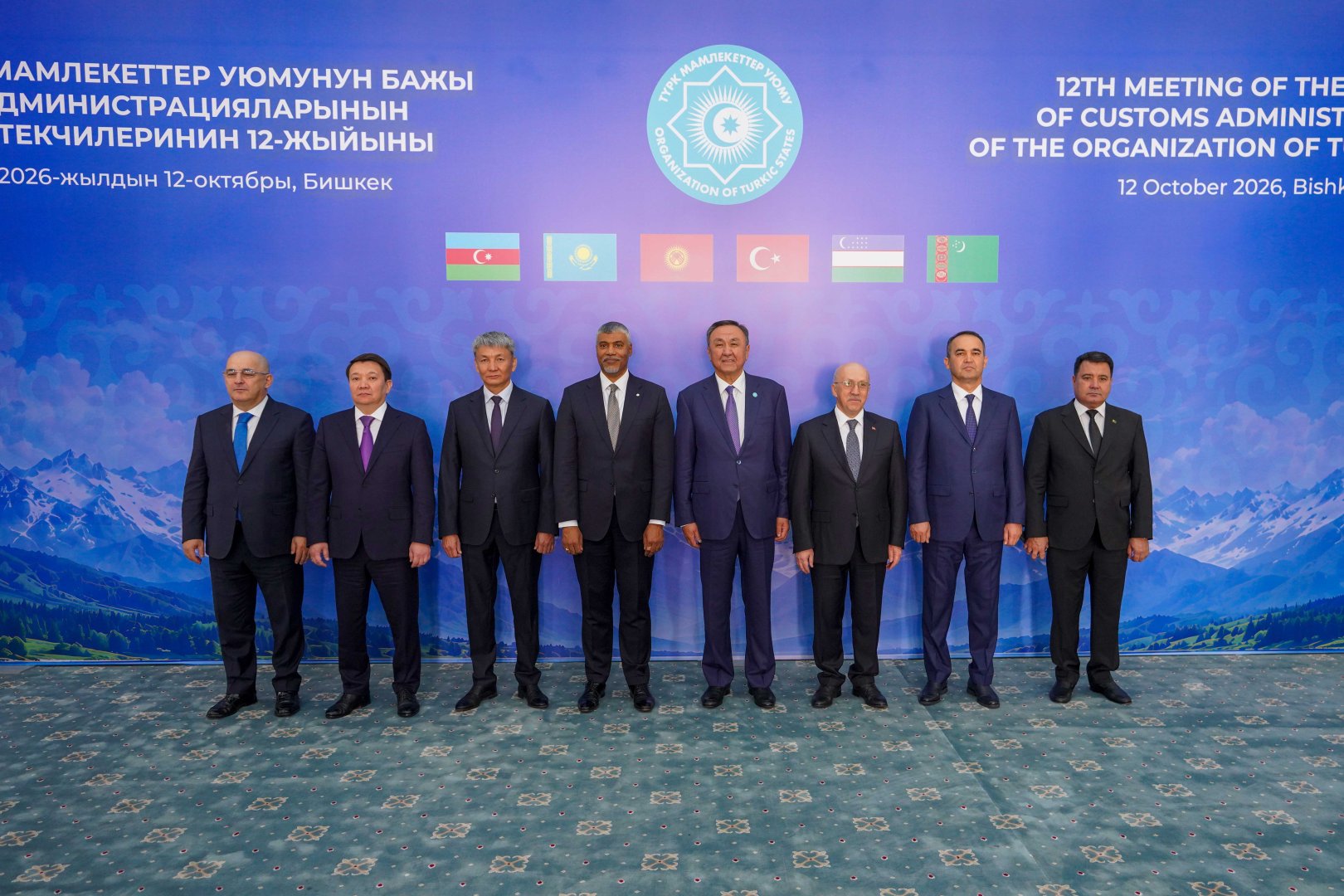

BAKU, Azerbaijan, October 21. Member states of the Organization of Turkic States (OTS) support the expansion of the digital TIR system.
This was reported by the International Road Transport Union (IRU).
IRU pointed out that the heads of customs administrations of the OTS member states reaffirmed their support for the expansion of the TIR system and its digital version, eTIR. These systems are of significant importance for strengthening transport connectivity in the region, accelerating border-crossing procedures, and enhancing security.
According to the information, the 12th meeting of the heads of customs administrations of the OTS member states, held in Bishkek, Kyrgyzstan, was attended by the heads of customs services, as well as OTS Secretary General Kubanychbek Omuraliev, World Customs Organization (WCO) Secretary General Ian Saunders, and IRU Director for TIR and Transit Services Tatiana Rey-Bellet.
The meeting highlighted the role of the TIR and eTIR systems in facilitating trade and transit. The participants noted the importance of utilizing proven international mechanisms to simplify customs procedures and strengthen regional cooperation.
eTIR system expands in Central Asia
"Currently, the eTIR system is operational across several transport corridors connecting Azerbaijan, Kyrgyzstan, Tajikistan, Turkmenistan, and Uzbekistan.
Meanwhile, Türkiye and Kazakhstan are preparing to launch eTIR operations on the Türkiye-Azerbaijan and Kazakhstan-Uzbekistan routes, respectively.
These developments represent a significant milestone in the advancement of digital transit connectivity within Central Asia and the broader region," the report noted.
Rey-Bellet highlighted the role of collaboration among customs authorities, the United Nations Economic Commission for Europe (UNECE), the IRU, and the OTS in achieving this progress.
She also identified the expansion of the eTIR system toward Europe and China as a key priority, with preparatory work currently underway. The objective is to establish digital transit corridors connecting Asia and Europe, with the OTS region playing a central role.
Digitalization should accelerate border-crossing procedures
The meeting also addressed the translation of digital solutions into tangible results at borders. The OTS supports the implementation of "green lanes" to facilitate the faster movement of low-risk cargo, thereby allowing customs authorities to focus their attention on high-risk shipments. The IRU has proposed extending this practice to eTIR operations.
Equipping customs representatives and transport operators with the necessary knowledge and skills to effectively utilize digital systems was also identified as a key priority. The customs administration of Uzbekistan emphasized the importance of continuous training during the transition from paper-based procedures to fully digital TIR operations.
Rey-Bellet noted that the IRU will continue to support customs administrations through technical cooperation, training, as well as the implementation of safe and transparent transit procedures.
"As an organization representing the road transport sector and the wider supply chain, as well as having a mandate to manage the TIR system, the IRU is fully committed to supporting customs administrations to achieve their goals of safe and facilitated transit and trade," she said.
Strengthening position of Kyrgyzstan as transit center
Within the framework of the meeting, Rey-Bellet and Urmat Kambarov, chairman of the Logistics and Transit Association (AliT), a new member of the IRU, met with the head of the department for monitoring the implementation of the decisions of the President and the Cabinet of Ministers of the Presidential Administration of Kyrgyzstan, Azamat Apsatarov.
At the meeting, measures were discussed to make Kyrgyzstan a more attractive transit country, especially for goods from China.
Kyrgyzstan and Tajikistan were the first countries to use the operational eTIR corridor in the region. Further improvement of procedures at border crossing points and inland logistics points can increase trade transparency.


