


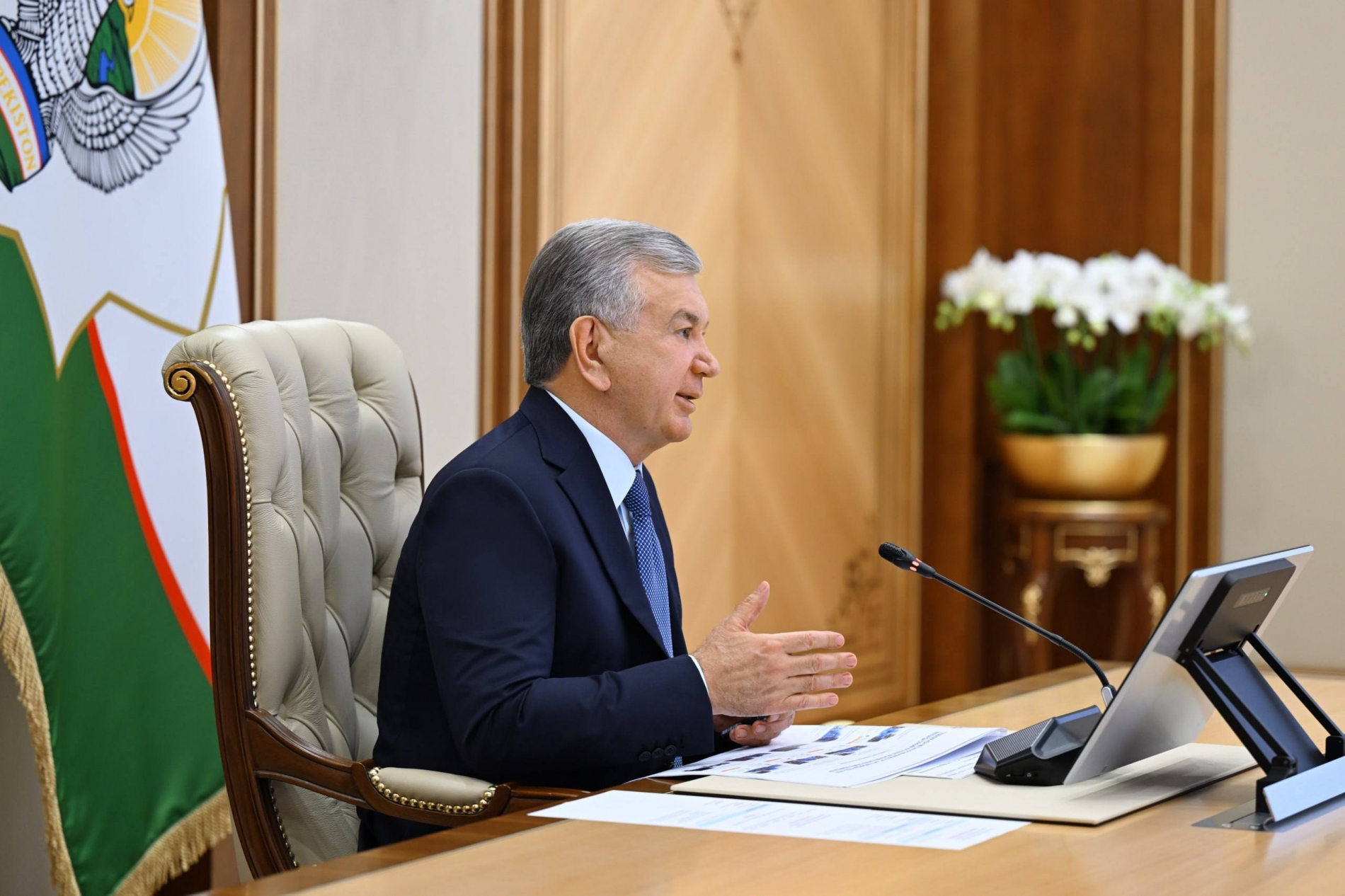

TASHKENT, Uzbekistan, June 16. Uzbek President Shavkat Mirziyoyev reviewed plans to expand the country’s critical minerals sector and boost the production of high-value industrial goods, as demand for strategic metals continues to grow globally.
This was reflected in the statement by the press service of the Uzbek President.
During a presentation on the development of Uzbekistan’s raw material base for critical minerals, officials outlined a 2026–2030 program that includes 120 projects worth a combined $4.2 billion. The initiative is aimed at increasing domestic processing capacity, strengthening technological industries, and expanding exports.
According to the plans presented, the sector’s annual output is expected to reach $1 billion by 2028 and double to $2 billion by 2030.
Global demand for technology metals and critical minerals has risen sharply due to their importance in industries such as electronics, machinery manufacturing, aviation, energy, and healthcare. While Uzbekistan possesses significant reserves of such resources, the Uzbek Technological Metals Plant currently focuses mainly on tungsten and molybdenum production.
Officials said the country has the potential to establish industrial production of 28 critical minerals through the development of new deposits and the construction of processing, hydrometallurgical, and pyrometallurgical facilities.
This year alone, Uzbekistan plans to launch 12 projects valued at $166 million. The projects will introduce production of three new metals—high-purity selenium, tellurium, and rhenium—as well as 21 types of import-substituting products, including powder metallurgy-based automotive components and sulfuric acid.
Authorities expect the new facilities to create hundreds of jobs, increase budget revenues, and expand export opportunities.
A key focus of the strategy is the development of a full value chain for tungsten and molybdenum, moving beyond concentrates and semi-finished products toward higher-value goods such as metal powders, alloys, rods, wire, industrial components, and other finished products.
As part of these efforts, the government plans to significantly expand the “Metals of the Future” technopark and an associated research and development center in Chirchik. The facilities are expected to support the commercialization of scientific research, startup development, and the production of high-purity metals and advanced materials.
Mirziyoyev instructed officials to consider additional incentives for the technopark and its residents, including support related to land use, infrastructure, and startup financing.
The presentation also covered plans to establish Central Asia’s only research and technology center dedicated to critical minerals. A nanoanalysis laboratory being created in Chirchik will provide advanced analytical services for geology, mining, and metallurgy projects. Once fully operational, the laboratory is expected to process up to 1,000 samples per day, replace $6.5 million worth of imported services, and generate an additional $4 million in service exports.
The president emphasized the importance of expanding geological exploration, assessing prospective deposits according to international standards, processing industrial waste, and attracting foreign investors and technology partners to accelerate project implementation.
Digitalization and artificial intelligence were also highlighted as priorities. Officials discussed plans to create a unified geological data platform, introduce 3D modeling for exploration activities, implement real-time monitoring of production processes, and use modern digital platforms for market analysis and project management.
Workforce development was another key topic. In cooperation with Tashkent State Technical University, Uzbekistan has introduced a dual education system and established two specialized departments in metallurgy and materials science at the Technological Metals Plant. Currently, 64 university students are undergoing practical training at the facility.
Mirziyoyev said the critical minerals sector would play an important role in developing new industries, increasing exports, strengthening technological self-sufficiency, and creating highly skilled jobs. He instructed officials to ensure strict oversight of all projects planned for 2026–2030.



