


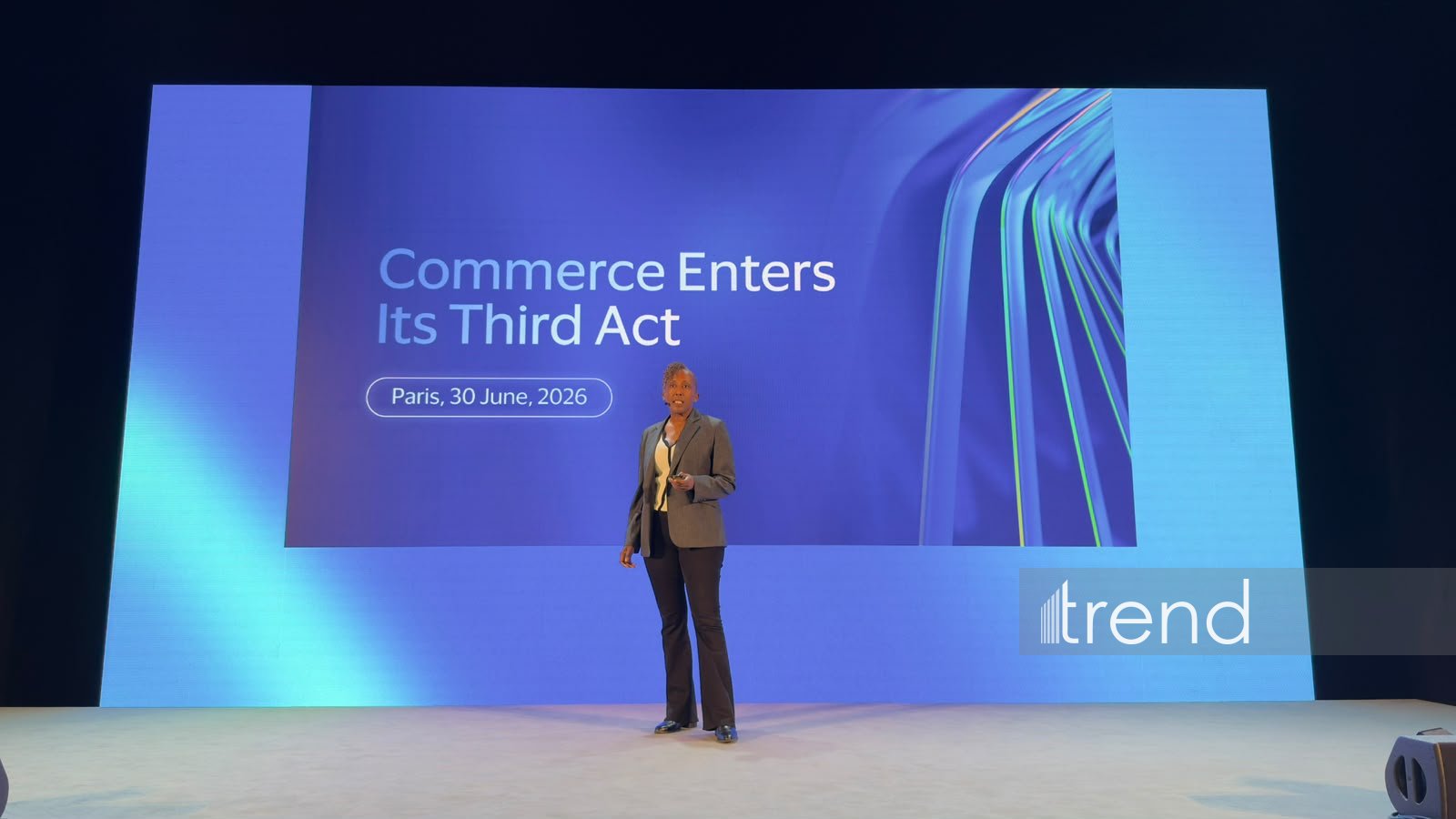

PARIS, France, June 30. Visa online retail loses up to 260 billion euro annually due to abandoned purchases.
The remarks were made by the Senior Vice President of Product and Solutions at Visa, Mehret Habteab during an information session at the Visa Payments Forum in Paris, Trend's special correspondent reports from the event.
According to her, the volume of online purchases today amounts to trillions, and the number of payment instruments and fraud protection systems continues to grow. However, a significant portion of transactions are abandoned at the checkout stage.
"Despite all this development, two out of three online purchases are abandoned. This means consumers begin the purchasing process but do not complete it," Habteab noted.
She emphasized that the industry losses due to abandoned transactions are estimated at approximately 260 billion euro annually.
According to the Visa representative, ensuring trust in payments is a key challenge in the context of the new wave of digital commerce, including generative artificial intelligence (AI), smart devices, and automated shopping scenarios.
"For the next wave of commerce to scale, people must trust the payments that happen in the background," she said.
Habteab noted that payment scenarios are increasingly expanding beyond traditional online stores and into social media, digital wallets, connected devices, and agent commerce systems.
Moreover, she noted that on social media, users want to make purchases without leaving the app, while digital wallets have already become full-fledged platforms with financial services, loyalty, and search features.
Mehret Habteab also emphasized the role of connected devices, from wearables to cars and televisions, which are increasingly becoming standalone payment tools.
Habteab emphasized the development of agent commerce, where purchases are processed by AI agents on the user's behalf, from searching and booking to paying for services, without leaving the app interface.
She also noted that the growing number of retail channels leads to the fragmentation of users' digital identities, which complicates risk assessment and increases the burden on security systems.
"Users make purchases through multiple channels and accounts, sometimes creating multiple profiles with the same merchant. This leads to identity fragmentation and complicates the verification of legitimate activity," she said.
An additional risk factor, she noted, is the rapid growth of AI-based fraud, which is increasing exponentially every year.
In response to these challenges, Visa is developing a "built-in trust" strategy, which aims to minimize friction during the payment process while simultaneously enhancing security.
Key elements of this strategy include improved transaction data quality, seamless biometric authentication, and expanded use of tokenization.
According to Habteab, improved data allows issuing banks to make more accurate decisions when authorizing payments, reducing denial rates without increasing fraud rates. Individual initiatives have already shown a significant impact in Europe, where billions of previously problematic transactions have begun to go through successfully.
She also noted that biometric authentication allows you to confirm the user's identity directly in the device without leaving the purchase process, and the Visa Payment Passkey solution is already working in 19 countries in Europe and 10 countries in the CEMEA (Central and Eastern Europe, the Middle East, and Africa) region.
Tokenization, a technology that replaces card data with secure digital identifiers, is a key focus of the company's strategy.
"Today, 60–70% of online transactions in our network are conducted using tokens, and we see a path to 100%," she pointed out.
According to her, tokenization simultaneously provides a higher level of security and increased efficiency: a 5% increase in successful transactions and a 35% reduction in fraud.



