


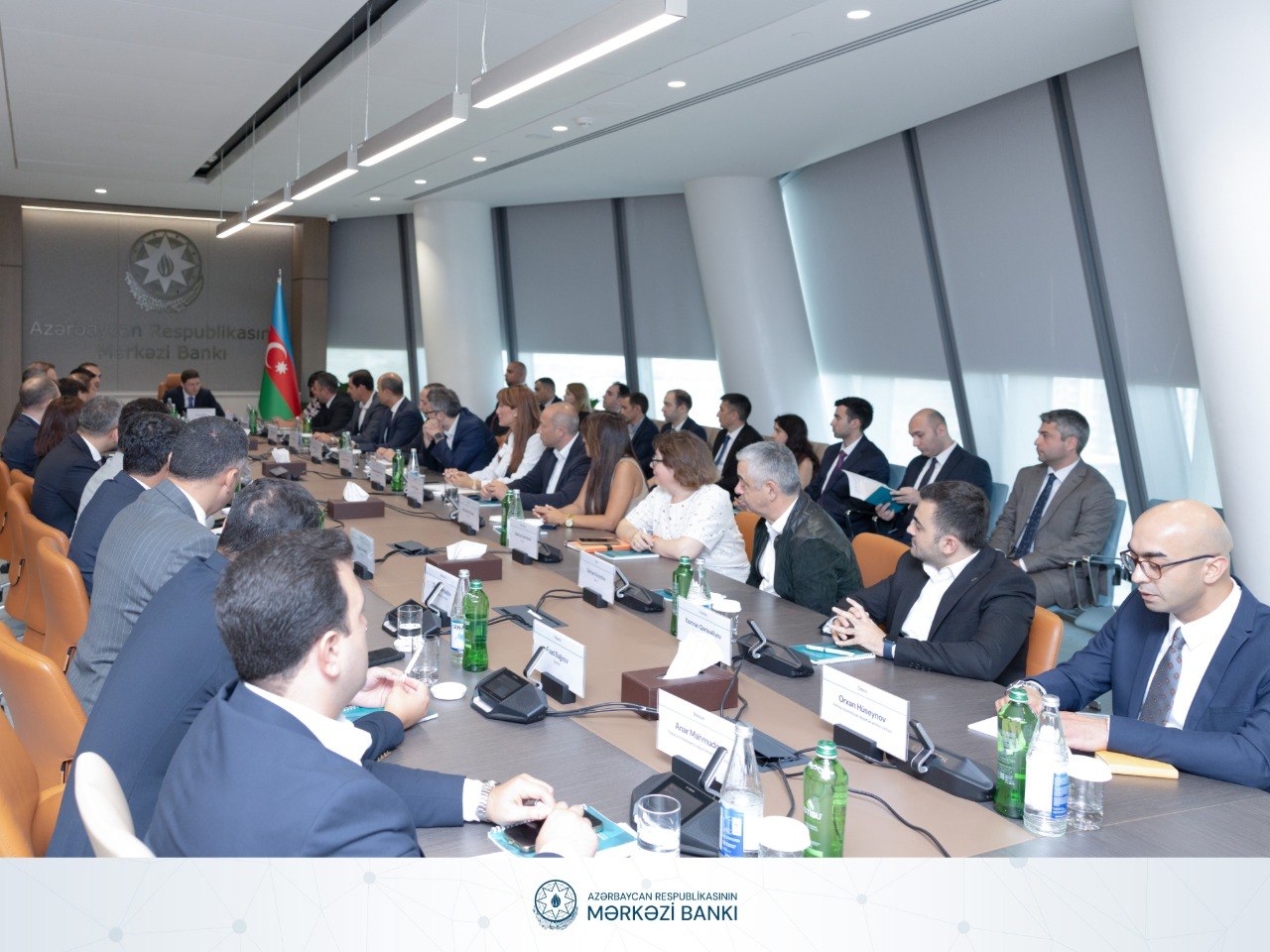

BAKU, Azerbaijan, August 13. The development of financial technology in Azerbaijan was discussed.
This was reported by the Central Bank of Azerbaijan (CBA), following the meeting between Vusal Khalilov, Deputy Chairman of the CBA, and representatives of the Azerbaijan Financial Technology Association (AzFina).
During the meeting, participants discussed the results achieved in the field of financial technology and payments in the second quarter of 2026, as well as key trends emerging in the ecosystem and future directions for development. In addition, special attention was paid to the implementation of a comprehensive regulatory framework covering the activities of cryptoassets and cryptoasset service providers, as well as the work that needs to be done to draft relevant regulations in this area.
The meeting also featured an exchange of views on the key strategic goals set for the sector in the next phase, as well as initiatives aimed at improving control mechanisms to prevent fraud and illegal transactions.
Meanwhile, the development of financial technologies has also led to a shift in payment habits in Azerbaijan.
Deputy Chairman of the Central Bank of Azerbaijan Vusal Khalilov stated at the roundtable discussion “Digital Architecture: Program Management and a Results-Oriented Approach,” held on July 15, that digital channels have already become the primary service platform in the financial sector.
“Digital channels in Azerbaijan have already become the primary service platform in the financial sector and have brought about significant changes in the financial behavior of citizens and businesses,” he said.
According to the CBA’s deputy chairman, the share of non-cash payments in card transactions has risen from 17.8% to 69.7% in recent years. The volume of transactions in the instant payment system reached 940 million manat ($553.02 million), compared to 87 million manat ($51.1 million) at the beginning of 2025.
“These figures demonstrate not only the adoption of technology but also a shift in the financial behavior of citizens and economic entities,” Khalilov noted.
He noted that in the financial sector, artificial intelligence technologies are used for credit scoring, risk assessment, and personalized product offerings. Work is also currently underway to implement large language models (LLMs).
According to Khalilov, the strategy of the Central Bank of Azerbaijan (CBA) is aimed not so much at directly providing citizens with a wide range of services as at creating favorable conditions for the private sector to develop innovative financial products.
In this context, priority areas include the development of an open API approach, the creation of new opportunities for market participants, the digitization of supervisory mechanisms, and the implementation of AI-based supervisory tools.
He also emphasized that risk-based regulation, special legal frameworks that allow for the testing of innovative products, expanded access to government databases, and the development of cloud infrastructure are of great importance for the further development of the financial sector.



