


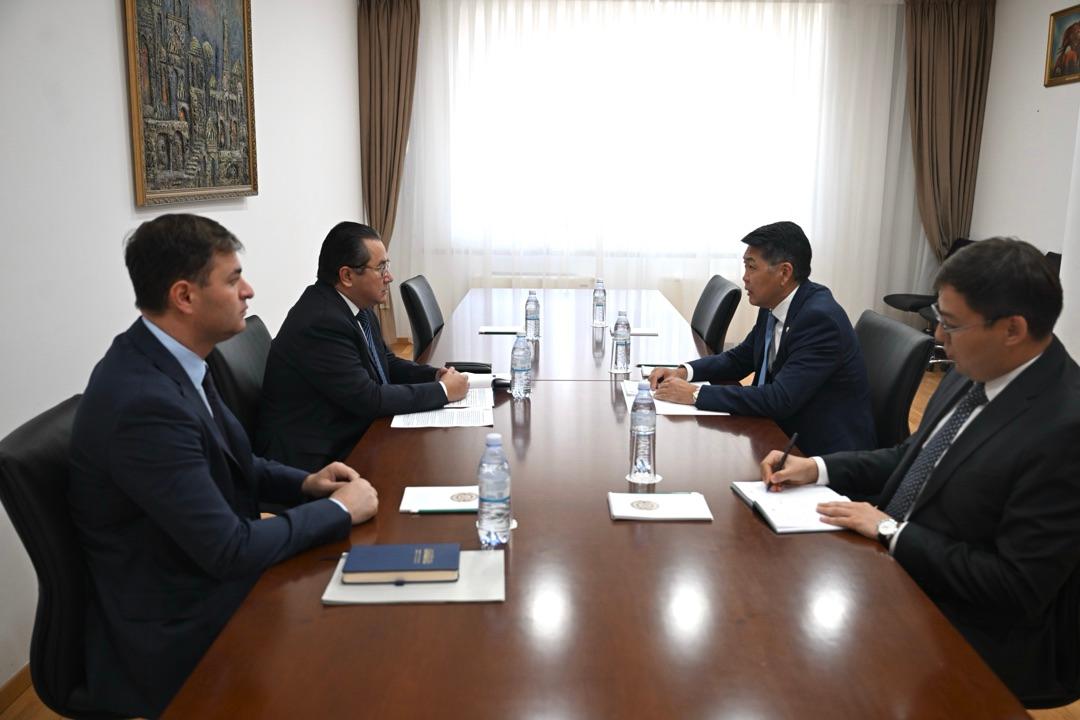

BAKU, Azerbaijan, August 13. Kazakhstan and the Islamic Organization for Food Security (IOFS) have discussed further cooperation in food security.
This was reported by the press service of the Ministry of Foreign Affairs of Kazakhstan, following a meeting between Deputy Foreign Minister Arman Isagaliyev and IOFS Director General Berik Aryn.
According to the report, the parties discussed current issues of cooperation between Kazakhstan and the organization aimed at implementing joint food security initiatives in IOFS member countries. Isagaliyev noted Kazakhstan's interest in further developing the organization's potential. Kazakhstan initiated the creation of the IOFS and has chaired it since May 2026.
"The IOFS Director General, in turn, briefed on the progress of a number of targeted projects, including the establishment of a Gene Bank in Kazakhstan aimed at preserving agricultural biodiversity in the Organization's member states," the report said.
Following the meeting, the parties agreed to continue bilateral and multilateral cooperation to strengthen food security within the Organization of Islamic Cooperation (OIC).
IOFS was established in 2013 at the initiative of Kazakhstan as a specialized structure of the OIC. The idea for its establishment was proposed by the First President of Kazakhstan, Nursultan Nazarbayev, in 2011 at the 38th session of the OIC Council of Foreign Ministers in Astana. The organization's headquarters are located in Astana. IOFS comprises over 40 member states. The organization works to strengthen food security, develop sustainable agriculture, respond to food crises, build capacity, and preserve agricultural biodiversity.
Since its founding, Kazakhstan has played a leading role in the IOFS and has chaired the organization since May 2026 (following the 7th session of the General Assembly). One of the priority projects is the creation of an International Gene Bank in Kazakhstan, aimed at preserving plant and animal genetic resources, supporting breeding, and increasing the resilience of participating countries' agricultural systems to climate change.



