


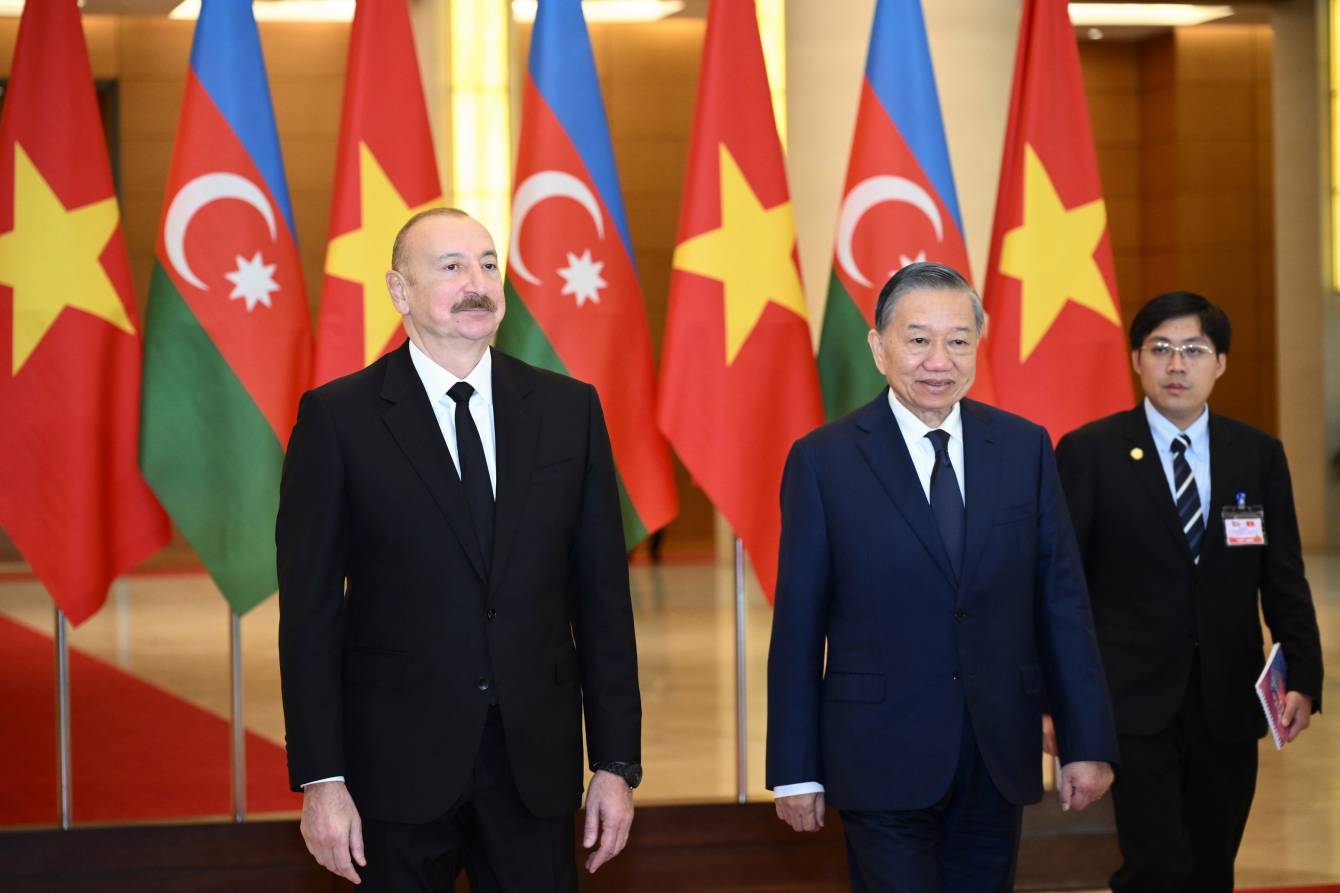

HANOI, Vietnam, November 21. During Azerbaijani President Ilham Aliyev’s official visit to Vietnam, the two countries adopted an important political document - a Joint Statement by the President of the Republic of Azerbaijan and the General Secretary of the Central Committee of the Communist Party of Vietnam, President of the Socialist Republic of Vietnam.
Adopted in Hanoi on November 21, the document outlines the main areas for further development of bilateral relations and effectively establishes a substantive roadmap for the strategic partnership between the two countries.
The significance of the statement goes beyond a traditional reaffirmation of friendly relations. It sets out a broad range of practical objectives, from expanding trade, investment, and energy cooperation to developing transport connectivity, defense industry ties, tourism, and coordination on international platforms.
From political dialogue to concrete economic projects
One of the central priorities of the Joint Statement is the development of economic ties. The two sides agreed to step up cooperation in priority sectors, particularly the economy, trade, and investment, while improving the effectiveness of existing bilateral economic mechanisms.
Particular attention was given to expanding market access for agricultural, forestry, and fishery products from both countries, introducing advanced technologies in agriculture, and developing cooperation in the mining and aluminum industries.
This area is especially important for diversifying economic ties. Azerbaijan and Vietnam have opportunities to expand bilateral trade not only through traditional product categories but also by establishing new production and investment links.
Practical groundwork for this has already emerged during the visit. At a meeting with Vietnamese Prime Minister Le Minh Hung on November 20, President Ilham Aliyev noted that relations between the two countries had reached the level of a strategic partnership. In turn, the Vietnamese prime minister reported the first positive results from implementing the agreements reached. According to him, companies operating in renewable energy, trade, real estate, and tourism have already begun operations in both countries.
Thus, the bilateral agenda is gradually taking on a more tangible investment dimension.
Energy as a key pillar of cooperation
Energy cooperation occupies a prominent place in the Joint Statement. The two sides reaffirmed their intention to strengthen ties in the oil and gas sector, expand supplies of energy products, and work toward concluding long-term agreements on crude oil and liquefied natural gas (LNG) supplies.
This area is particularly significant given Azerbaijan's experience in the oil and gas industry and Vietnam's need to ensure energy security and diversify its sources of supply.
During the meeting with Prime Minister Le Minh Hung, the sides discussed separately the export of Azerbaijani petroleum products to Vietnam and through its territory to markets in other countries in the region, as well as prospects for establishing joint production facilities.
At a meeting with Chairman of Vietnam's National Assembly Tran Thanh Man, President Ilham Aliyev emphasized that one of the important achievements in bilateral relations was the clear vision and framework the two countries had developed for continued cooperation in the energy sector.
"Energy security, as we always say, is part of the national security of every country," the head of state said.
Beyond conventional energy, renewable energy development is another promising area. During the visit, an implementing agreement was exchanged between Azerbaijan's Ministry of Energy and ROX Group on the assessment, development, and implementation of solar and wind power projects in Azerbaijan.
The document gives practical substance to the agreements on green energy and opens up opportunities for Vietnamese businesses to participate in the development of Azerbaijan's energy infrastructure.
Middle Corridor as a link between regions
Transport and logistics are another area of strategic importance. In the Joint Statement, the two sides expressed their readiness to expand the exchange of experience in railway, road, air, and maritime transport, as well as actively promote cooperation through the Trans-Caspian International Transport Route, known as the Middle Corridor.
For Vietnam, one of Southeast Asia's major manufacturing and export hubs, developing alternative routes to European and other markets is of practical interest. For Azerbaijan, in turn, stronger links with Southeast Asian economies broaden the pool of potential trade and logistics partners.
At the meeting with the Vietnamese prime minister, President Ilham Aliyev specifically noted that the Middle Corridor offered favorable opportunities for Vietnamese companies to access regional markets. In this context, Azerbaijan's readiness to cooperate with Vietnam was emphasized.
Thus, the transport dimension of the partnership could become an important tool not only for bilateral trade but also for broader economic ties connecting Central Asia, the South Caucasus, and Southeast Asia.
The Joint Statement also provides for the development of cooperation in defense and security. In particular, the two sides intend to expand information and experience-sharing between law enforcement agencies and strengthen coordination in combating transnational organized crime, drug trafficking, human trafficking, and cybercrime.
The talks also addressed prospects for cooperation in the defense industry, an area of mutual interest to both countries.
Another important practical priority is the development of direct air links. The document specifically emphasizes the need to facilitate the launch of direct flights between Azerbaijan and Vietnam. This is expected to help increase tourism, trade, and people-to-people contacts.
Cooperation in education and culture also remains important. The contribution of Azerbaijani specialists to the establishment and development of Vietnam's oil industry has historically served as a significant link between the two countries. As Le Minh Hung noted at his meeting with President Ilham Aliyev, Vietnamese specialists who received oil-sector education in Azerbaijan continue to play an important role in their country's development.
Another significant signal was the announcement that Vietnam would soon open an embassy in Azerbaijan. President Ilham Aliyev welcomed this step. Noting that Azerbaijan's embassy in Vietnam had been operating for a long time, he emphasized that the full operation of diplomatic missions in both countries would give significant momentum to bilateral relations.
The Joint Statement also provides for continued high-level reciprocal visits, stronger contacts between government agencies, and exploration of opportunities to establish new cooperation mechanisms.
Particular attention is given to parliamentary diplomacy. The two sides intend to expand cooperation between their legislative bodies and develop ties between Azerbaijan's ruling New Azerbaijan Party and the Communist Party of Vietnam.
At the multilateral level, the countries expressed their readiness to strengthen coordination within the United Nations, the Non-Aligned Movement, and the Conference on Interaction and Confidence Building Measures in Asia (CICA). The statement also highlights the need to promote relations between Azerbaijan and ASEAN, as well as its member states.
The practical dimension of the visit was further reinforced by the exchange of documents attended by the presidents of the two countries on November 21.
In addition to the implementing agreement on renewable energy between Azerbaijan's Ministry of Energy and ROX Group, the sides formalized arrangements on cooperation between Azerbaijan's Ministry of Emergency Situations and Vietnam's Ministry of Public Security in fire and rescue services, as well as a memorandum of understanding between the Presidential Administration of Azerbaijan and the Office of the President of Vietnam.
Taken together, these documents reflect the two countries' intention to translate political agreements into concrete interagency and business cooperation.
New geography for the strategic partnership
President Ilham Aliyev's visit to Vietnam demonstrated the two countries' determination to take traditionally friendly relations to a broader level of practical cooperation.
For Azerbaijan, deeper ties with Vietnam offer additional opportunities to strengthen its presence in Southeast Asia, attract investment, and expand trade and logistics links. For Vietnam, cooperation with Azerbaijan creates further prospects for accessing markets in the South Caucasus, Central Asia, and Europe.
The next stage will be the practical implementation of the priorities outlined in the Joint Statement through long-term energy agreements, investment projects, expanded transport links, and more active business contacts.


