


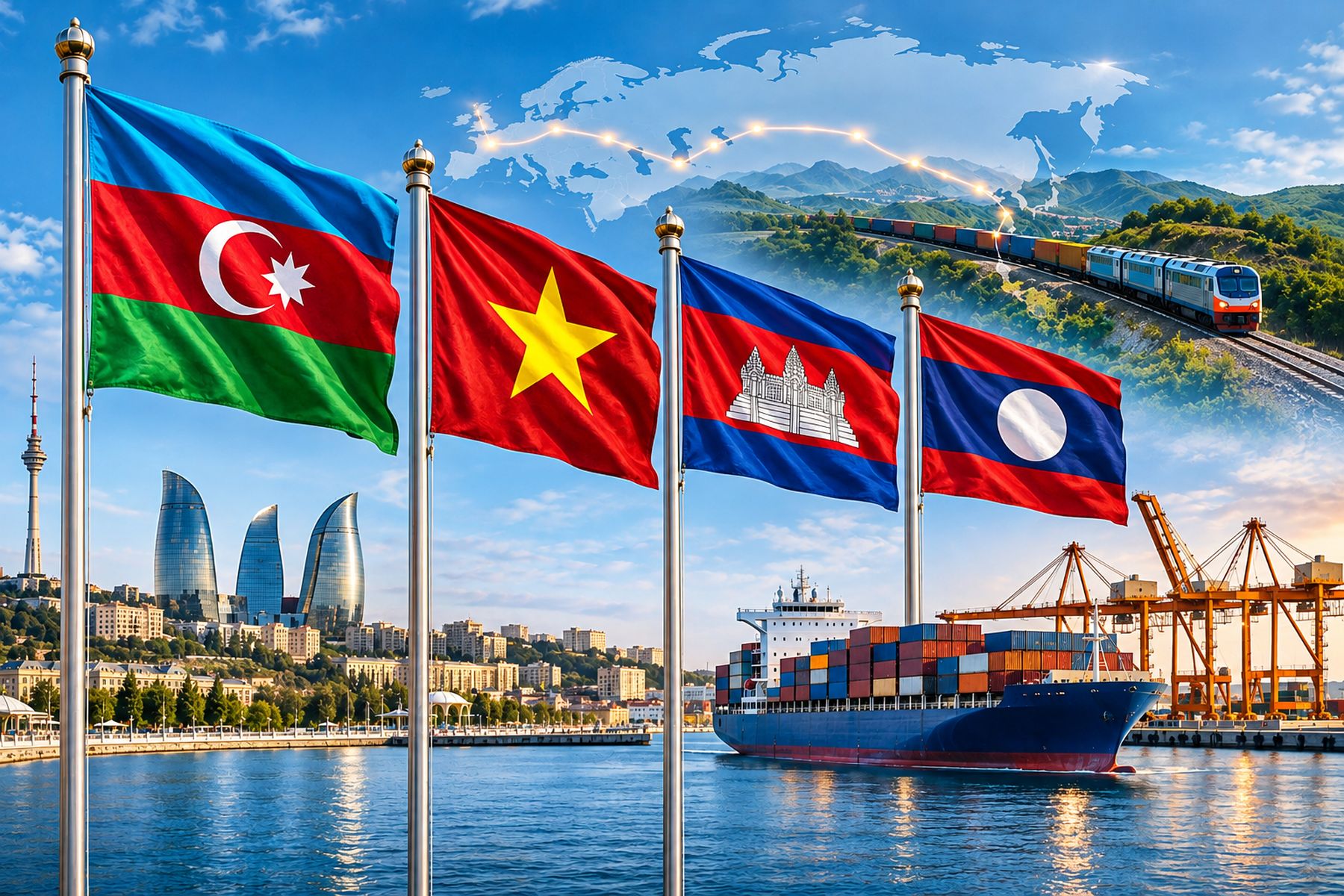

BAKU, Azerbaijan, November 21. Azerbaijan's engagement with Southeast Asia is gaining momentum and taking on greater strategic significance. President Ilham Aliyev's official visit to Vietnam, following visits to Baku by senior officials from Cambodia and Laos, alongside the signing of bilateral agreements and discussions on transport and logistics cooperation, reflects Azerbaijan's efforts to broaden its international partnerships and strengthen its presence in the region.
These developments extend beyond the expansion of bilateral diplomatic ties. They reflect Azerbaijan's broader strategy to deepen political, energy, investment and transport cooperation with Southeast Asia's rapidly growing economies, while leveraging its strategic geographic position to facilitate their access to European markets.
President Ilham Aliyev's official visit to Vietnam on November 19-21 is particularly significant in this regard. During meetings with the Vietnamese leadership, the sides discussed expanding cooperation in energy, trade, investment, the defense industry, security, tourism and transport.
On November 21, a ceremony was held in Hanoi to exchange documents between the two countries. President Ilham Aliyev and Vietnamese President To Lam also adopted a Joint Statement. The documents included a memorandum of understanding on cooperation in emergency management and firefighting and rescue operations, a memorandum of understanding between the Presidential Administration of Azerbaijan and the Office of the President of Vietnam, as well as an implementation agreement on the assessment, development and construction of solar and wind power plant projects in Azerbaijan.
These agreements demonstrate that cooperation is moving beyond political dialogue towards concrete institutional arrangements and economic projects.
In fact, the visit to Vietnam does not mark the beginning of Azerbaijan's interest in the region. Developments in recent months show that Baku has been pursuing a systematic expansion of relations with Southeast Asian countries.
One notable example came during the 7th Summit of the Conference on Interaction and Confidence Building Measures in Asia (CICA), held in Baku on October 12-15, 2026. During those days, Cambodian Prime Minister Hun Manet and Lao President Thongloun Sisoulith visited Azerbaijan.
During Prime Minister Hun Manet's visit, the two countries exchanged three documents. These included a framework agreement on trade and economic cooperation, an agreement on the avoidance of double taxation and the prevention of tax evasion, and a memorandum of understanding between Azerbaijan's ADA University and Cambodia's National Institute of Diplomacy and International Relations.
The documents establish a legal and institutional basis for increasing bilateral trade, developing business ties, and expanding cooperation in education and diplomatic training.
Azerbaijan's hosting of the CICA summit was particularly important for its relations with Laos. On October 14, the key founding documents concerning Laos's accession to the organization were signed, and on October 15, its membership was approved at the 7th Summit. Laos thus became a full-fledged member of CICA.
This development is also significant in terms of Azerbaijan's diplomatic initiatives. Baku is not only developing bilateral relations but also contributing to broader participation by Asian countries in multilateral platforms. Laos's accession demonstrates that Azerbaijan's political engagement with Southeast Asia is extending into multilateral institutional cooperation.
One of the notable areas of cooperation between Azerbaijan, Cambodia and Laos is addressing the threat posed by landmines and unexploded ordnance.
All three countries have experience dealing with the consequences of conflicts and wars, including the humanitarian challenges posed by unexploded ordnance and landmines. Cambodia and Laos have faced these problems for decades, while Azerbaijan is carrying out extensive demining operations in its liberated territories.
This creates practical opportunities for cooperation in sharing expertise, training specialists, applying technology and conducting humanitarian demining operations. Such cooperation is important both for Azerbaijan to share its experience internationally and to benefit from the expertise of other countries.
Vietnam, Cambodia and Laos have a combined population of approximately 129 million. For Azerbaijan, this represents not only a sizeable consumer market but also opportunities for cooperation in manufacturing, investment, energy and logistics.
Among these three countries, Vietnam stands out for its economic scale, industrial output and position in international trade. It is a major producer of electronics, textiles, agricultural products, furniture and other industrial goods. Cambodia and Laos are also strengthening their positions in regional trade and production chains.
For Azerbaijan, the key objective is not simply to sell products in these markets. It is also to attract companies from these countries to investment projects in Azerbaijan and expand the use of the country's transport infrastructure to move their exports towards Europe.
There are already tangible developments in this direction in Azerbaijan's relations with Vietnam. According to President Ilham Aliyev, bilateral trade exceeded $150 million in 2025. A memorandum signed in 2025 between the State Oil Company of Azerbaijan (SOCAR) and Vietnam's PetroVietnam envisages cooperation in oil and gas exploration and development, technical services and specialist training.
In addition, Vietnam's ROX Group has expressed interest in construction, infrastructure and renewable energy projects in Azerbaijan. The signing of relevant documents with the company in September 2026 on wind and solar power projects also indicates that investment cooperation is moving towards specific areas of activity.
One of Azerbaijan's greatest strategic advantages in developing relations with Southeast Asia could be its geographical position and transport infrastructure.
Goods produced in Vietnam, Cambodia and Laos reach European markets through various maritime and land routes. Diversifying these routes is becoming increasingly important amid growing uncertainty in global logistics chains.
This is where the Middle Corridor becomes an important geoeconomic asset for Azerbaijan. The route runs from China and Central Asia across the Caspian Sea to Azerbaijan, and onwards to Europe via Georgia and Türkiye, offering Asian producers an alternative logistics option.
Azerbaijan's transit capabilities are not limited to rail transport. The Port of Baku and the logistics infrastructure taking shape in the Alat settlement play an important role in organizing cargo transportation across the Caspian Sea. Once cargo reaches Azerbaijan, it can be transported towards Europe via the Baku-Tbilisi-Kars railway and other transport links.
According to official transport data, the Middle Corridor provides a route of approximately 8,000-10,000 kilometers between China and Europe. This offers a distance advantage compared with the approximately 20,000-kilometer route through the Suez Canal. Official sources put transit times at 12-18 days for the Middle Corridor, compared with 30-45 days via the Suez route. However, the economic efficiency of transporting specific Vietnamese cargo through the corridor would need to be assessed separately, taking into account the mode of transport, distance, port charges and the nature of the goods.
One important point should be considered: the Middle Corridor is already used to transport cargo from China and Central Asia. This means Azerbaijan does not need to build an entirely new logistics system. Instead, it can seek to make its existing transport infrastructure more attractive to other producers and exporters in Southeast Asia.
Figures related to Vietnam indicate that this potential is already beginning to materialize. According to Azerbaijan's Ministry of Energy, transit shipments associated with Vietnam increased approximately sixfold in January-September 2026 compared with the same period a year earlier. More than 8,000 tons of such cargo passed through Azerbaijan during this period.
Although this is not yet a large volume of transit traffic, it is an important indicator of the route's development potential.
In the future, greater involvement of Vietnamese companies in the Middle Corridor, long-term agreements between freight operators, the establishment of logistics centers and expanded use of the Port of Alat could increase Azerbaijan's transit revenues.
The issue is not limited to transporting Vietnamese goods through Azerbaijan to Europe. Azerbaijani companies could also gain access to the Vietnamese market and promote their own products across Southeast Asia.
Growing Vietnamese interest in the Middle Corridor could open up new prospects for Azerbaijan's foreign policy and economic diplomacy.
In this context, connecting Vietnam to the corridor should primarily involve establishing direct cooperation mechanisms between Azerbaijan and Vietnamese exporters, ports, logistics operators and transport companies.
Vietnam's trade links with Europe, substantial manufacturing capacity and export-oriented economy could make it a promising partner for the Middle Corridor. Azerbaijan's main advantages include transport links across the Caspian Sea, the capacity of the ports of Baku and Alat, its railway infrastructure, and access to European markets through Türkiye and Georgia.
Azerbaijan's foreign policy has long been characterized by active diplomatic engagement across the South Caucasus, Türkiye, Europe, Russia, Central Asia and the Middle East. In recent years, expanding ties with Central Asia, strengthening cooperation within the Organization of Turkic States and developing the Middle Corridor have added a new economic dimension to this policy.
Southeast Asia is now also becoming an important part of this expanding geographical scope.
The strategic partnership with Vietnam, economic and institutional agreements signed with Cambodia, Laos's accession to CICA, cooperation on addressing the threat posed by landmines, and emerging opportunities in transport and logistics all demonstrate Azerbaijan's intention to take a more active role in the region.
The main strength of this approach is that Baku is developing relations with different regions not as isolated foreign policy tracks, but as interconnected elements of a broader system of international and economic cooperation.
Close political and economic ties with Europe, a balanced approach to relations with China, the United States and Russia, strategic cooperation with Türkiye and Central Asia, new partnership opportunities in the Middle East, and expanding diplomatic engagement with Southeast Asia are creating opportunities for Azerbaijan to strengthen its international position across a wider geographical area.
President Ilham Aliyev's visit to Vietnam can be viewed as a continuation of this strategy. The main objective is not merely to strengthen political relations, but to translate them into investment, trade, energy projects, transport links and long-term economic partnerships.
Ultimately, by expanding its engagement with Southeast Asia, Azerbaijan is increasing its opportunities to position itself not only as an important political and economic actor in the South Caucasus, but also as a multifaceted bridge for cooperation between Asia and Europe. This means not only extending the geographical reach of the country's foreign policy, but also strengthening its transit, investment and economic diplomacy potential.


