


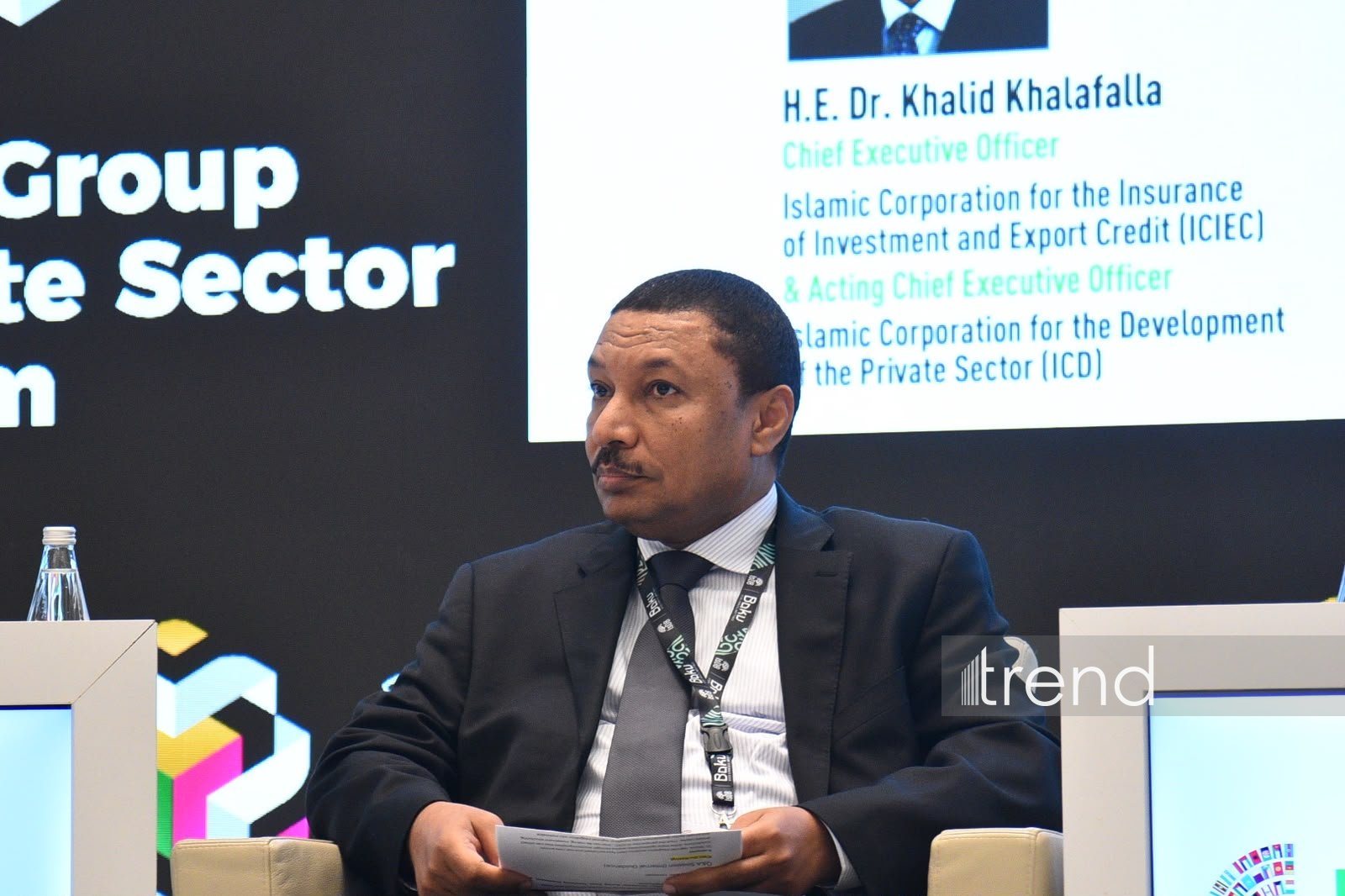
BAKU, Azerbaijan, June 17. One of the main objectives of the Islamic Corporation for Investment and Export Credit Insurance (ICIEC) is to expand trade among member countries and strengthen regional integration, CEO of the Islamic Corporation for the Insurance of Investment and Export Credit (ICIEC), Khalid Khalafalla, said, Trend's correspondent reports from the event.
He made the remark at the event titled "CEO's session on making regional integration attractive for investment: promoting trade, mobilizing investment and systematically de-risking growth" held within the framework of the 51st Annual Meeting of the Islamic Development Bank (IsDB) Group in Baku.
"Usually, exporting companies lack information about the creditworthiness of buyers, or these risks are assessed higher due to country ratings and information limitations. By insuring these risks, we create conditions for more reliable and convenient trade," said Khalafalla.
According to him, investment insurance and risk reduction are manifested in two main directions in regional integration: supporting infrastructure projects and energy projects. The CEO emphasized that transport infrastructure, especially railways and highways, plays an important role in facilitating trade by connecting member countries.
"We support large infrastructure projects connecting member countries, especially railways and highways. These projects strengthen interregional relations and facilitate exports," he said.
Noting that the IsDB Group and ICIEC have extensive international cooperation in this area, Khalafalla said that large infrastructure projects are usually implemented not by a single institution, but jointly with international financial institutions and export credit agencies.
"We cooperate with the World Bank's insurance structures, Daman for Arab countries, ATIDI for African countries. At the same time, we work together with European export credit agencies - Euler Hermes, Coface, CESCE, as well as the U.S. Exim Bank. Because, especially in the railway sector, the main part of the technology is of European and U.S. origin," the head of ICIEC emphasized.
He also explained the specific results of this cooperation with examples.
"We provided insurance support together with European agencies in the Riyadh metro project, and the same mechanisms were applied in the Dubai metro. Last year, we provided insurance coverage for three railway projects in Turkey. One of them was located close to the Azerbaijani border, which actually contributes to regional integration," he explained.
Khalafalla noted that the political risk insurance provided by ICIEC creates credit comfort for financial institutions, which allows commercial banks to allocate funds to more projects.
"We are an AA-rated insurance company and operate within the Islamic Development Bank Group. This status provides banks with credit comfort and allows them to finance more operations," he said.
According to him, political risk insurance reduces not only real risks, but also the perception of risk in the market, which leads to an expansion of investment flows.
"Sometimes the risk is not real, it's simply overestimated due to lack of information or media influence. Our insurance mechanisms reduce this perception and allow countries to attract more resources," he emphasized.
The head of ICIEC added that the main share of the organization's portfolio is occupied by infrastructure, especially transport and energy sectors: "Energy projects sometimes meet only domestic demand, and in some cases are aimed at exporting to neighboring countries. This also makes an additional contribution to regional energy integration," the CEO pointed out.
In conclusion, Khalafulla noted that ICIEC's investment insurance activities as a whole serve to strengthen regional integration, facilitate trade, and stimulate economic growth.



