



BAKU, Azerbaijan, June 30. Kazakhstan plans to continue transforming its parliamentary system, the press service of the President of Kazakhstan reported.
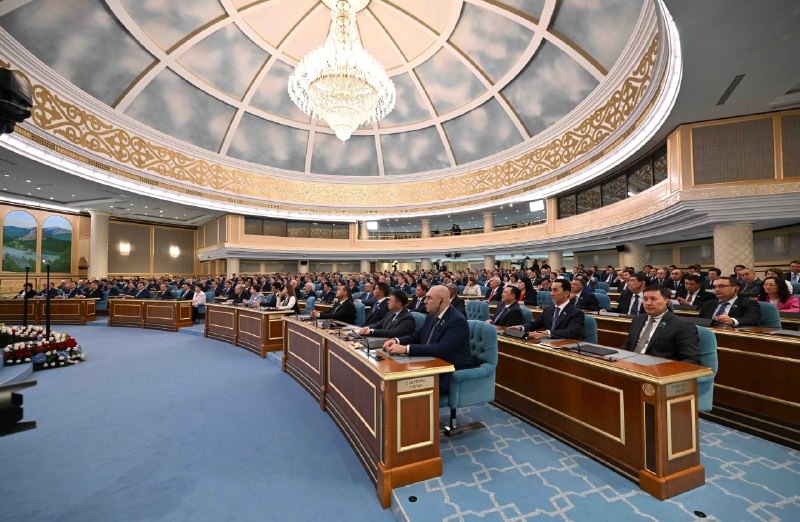
President Kassym-Jomart Tokayev made the remarks during the final joint session of the chambers of Parliament.
According to Tokayev, the Kurultai will be tasked with eliminating bureaucratic barriers, improving the speed and quality of lawmaking, and ensuring the effective work of qualified experts and advisers.
“In the era of total digitalization and artificial intelligence, the Kurultai will have to operate at an accelerated pace in order to promptly adapt national legislation to rapidly changing realities in the digital environment. This is a critically important task because it will determine Kazakhstan’s readiness to compete globally,” Tokayev said.
The president expressed confidence that the new legislative institution could become a key driver of technological progress. Tokayev recalled that during the first meeting of the parliamentary reform working group in October last year, he raised the issue of introducing a full-scale e-Parliament system.
He noted that while Kazakhstan already ranks among the world’s top 25 countries in e-Government development, building and advancing an Electronic Parliament will require substantial efforts.
According to the president, newly elected deputies will need to adopt new approaches to lawmaking based on predictive analytics, modeling of economic impacts and social risks, and the use of Big Data tools.
Tokayev also stressed the importance of opening discussions on key draft laws to experts and civic representatives. At the same time, he said digital tools should be actively used to expand participation and turn legislative discussions into genuine public debate.
“The Kurultai is expected to become a platform for open nationwide dialogue and respond quickly to issues of public concern. This means that the specific needs of citizens must be prioritized when assigning tasks to state bodies through concrete legislative acts,” Tokayev said.
The country’s Constitution was adopted following a national referendum held on March 15, 2026. Under the new Constitution, the bicameral Parliament will be dissolved and replaced by a unicameral Kurultai consisting of 145 deputies.



