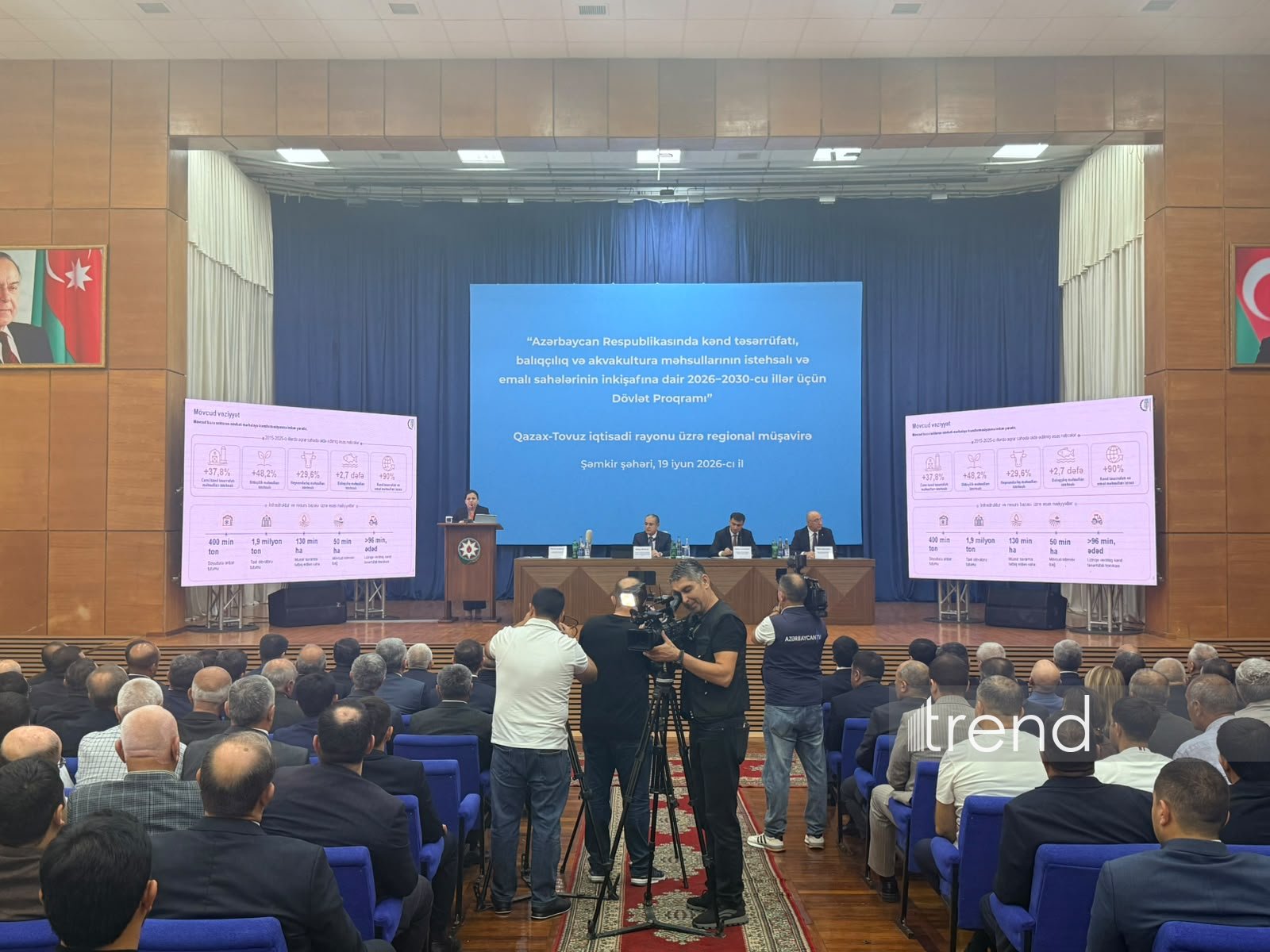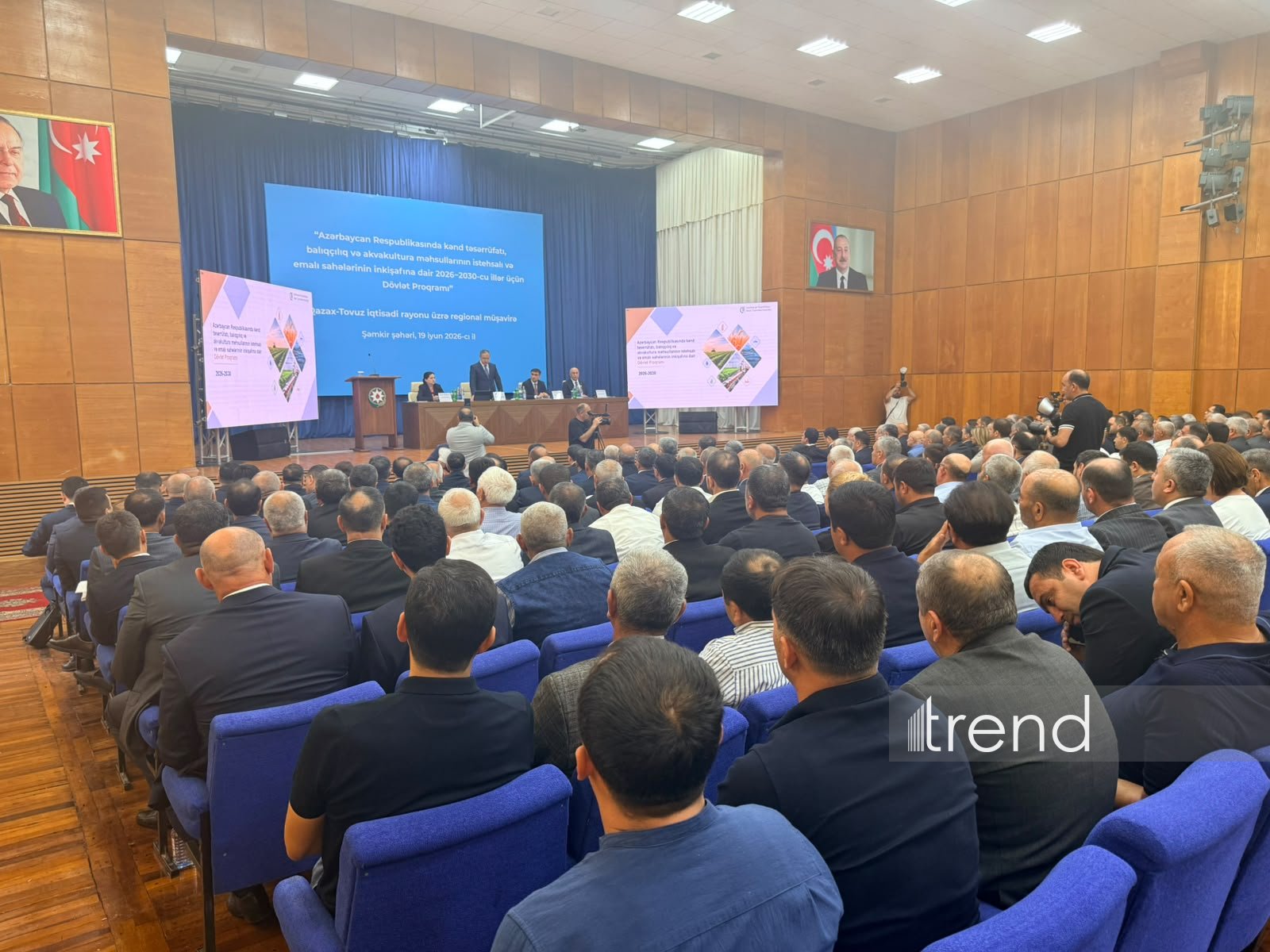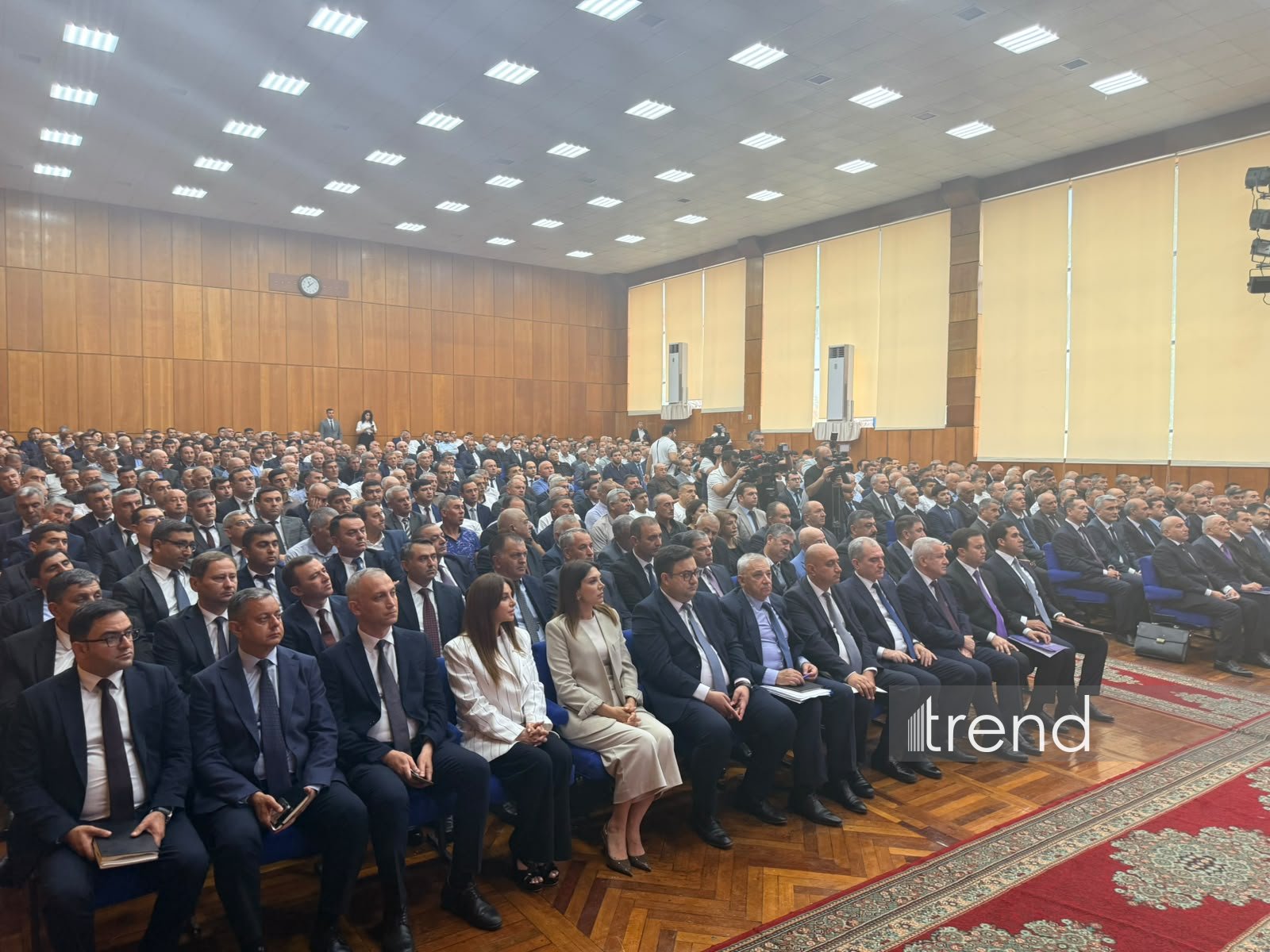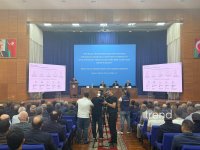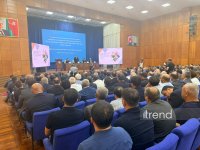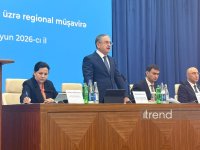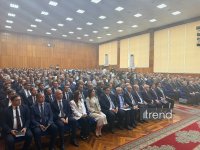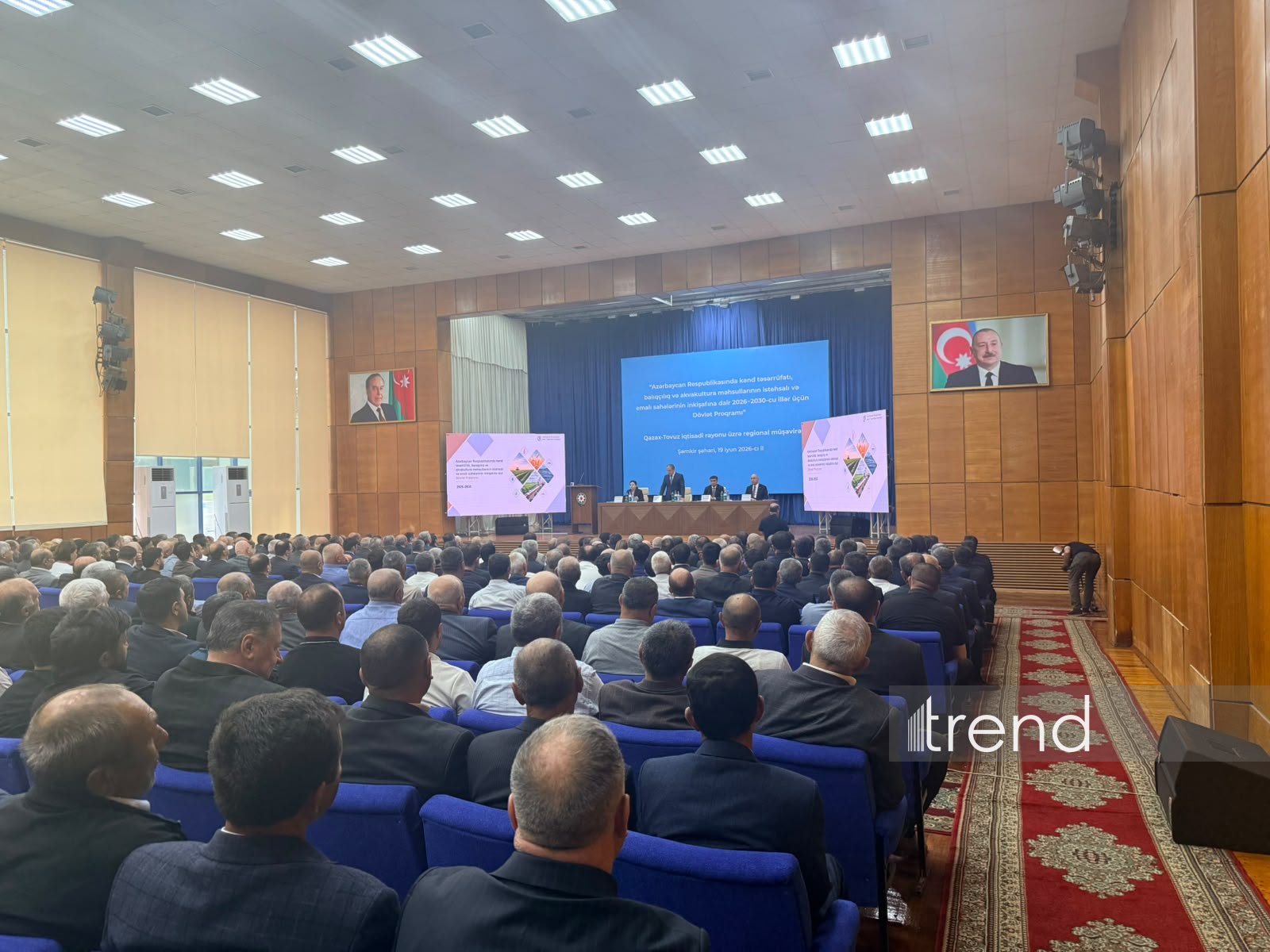

SHAMKIR, Azerbaijan, June 19. A regional consultation has been conducted in Shamkir to discuss the State Program for the Development of Agricultural Production and Processing, Fisheries, and Aquaculture in Azerbaijan for 2026–2030, approved by the decree of the President of Azerbaijan dated May 25, 2026, in the Gazakh-Tovuz economic region, Trend's correspondent reports from the event.
The event has been organized to implement the directives established at the agricultural consultation held on May 25, 2026, chaired by President of Azerbaijan Ilham Aliyev, and to ensure the coordinated, flexible, and effective execution of the measures envisaged in the state program across the regions.
The consultation brought together heads and authorized representatives of relevant state agencies, as well as farmers from Aghstafa, Gadabay, Gazakh, Shamkir and Tovuz districts.
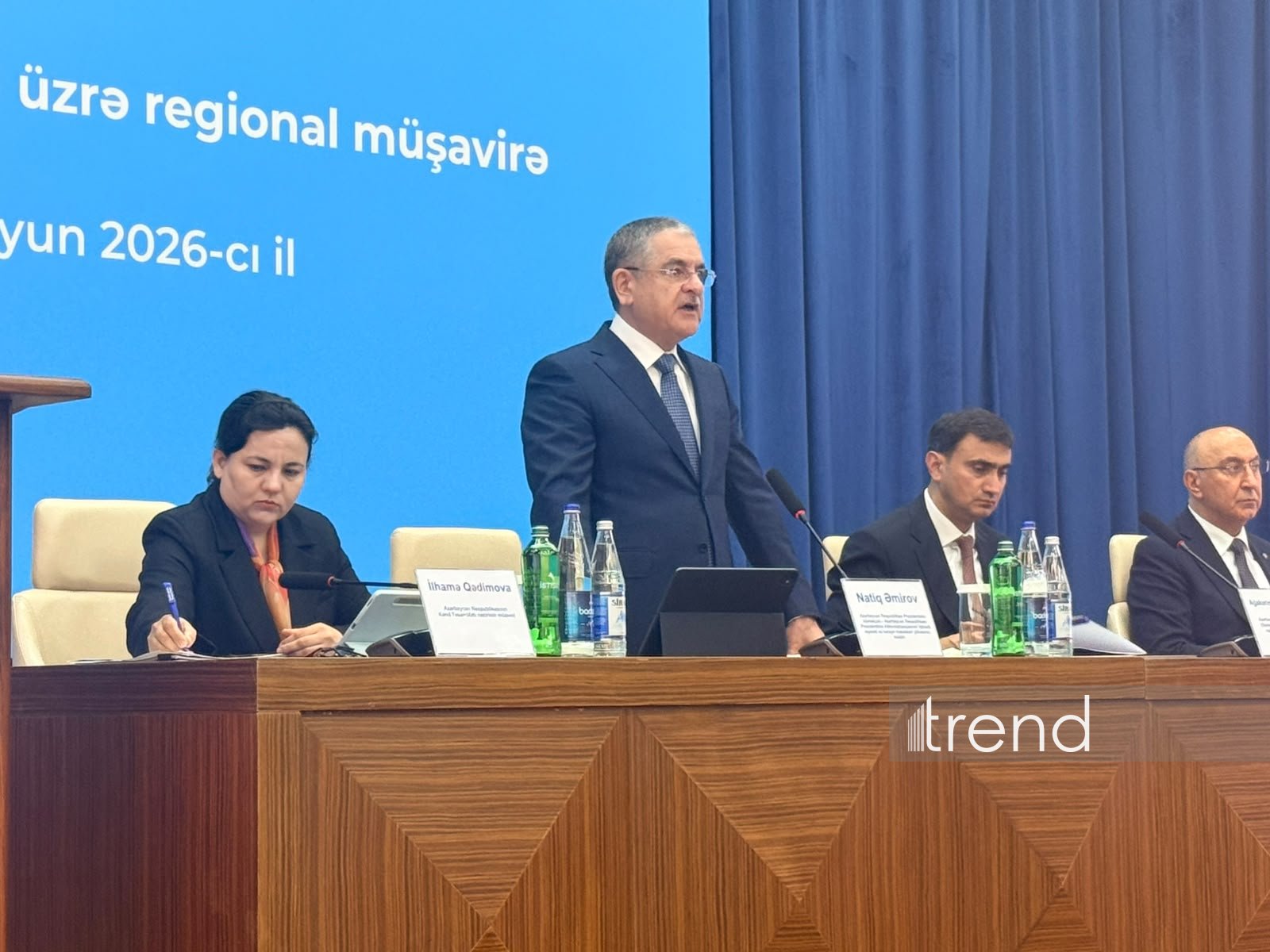
Speaking at the event, Assistant to the President of Azerbaijan - Head of the Department of Economic Policy and Industrial Affairs of the Presidential Administration, Natig Amirov said that State Program for the Development of Agricultural Production and Processing, Fisheries, and Aquaculture in Azerbaijan for 2026–2030 is a strategic document defining a new development model for the agricultural sector for the coming period.
"This program is a strategic document that defines a new development model for the agricultural sector for the coming period and acts as an important roadmap in terms of increasing agricultural production, efficient use of resources, expansion of processing and export opportunities, and transitioning the development of value chains, as well as fisheries and aquaculture, to a new stage. The main goal is not just to increase production volumes, but to obtain higher and higher quality products from each hectare, that is, to ensure the transition from an extensive approach to intensive development in the agricultural sector," Amirov noted.
He also explained the directions of the state program.
"The state program envisages ensuring sustainable development in the field of agricultural production in 2026-2030, strengthening food security, increasing domestic production potential, productivity, added value and export orientation, accelerating the transition to an intensive and competitive production model, developing value chains in the agricultural sector, expanding farmers' access to modern agricultural services, as well as developing the fisheries and aquaculture sectors," the official pointed out.
He added that from 2015 through 2025, under the direct leadership and personal control of the President of Azerbaijan, Ilham Aliyev, revolutionary reforms were implemented in the country regarding the development of the agrarian sector.
"During this period, state programs were adopted for the development of viticulture, tea, rice, citrus, hazelnut, tobacco, cocoon, and cotton growing. State support for the agricultural sector was increased, and as a result of the measures taken, the production and export potential in traditional areas such as cotton, tobacco, viticulture, and winemaking significantly increased, the level of self-sufficiency in a number of main products improved, and full self-sufficiency in fruits, vegetables, and eggs was achieved.
Positive dynamics were also observed in the level of self-sufficiency in meat, milk, fish and potato products. Many large projects were implemented to provide agricultural areas with irrigation water, the application of modern irrigation systems was expanded, large reservoirs were built, irrigation canals were reconstructed, and this process is still ongoing. A lot of work has been done to provide the agricultural sector with equipment, and the technical park has been almost completely renewed," Amirov also said.
Deputy Minister of Agriculture Ilhama Gadimova noted that the State Program has especially identified several fundamental directions.
According to the deputy minister, the main directions include increasing intensive garden areas, increasing wheat productivity, expanding modern irrigation areas, expanding agropark and greenhouse activities, forming small wineries, and increasing intensive livestock farms.
"Besides, the program covers not only production areas, but also supporting measures. Legislative initiatives, institutional reforms, and digitalization are important pillars of this program. It is planned to improve the legislation 'On the agricultural sector', 'On seed production', 'On fisheries', make changes to the subsidy rules and mechanisms for applying discounts to agricultural machinery.
Concurrently, the expansion of the agricultural artificial intelligence system and the development of data-oriented subsystems of the Electronic Agricultural Information System (EAIS) will serve for more flexible and information-based management of the field.
Today, agrarian policy is no longer limited to the work done in the field. Our decisions should be based on data, maps, electronic systems, satellite observations, soil and water balance, and real productivity indicators. Therefore, digitalization is becoming an important tool for both farmers and the state," she explained.
Gadimova pointed out that one of the most important directions of the program is to increase wheat production and increase productivity.
"As many as 22 districts have been identified as target regions for wheat production. These regions provide a large part of the grain produced in the country and have higher irrigated areas, modern irrigation potential, agropark infrastructure, and laser leveling capabilities. Shamkir and Tovuz districts are included in the list of these 22 districts.
It's planned to bring the average yield to 50 centners in the target regions, and to 30 centners in the Damya regions, which also include Aghstafa and Gadabay. In the perspective districts, including the Gazakh district, the yield target is set at 50 centners after 2029," she noted.
The deputy minister said that in order to achieve the targets, it is planned to expand the application of modern irrigation systems, improve technical support, apply laser leveling technology, increase state support for wheat production, and strengthen control over agrotechnical maintenance.
"First, the application of modern irrigation systems will be expanded. Second, technical support will be improved. Third, the application of laser leveling technology will be expanded. Fourth, state support for the development of wheat production will be increased. Fifth, control over agrotechnical maintenance will be strengthened, and necessary land reclamation measures will be implemented. One of the support mechanisms that should be specially noted here is the subsidization of loan interest rates.
It's planned to pay the part of the annual interest rate of loans provided by banks to farmers for the production of annual crops, not exceeding 19 percent, from the state budget. This is an important support in terms of reducing the financial burden of farmers and attracting funds more easily for the crop cycle," she clarified.
She noted that another important support is related to laser leveling.
"For every ton of the product produced by farmers applying laser leveling, it is envisaged to apply an additional product subsidy to both the farmer and the mill for each ton delivered to the mills. This mechanism both encourages the farmer to use the technology and strengthens the relationship between processing enterprises and the producer," Gadimova pointed out.
The deputy minister said that subsidies alone aren't enough to increase productivity in wheat production. Seeds should be selected correctly, soil analysis should be conducted, sowing should be carried out in the optimal period, the fertilization rate should be determined in accordance with the real composition of the soil, irrigation should be carried out on time, and the fight against diseases and pests should not be delayed.
According to her, the next main direction is the expansion of modern irrigation systems.
"The efficient use of water resources is one of the most urgent issues in agriculture today. Climate change, reduced precipitation, and increased demand for water necessitate the transition to more economical and more efficient irrigation technologies," she said.
Gadimova highlighted that the state program has identified the expansion of the application of modern irrigation, increasing the beneficial use of water, and increasing productivity as the main goals. In this direction, the application of pivot, drip, and sprinkler irrigation systems will be expanded.
She said that currently, the areas where modern irrigation systems are installed are 130,000 hectares.
"It is projected that this indicator will reach 300,000 hectares by 2030, of which 88,100 hectares are planned in 22 target districts, and 12,000 hectares in 8 perspective districts," added the official.
Deputy Chairman of Azerbaijan State Water Resources Agency Ilham Bayramov said that proper management of water resources is one of the key conditions for sustainability.
According to Bayramov, considering that the agricultural sector accounts for 70–75% of the country's total water consumption, proper management of water resources is one of the main conditions for both agrarian development and economic sustainability.
"One of the main goals of the new state program is to ensure the transition to intensive farming that creates high added value. The state program has set the goals of increasing productivity, increasing profitability in agriculture, and improving the well-being of the rural population. Various concessions and state support mechanisms are envisaged in this direction. I believe that local authorities and officials should strengthen the education of farmers, especially family farms, and provide real support for them to benefit from these opportunities," he noted.
Bayramov pointed out that the Gazakh-Tovuz economic region is one of the regions of our country with significant agricultural potential.
"In the Aghstafa, Gadabay, Gazakh, Shamkir, and Tovuz districts, viticulture, potato growing, grain growing, and livestock breeding are the main specialization areas. Reliable water supply, maintenance of irrigation networks in working condition, and economical use of water resources are of crucial importance for the sustainable development of these areas.
In the region and in the country as a whole, against the backdrop of increasing average annual temperatures, prolonged drought periods, uneven distribution of precipitation, and increasing pressure on water resources, large-scale projects have been implemented in recent years to protect water resources, create new water sources, renew existing infrastructure, and modernize irrigation systems. These projects are of great importance in terms of improving sustainable water supply for agriculture in the western region of the country, including the Gazakh-Tovuz economic region.
Over the past 20 years, significant state funds have been directed to this area, and the Takhtakorpu, Heydar Aliyev, Shamkirchay, Tovuzchay, and Goytapa reservoirs with a total water capacity of 557 million m³ have been built. At the same time, 4,770 km of irrigation canals, 3,610 km of collector-drainage networks were built and restored, 1,600 km of pipelines were laid, 3,394 sub-artesian wells were drilled, and 234.7 km of coastal protection measures were implemented," he said.
Bayramov also informed about water infrastructure projects being implemented in the liberated territories.
"The Zabukhchay reservoir with a total water capacity of 26.8 million m³ has been built, and the Sugovushan, Khachinchay, Kondalanchay-1, Kondalanchay-2, and Ashaghi Kondalanchay reservoirs have been reconstructed. On the Araz river, the Khudafarin and Giz Galasi reservoirs with a total water capacity of 1,662 million m³ have been built together with the hydropower plant.
As a result of the construction of the Shamkir Machine canal, a total of 102,000 hectares of land in Shamkir, Samukh, Goranboy and Goygol districts are planned to be provided with water. The construction of the I and II stages of the three-stage project has already been completed.
The Azerbaijan State Water Resources Agency, together with relevant agencies, is also implementing measures to improve the level of exploitation of water management facilities. Currently, there are 123,157 hectares of irrigated land in the Gazakh-Tovuz economic region. The region's water management infrastructure consists of more than 3,957 kilometers of irrigation network, 3,223 hydrotechnical facilities, 1,839 subartesian wells, and 81 pumping stations. Approximately 98.6 thousand agricultural producers were provided with water for irrigation and other purposes this year, and water supply is currently ongoing.
"During 2025, 7.2 kilometers of canals were concreted in the Gazakh-Tovuz economic zone, and 30 subartesian wells were overhauled. Within the framework of the current repair plan, repair work was carried out on 549 subartesian wells, 9 pumping stations, and 201 hydrotechnical facilities, 1.87 million cubic meters of irrigation canals, and about 4,000 cubic meters of collector-drainage networks were cleaned of silt, and in addition, about 264,000 cubic meters of riverbeds were regulated. As a result of these measures, the reliability of irrigation systems increases, water losses are reduced, and water supply to farmers becomes more sustainable," the deputy chairman added.