


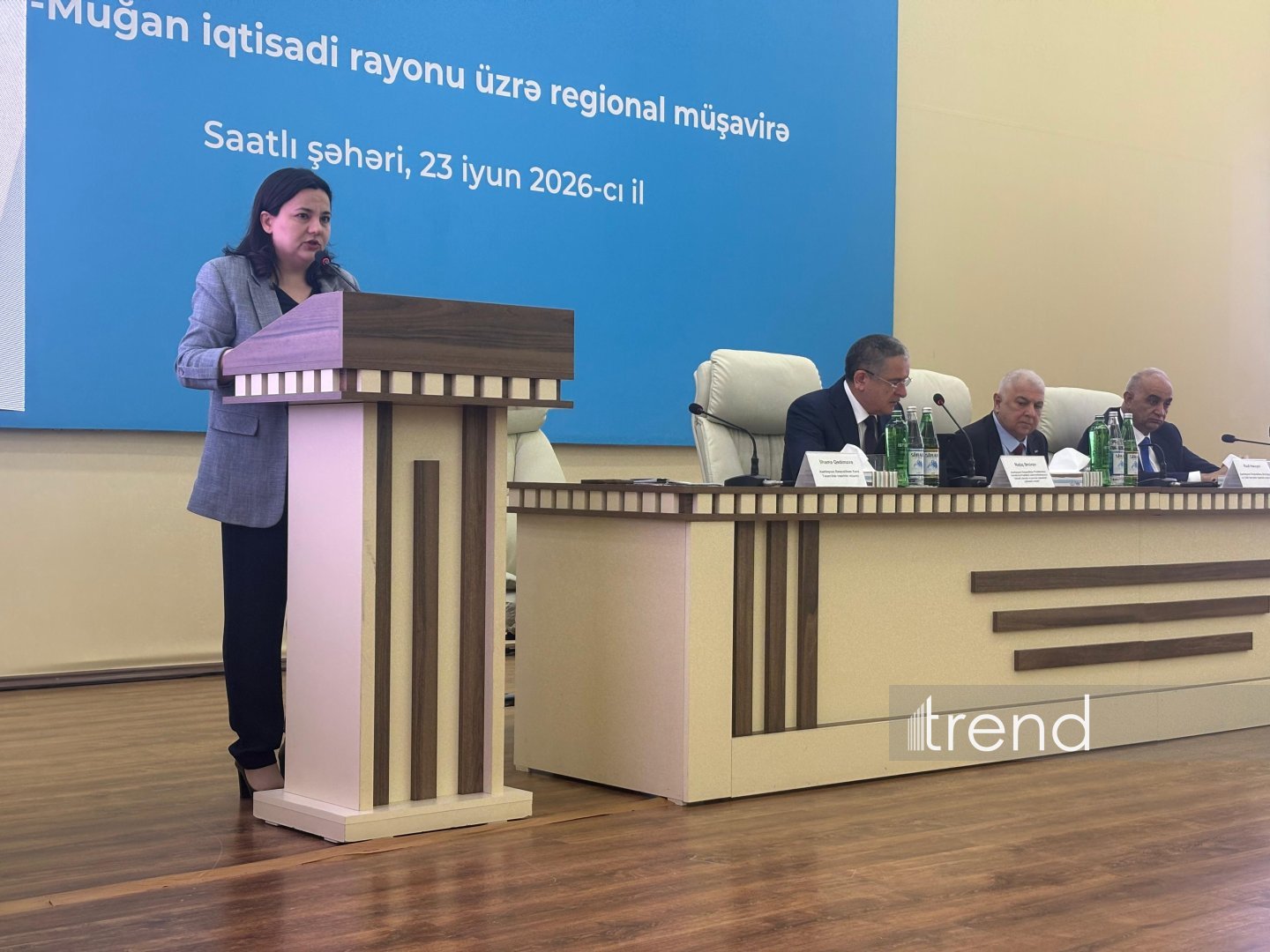

SAATLI, Azerbaijan, June 23. Advance payment of a portion of the subsidy for agrotechnical maintenance in horticulture will also be an important support mechanism in Azerbaijan, Deputy Minister of Agriculture Ilhama Gadimova said, Trend's correspondent reports from the event.
She made the remark at a regional consultation on the Mil-Mughan economic region, held in Saatli to discuss the State Program for the Development of Agricultural Production and Processing, Fisheries, and Aquaculture in Azerbaijan for 2026–2030.
"Pre-payment of a part of the subsidy intended for agrotechnical maintenance in horticulture will also be an important support mechanism. Because pruning, fertilization, disease and pest control, irrigation, and other maintenance measures in horticulture must be carried out on time. The farmer's financial ability at the beginning of the season directly affects the quality of these measures," the deputy minister explained.
According to her, it's envisaged to apply the certification subsidy.
"Global G.A.P. and organic certificates are an important condition for access to export markets. We should not only produce products, but also present them in accordance with the standards required by international markets. The application of product subsidies for apples and pomegranates is also important in terms of encouraging producers in horticulture. This will serve both to increase productivity and to develop export-oriented horticulture.
Livestock breeding is also one of the main directions of the state program. In particular, in the cattle breeding sector, increasing milk and beef production, increasing the share of pedigree animals in the herd, reducing dependence on imports, and increasing the level of self-sufficiency have been identified as the main goals.
It's planned to increase milk production by 10% and beef production by 20% by 2030. It's planned to increase the share of pedigree animals in the herd to 10%. The goal is to reduce milk imports by 49.6% and beef imports by 40.2%. An increase of 8.5 % in milk and 11.5% in beef is also planned for the level of self-sufficiency. To achieve these goals, it is planned to create dairy and beef clusters, form about 1,000 new farms with various capacities within the cluster, and support the provision of these farms with pedigree animals. In addition, the establishment of 90 milk collection points and 15 skin collection points will be supported. This serves not only to establish production in livestock, but also to establish a supply, processing, and sales chain, " Gadimova noted.



