


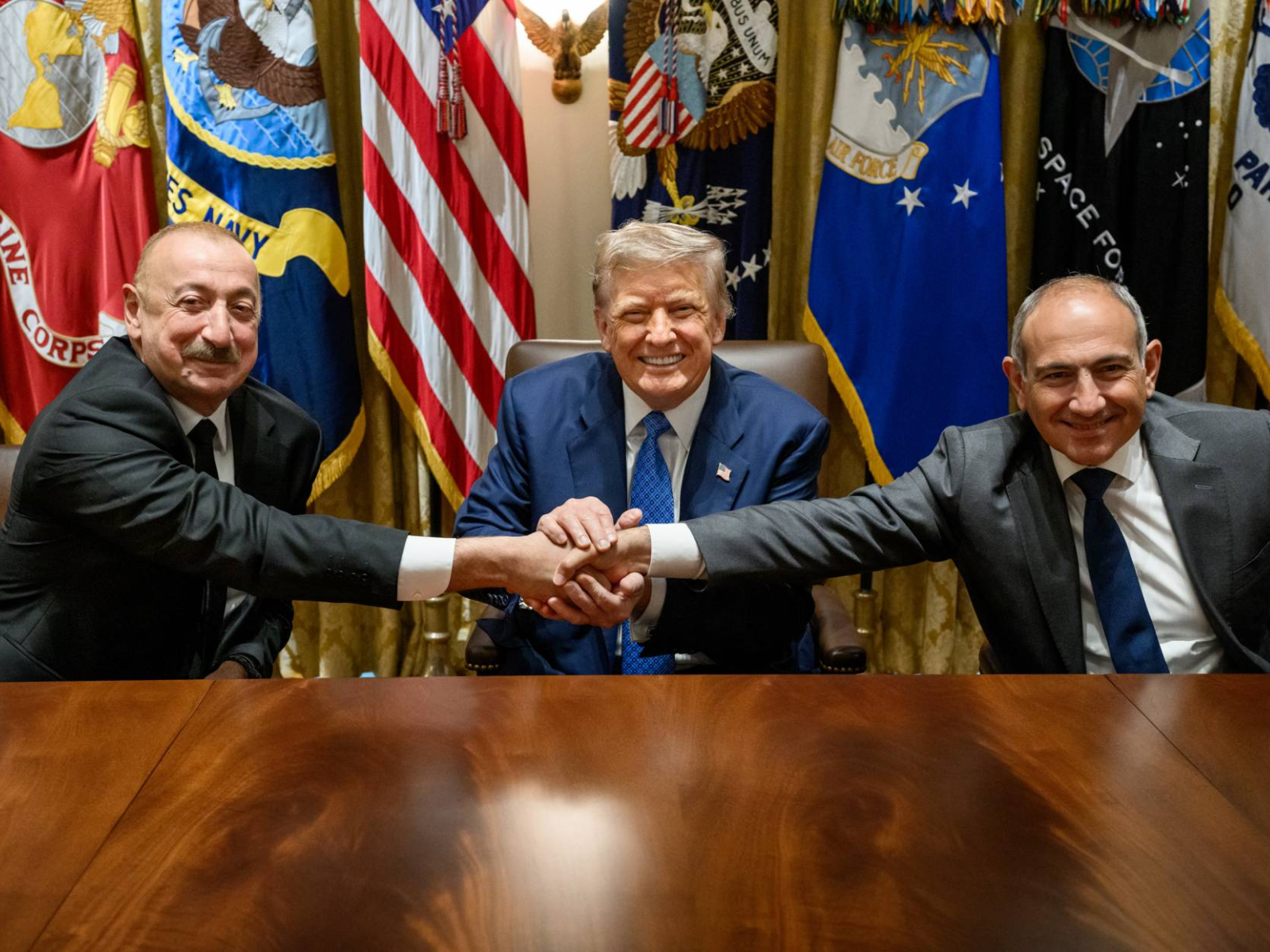

BAKU, Azerbaijan, August 8. To view the events that took place in Washington on August 8, 2025, solely as a meeting between the leaders of Azerbaijan, Armenia, and the US, the initialing of a peace agreement, and the signing of a Joint Declaration is to fail to fully capture the political significance of that day.
A year later, when assessing this date in a broader context, a larger picture emerges: following a long-standing conflict, Azerbaijan has charted a consistent course toward consolidating the new realities not only in the military-political sphere, but also in the diplomatic, legal, economic, and transportation spheres. Washington, in turn, has become one of the most important milestones of this course on the international political stage.
The Broader Political Context Behind August 8
To understand the essence of the Washington summit, we need to take a step back and examine the events that preceded what happened that day at the White House. After all, August 8, 2025, was not a diplomatic outcome that materialized in an instant. It was driven by the new realities that had taken shape in the South Caucasus after 2020, the peace initiative put forward by Azerbaijan, the negotiation process between the two nations, and efforts to define the future legal framework for interstate relations.
The key feature of Azerbaijan’s approach was that its goal was not to keep the postwar situation in a state of uncertainty, but to consolidate the new reality through legal and political mechanisms. To this end, Baku proposed drafting a peace treaty and outlined five fundamental principles.
These five principles formed the political foundation for subsequent negotiations. According to Azerbaijan’s position, a lasting peace is possible only through the recognition of mutual sovereignty, territorial integrity, and the inviolability of borders; the rejection of territorial claims against one another; and the establishment of interstate relations based on the fundamental principles of international law.
Thus, Azerbaijan’s peace agenda was not merely a diplomatic move undertaken after the war, but a strategy to transform the military outcome into a political and legal result. The position articulated by President Ilham Aliyev in Washington also emphasized that drafting a peace treaty following the end of the war is the next logical step.
In this regard, the key question on August 8 is not “What happened in Washington?” but “To what level has the peace agenda formulated by Azerbaijan in Washington been elevated?”
Turning Victory into a Political Outcome
The 2020 war changed the previous status quo in the South Caucasus. The full restoration of Azerbaijan’s sovereignty over Karabakh in 2023 effectively brought the military-political phase of the conflict to an end.
After that, we faced an entirely different task: establishing a new system of relations between the two states in place of the former conflict.
It was precisely here that an important feature of Azerbaijan’s diplomatic approach became apparent. Baku did not opt for a policy of maintaining the status quo or continuing the confrontation after its military victory. On the contrary, it proposed an initiative to legally enshrine the new reality in a peace agreement.
This point is also emphasized in the documents: Azerbaijan is presented as the initiator of the five principles outlined in the peace agreement, and the signing of the agreement on August 8 is assessed as the result of a long-term diplomatic strategy.
This fits into the broader logic of Azerbaijan’s foreign policy. The goal was not only to end the war but also to shape the postwar period in accordance with Azerbaijan’s national interests.
The True Essence of the Washington Documents
The political significance of the Joint Declaration signed on August 8 lies, first and foremost, in the consolidation of several parallel processes into a single document.
The leaders of Azerbaijan and Armenia witnessed the signing by the foreign ministers of the agreed-upon text of the agreement on peace and the establishment of interstate relations. At the same time, the need for additional measures to sign and ratify the agreement was identified.
This detail is particularly important. After all, the signed text was not the final peace treaty itself. In other words, Washington did not define the endpoint of the peace process, but rather a decisive stage for the legal finalization of the political agreement.
On the other hand, a key part of the documents was the signing by the foreign ministers of Azerbaijan and Armenia of a joint statement calling for the closure of the OSCE Minsk Process and its associated structures.
This step is more than symbolic. After all, the Minsk mechanism was created specifically to resolve the Azerbaijani-Armenian conflict. The fact that the conflict has already entered a new phase in a new reality has made it necessary to consign this mechanism to history.
Thus, on the one hand, a new peace mechanism has been established in Washington, and on the other, a step has been taken toward closing one of the main elements of the conflict’s former architecture.
The Post-Minsk Phase
This phase reveals a broader political outcome.
For more than thirty years, efforts to resolve the Azerbaijani-Armenian conflict have been conducted within the framework of international mediation mechanisms. However, a final resolution has not been achieved. In this new phase, responsibility for the process is being transferred directly to Baku and Yerevan.
According to the Azerbaijani Ministry of Foreign Affairs, the termination of the Minsk Process and its associated structures was one of the issues that Azerbaijan had continued to advance on its agenda since 2020, and this step is viewed as the removal of one of the major obstacles to the peace process.
This signifies a shift in the model of mediation in the South Caucasus. Whereas the main question used to be, “How will the conflict be resolved?”, the key question now is, “What legal and economic mechanisms will be used to consolidate peace?”
The Trump Factor and the Choice of Washington
The choice of Washington also carried its own distinct political significance.
President Ilham Aliyev’s visit to Washington at the invitation of U.S. President Donald Trump brought together two key themes on a single platform: the peace agenda in Azerbaijan and Armenia, and the transition of Azerbaijani-American relations to a new phase.
On the first day of the visit, President Ilham Aliyev met with U.S. Special Envoy Steve Witkoff, and the signing of a memorandum of cooperation between SOCAR and ExxonMobil already demonstrated that the visit’s agenda was not limited to political issues.
The following day, President Ilham Aliyev met with President Donald Trump at the White House. Later, the two countries signed a memorandum of understanding on the establishment of a Strategic Working Group to draft a Charter of Strategic Partnership.
Thus, the Washington meeting yielded two parallel outcomes: a political foundation for a transition toward peace in Azerbaijani-Armenian relations and an institutional foundation for a strategic partnership in Azerbaijani-American relations.
A New Chapter in Baku-Washington Relations
The establishment of the Strategic Working Group is not a typical diplomatic mechanism. According to the document, the plan was to draft a Strategic Partnership Charter within the next six months. The group’s scope of activity included regional ties, particularly in energy, trade, and transit; artificial intelligence and digital infrastructure; economic investment; defense; security; and counterterrorism.
Taken together, it becomes clear that Azerbaijani-American relations are no longer viewed exclusively through the prism of energy and security.
Energy remains as important as ever, but alongside it, transit, digital technologies, artificial intelligence, investment, and defense cooperation are also developing. This implies a transition toward a more multifaceted model of relations.
President Ilham Aliyev also spoke highly of the results of the visit and stated that a new chapter has begun in Azerbaijani-American relations — a chapter of cooperation and strategic partnership.
This assessment is one of the main points explaining the essence of the visit to Washington.
Repeal of Amendment 907
Another important outcome of the visit was the decision to suspend the application of Amendment 907 to the U.S. “Support for Freedom” Act.
This issue, which had remained unresolved for many years in Azerbaijani-American relations, was particularly politically sensitive. The Azerbaijani Ministry of Foreign Affairs viewed the suspension of Amendment 907 as an important step toward eliminating the negative legacy of the past in bilateral relations.
This is not merely about the removal of a technical restriction. In a broader sense, this decision signaled a shift in the previous political framework governing Washington’s relations with Baku.
Thus, August 8 became a date that marked the end of certain elements of the previous phase in both Azerbaijani-Armenian relations and Azerbaijani-American cooperation.
TRIPP: Economic Support for Peace
One of the most strategically important elements of the Washington documents is the “Trump Route for International Peace and Prosperity” project—TRIPP.
According to the documents, the project aims to ensure unimpeded connectivity between the main part of Azerbaijan and the Nakhchivan Autonomous Republic through Armenian territory.
It would be incorrect to view this project solely as a transportation issue.
In fact, the idea is to transform the geography of the South Caucasus—which for many years has been defined by conflicts and closed borders—into a landscape of economic ties.
If the connection between Azerbaijan and Nakhchivan through Armenian territory is fully realized, it will not only facilitate communication between the two parts of Azerbaijan. The new route could expand connections with Turkey and, more broadly, the capabilities of the East-West transportation system.
Thus, an economic dimension of peace emerges: a geography that was yesterday the subject of conflicts and confrontations is today becoming an opportunity for trade, transit, and investment.
This could become one of the strongest guarantees of peace. Because as real economic interests take shape alongside a political agreement, the economic costs of violating it also increase.
The Energy Sector Is Once Again Moving Closer to the U.S.
The economic implications of the visit to Washington extend beyond TRIPP.
The memorandum of cooperation signed between SOCAR and ExxonMobil could mark a new phase of collaboration with U.S. companies in Azerbaijan’s energy sector.
The Ministry of Foreign Affairs reported that the document covers potential cooperation in assessing both conventional and unconventional opportunities in the oil and gas industry.
This is particularly significant, as the foundation of the Azerbaijani-American energy partnership was laid in the 1990s. Now, this cooperation is being revitalized amid new geopolitical and technological conditions.
Thus, during the visit to Washington, the energy issue was on the agenda not only as a reminder of past successes but also as an opportunity to explore new investment and technological possibilities.
The statistics already paint a positive picture.
When assessing the results of the Washington Summit one year later, the most interesting aspect is not only the political documents but also the changes that have occurred in economic statistics.
Trade ties between Azerbaijan and Armenia, which had been virtually nonexistent for many years, have already begun to be reflected in official statistics.
In the first half of 2026, the volume of Azerbaijan’s exports to Armenia reached approximately $17.1 million. This figure remains modest compared to the economic potential of the two countries. However, what matters most here is not the size of the figure, but its political significance.
This marks the beginning of actual economic transactions between two countries that have been in a state of conflict for decades.
In the first five months of 2026, trade between Azerbaijan and Armenia totaled $11,273,000. Of this amount, $11,272,000 came from Azerbaijan’s exports to Armenia, while imports from Armenia totaled just $1,000.
The bulk of exports consisted of heavy distillates and gas oils, including diesel fuel, amounting to $9,426,000, motor gasoline—$1,167,000, motor gasoline with specific technical characteristics—$672,000, and plastic construction components worth $6,000.
These figures point to a significant shift: in Azerbaijani-Armenian relations, economic cooperation is no longer viewed solely as a prospect for the future—it has, in fact, begun to take shape.
Fuel exports are particularly noteworthy from a political standpoint. The fact that two countries that once waged war against each other now act as buyer and seller of energy resources is one of the most concrete indicators of the new realities that have taken shape in the region.
Washington’s Second Outcome for Azerbaijan
Thus, the consequences of August 8 cannot be assessed solely in the context of the Baku–Yerevan axis.
On the same day, Azerbaijan entered a new phase in its relations with the United States as well.
The creation of the Strategic Working Group, the inclusion of energy and transit issues on the agenda, plans for cooperation in the fields of artificial intelligence and digital infrastructure, the expansion of investment and security initiatives, the suspension of the application of the 907 Amendment, and the signing of a memorandum between SOCAR and ExxonMobil may appear to be separate events. However, in reality, they are different elements of a single strategic approach.
Azerbaijan presents itself not only as a party advocating for peace in the South Caucasus, but also as one of the key players in the region’s new economic and transportation architecture.
The United States, for its part, is demonstrating the potential to shift its relations with Azerbaijan into a broader strategic framework.
The Main Problem Facing the Peace Process
Despite all these positive results, we must not overlook one important aspect of the Washington documents: on August 8, only the agreed-upon text of the peace treaty was signed.
The Joint Declaration clearly stated that additional measures are necessary for the signing and possible ratification of the agreement.
From Azerbaijan’s perspective, the removal of territorial claims against Azerbaijan from the Armenian Constitution is one of the key issues for signing the peace treaty. This issue is also particularly emphasized in the materials released by the Ministry of Foreign Affairs.
This is, in essence, a matter of principle from the standpoint of the very nature of peace.
This is because peace must be reinforced not only by the political will of the two leaders, but also by legal mechanisms that account for the possibility of that will changing in the future.
Once the peace treaty is signed, its ratification and incorporation into the domestic legal system will mean that the political agreement becomes an institutional guarantee.
The True Significance of August 8
August 8, 2025, holds significance for the South Caucasus that extends far beyond a single date.
On this day, with the initialing of the agreed text of the peace agreement between Azerbaijan and Armenia, an important step was taken toward legally enshrining the political outcomes of a conflict that had lasted more than three decades. At the same time, a joint step was taken toward ending the activities of the Minsk Process and its associated structures, marking a departure from one of the key elements of the previous conflict architecture.
The peace agenda, shaped on the basis of the five principles put forward by Azerbaijan, received international political endorsement in Washington.
At the same time, a new phase began in relations between Azerbaijan and the United States. An institutional mechanism was established to draft a Strategic Partnership Charter, and an agenda was defined covering a wide range of areas, including energy, trade, transit, investment, artificial intelligence, digital infrastructure, defense, and security. The suspension of the application of the 907 Amendment took on particular significance in terms of resolving a political issue that had lingered in relations between the two countries from the previous period.
The TRIPP project has placed all these processes within a broader regional context. The idea of establishing a connection between the main part of Azerbaijan and Nakhchivan through Armenian territory creates a new mechanism linking the region with transportation and economic interests.
The fact that trade between Azerbaijan and Armenia is already appearing in official statistics just one year later is one of the first indicators that the process is moving from political documents to actual implementation. Fuel exports to Armenia are particularly symbolic in this regard: the two countries, which were once parties to the conflict, have now begun to establish economic relations, at least in certain areas.
All of this points to one truth: the essence of the Washington meeting lies not only in the signing of a peace treaty.
The real changes lie in the fact that Azerbaijan is gradually transforming the new post-war status quo into a system of peace, law, diplomacy, transportation, energy, and economic cooperation.
This also reflects Azerbaijan’s position regarding the political leadership of this process. The reality that changed on the military front in 2020 shifted to the diplomatic and legal spheres in the following years; in 2023, a new phase began with the full restoration of Azerbaijan’s sovereignty; And on August 8, 2025, a historic step was taken toward transforming this reality into an agenda for global and regional cooperation.
The main task now is to bring this process to its final stage: signing the initial text, ratification, strengthening mutual trust, opening communication channels, and expanding economic ties.
If these stages are completed, August 8, 2025, will go down in history not only as a turning point in the Azerbaijani-Armenian peace process, but also as the beginning of a new post-conflict political and economic order in the South Caucasus.
And the defining feature of this new order—conceived by President Ilham Aliyev- will no longer be the preservation of the status quo of the past, but rather the institutionalization of the reality created by Azerbaijan through peace and cooperation.



