


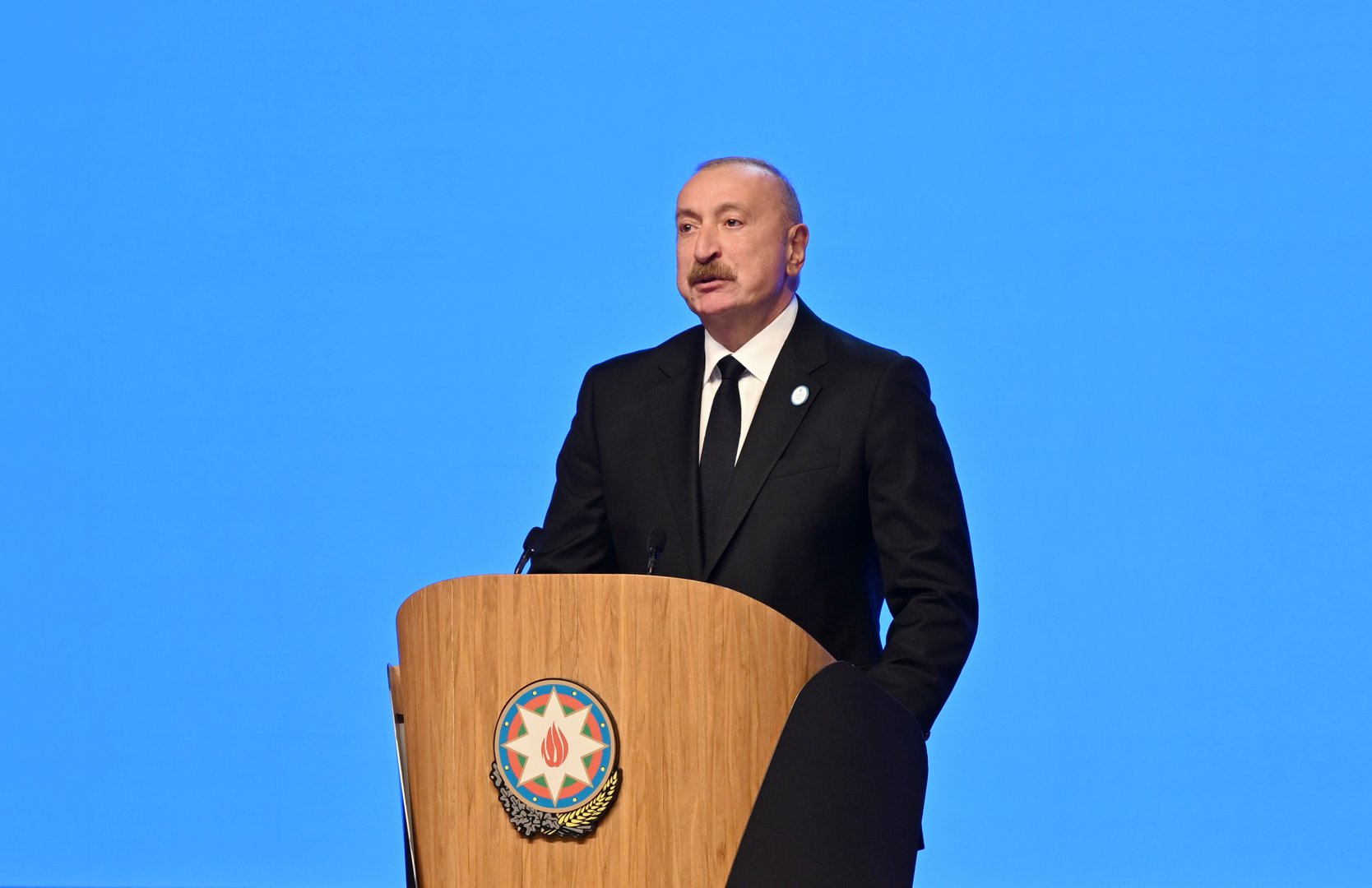
BAKU, Azerbaijan, October 3. The 8th congress of the ruling New Azerbaijan Party was held in Baku, and, naturally, the main event was the major programmatic speech by party chairman and President Ilham Aliyev. Most of the issues addressed by the head of state at the congress were easy to classify as entirely predictable - the outcome of the Victory, the economy, energy, transit corridors, and the reconstruction of Karabakh. But in the section devoted to security, there was a passage that made many people go back and read the transcript again. Some did so more than once.
Ilham Aliyev spoke about how Azerbaijan armed itself, and about who helped it and how. The short answer was: no one, in no way. And, seemingly answering questions that might have been asked, he uttered a phrase that probably shut quite a few mouths in very different parts of the world: “Whatever we acquired, we purchased with money.”
The quote is important enough to be read again, in full. Here is what Ilham Aliyev said:
“We need no one's help or patronage. When we needed help, no one helped us. When we had one million refugees, no one reached out to us. Whatever we acquired, we purchased with money. That includes all weapons, which were bought with money at world prices—down to the last bullet. I tell you this with full responsibility as Supreme Commander-in-Chief and as the person overseeing all these matters. You know how much Azerbaijan has armed itself since 2003, establishing local production and purchasing from abroad. Not once were we granted a single manat or single dollar discount. In fact, sometimes they sold to us at prices several times higher than the world market rate, and we were forced to turn a blind eye to it.”
Ilham Aliyev’s short punchline contains several important points at once: everything Baku received, it paid for, and it paid full price. There were no discounts. At times, our partners were frankly hiking prices, even above world-market levels, knowing that Baku had no alternatives at the time. There really were no alternatives, and Baku was forced to pretend it saw nothing.
Yesterday, Ilham Aliyev explained quite clearly that he had seen and understood everything. And, by the way, not only that. The president also made it clear that Azerbaijan needs neither assistance nor patrons, while reminding everyone of the “big backers” who help one warring country or another today. Behind every side, there is such an backer; according to Aliyev, some have several. Azerbaijan did everything on its own, the president reminded all those who may suddenly have decided to join the queue for “patronage.”
The fact that weapons were purchased is hardly a secret. What is striking is something else: why did the president feel the need to put it so bluntly, and why now?
The answer appears to lie in the information space of recent weeks. In a number of foreign media outlets and among popular bloggers - and it is not necessarily the case that this has happened without the help of yet another set of big backers - a narrative has been gaining traction that Azerbaijan was able to regain Karabakh only because it was supplied with equipment and weapons. From there comes the argument about “ingratitude” and “insufficient loyalty.” The logic behind it is simple: if Baku received something, then it owes something in return, and that debt can be presented at any time.
Ilham Aliyev dismissed that self-appointed bill. If the weapons were bought at full price, or even above it, then this was an ordinary commercial transaction, not a gift, and it cannot carry any political strings attached. The argument over authorship is closed. No one owes anyone anything and no one ever did. And someone else’s expectations are someone else’s problem.
It is also noticeable that Ilham Aliyev did not name the addressee. This is entirely in keeping with the speech as a whole. Azerbaijan, the president stressed, does not join any camps, and its word “is worth as much as its signature.” Publicly picking a fight with a specific partner under such a position would have been strange. Ilham Aliyev took a much subtler approach: he put it in such a way that the people who needed to understand would understand it themselves, while leaving no grounds for a diplomatic scandal. Those circles building campaigns around the idea that Baku is “in debt” surely got the message: the account is closed, the bill has been paid, move along.
At the same time, reducing the whole matter to a single addressee would be wrong. Domestically, this is first and foremost a reinforcement of the main narrative: the Victory belongs to the people and the state, not to someone on the outside. Ilham Aliyev himself linked this to ideological security, saying that pride in the Victory is the best protection against “ideological provocations.”
For foreign partners, it is a reminder of how Baku sees its relations. Azerbaijan has built ties with all poles and signed strategic partnership documents with both superpowers - China and the United States. In such a system, there is simply no room for “senior” and “junior” partners. And to those conducting information pressure, the president made it clear that no one is going to justify themselves. For those with a short memory, Ilham Aliyev once again reminded them that Baku responds to every strike - and does so several times harder.
In Baku, the question of who owns the Victory has long, and quite rightly, been seen as a question of sovereignty. It is no longer just history, but also an instrument of present-day politics: the various backers claiming co-authorship of the Victory are not doing so for nothing. They are claiming a semi-official right to tell Azerbaijan, or even dictate to it, what to do next. Ilham Aliyev patiently but firmly pushes back: do not tell us how to live. Your “noble support” has a very measurable currency equivalent, and you got what you were owed.
Ilham Aliyev was talking about weapons, but in reality he was once again talking about sovereignty. And he was doing it in Baku’s characteristic manner, without asking anyone to understand and without trying to win anyone’s approval. Instead, everyone interested was given a free lesson in political accounting. In the “income” column: weapons and equipment. In the “expenses” column: Azerbaijani money. And there was no column saying, “Now you owe us for the rest of your life.”
Judging by how quickly various foreign journalists and bloggers who were still intensely interested yesterday in the origins of the weapons and equipment of the Azerbaijani Armed Forces suddenly lost interest, Ilham Aliyev’s intended audience got the message.
Good for them.



