


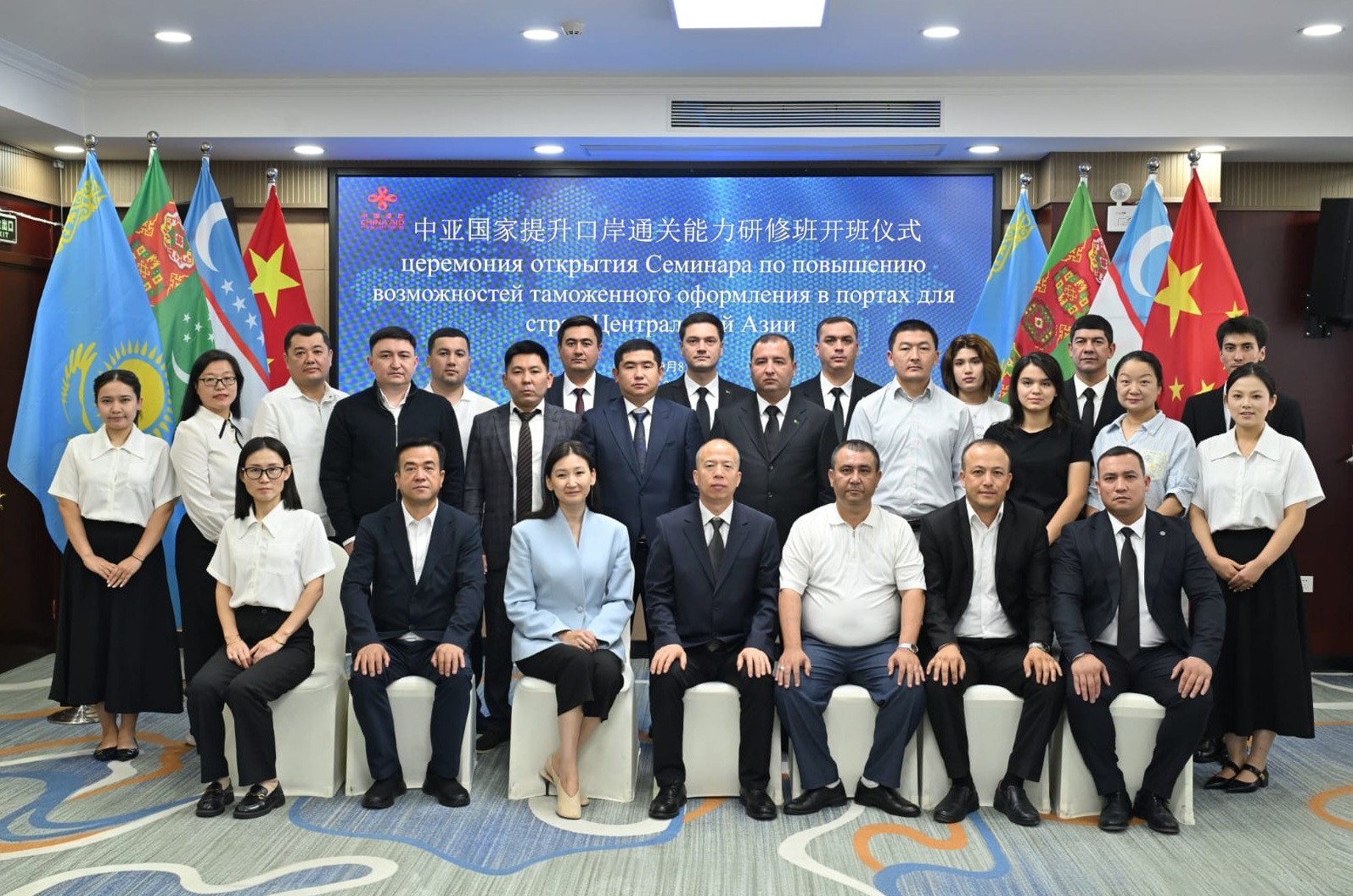

BAKU, Azerbaijan, October 2. A two-week training seminar on enhancing customs clearance capabilities at seaports for Central Asian countries was held in Urumqi, China, from September 8 through 21.
This was reported by the State Customs Service of Turkmenistan in a press release published today.
According to the publication, the seminar, organized at the invitation of the Chinese side, brought together customs officials to study technologies and practices aimed at accelerating clearance procedures at maritime ports.
A delegation from Turkmenistan’s State Customs Service participated in the training, with officials representing customs posts at land and maritime ports under the Ashgabat City and Balkan Region customs administrations.
"During the training, participants gained a detailed understanding of practical procedures for expediting customs clearance at seaports, the operation of contactless inspection systems, the automated processing of electronic documents, and the functioning of the “Smart Railway Port” system, which is designed to facilitate the rapid clearance of containers at border crossings," the report says.
The training also covered the issues related to intelligent customs risk management systems.
According to the publication, the experience gained by the Turkmen delegation will contribute to ongoing efforts to modernize customs posts at the International Seaport of Turkmenbashi.
A similar agenda was being discussed in Azerbaijan, another key link in the Middle Corridor connecting Central Asia with international markets via the Caspian Sea.
As Trend reported yesterday, Azerbaijan Railways (ADY) Chairman Advisor Emil Mammadov said during a World Bank Group online event that digitalization is crucial for improving the efficiency of the Middle Corridor. He noted that Azerbaijan is investing in the modernization and electrification of railway infrastructure, as well as the expansion of the Baku port and operational efficiency.
"When we speak of digitalization, we mean ensuring that the cargo owner has a better and clearer understanding of the cargo's status throughout the entire corridor. In other words, it’s not a 'black box' concept; rather, it’s a corridor that provides precise information regarding delivery, transport, and storage conditions, among other details," Mammadov said.
The events unfold against the backdrop of Central Asian countries' efforts to improve their connectivity within the Middle Corridor, while Azerbaijan is expanding infrastructure and digital solutions along the route to increase its capacity and improve the movement of cargo across the Caspian Sea.
For reference, the Middle Corridor, formerly known as the Trans-Caspian Transport Corridor, is a multimodal trade route connecting China and Central Asia with the South Caucasus, Türkiye and Europe through railways, the Caspian Sea and road links. Turkmenistan is among the countries covered by the broader corridor, with the Turkmenbashi port providing a maritime link across the Caspian Sea.
The World Bank said in September 2026 that targeted investments in the corridor could more than triple trade volumes and halve travel times by 2040. The bank identified digitalization, including a single digital corridor system for transport, transit and trade data, as one of the key measures needed to improve the route’s efficiency.
Meanwhile, the “Smart Railway Port” model is used at Chinese railway border ports to coordinate customs, railway and border-inspection procedures. At Horgos on the Chinese-Kazakh border, for example, the model combines train handling, transshipment, inspection and customs release into a coordinated process. Chinese authorities say the approach has helped increase the port’s turnover efficiency by more than 20%.



