


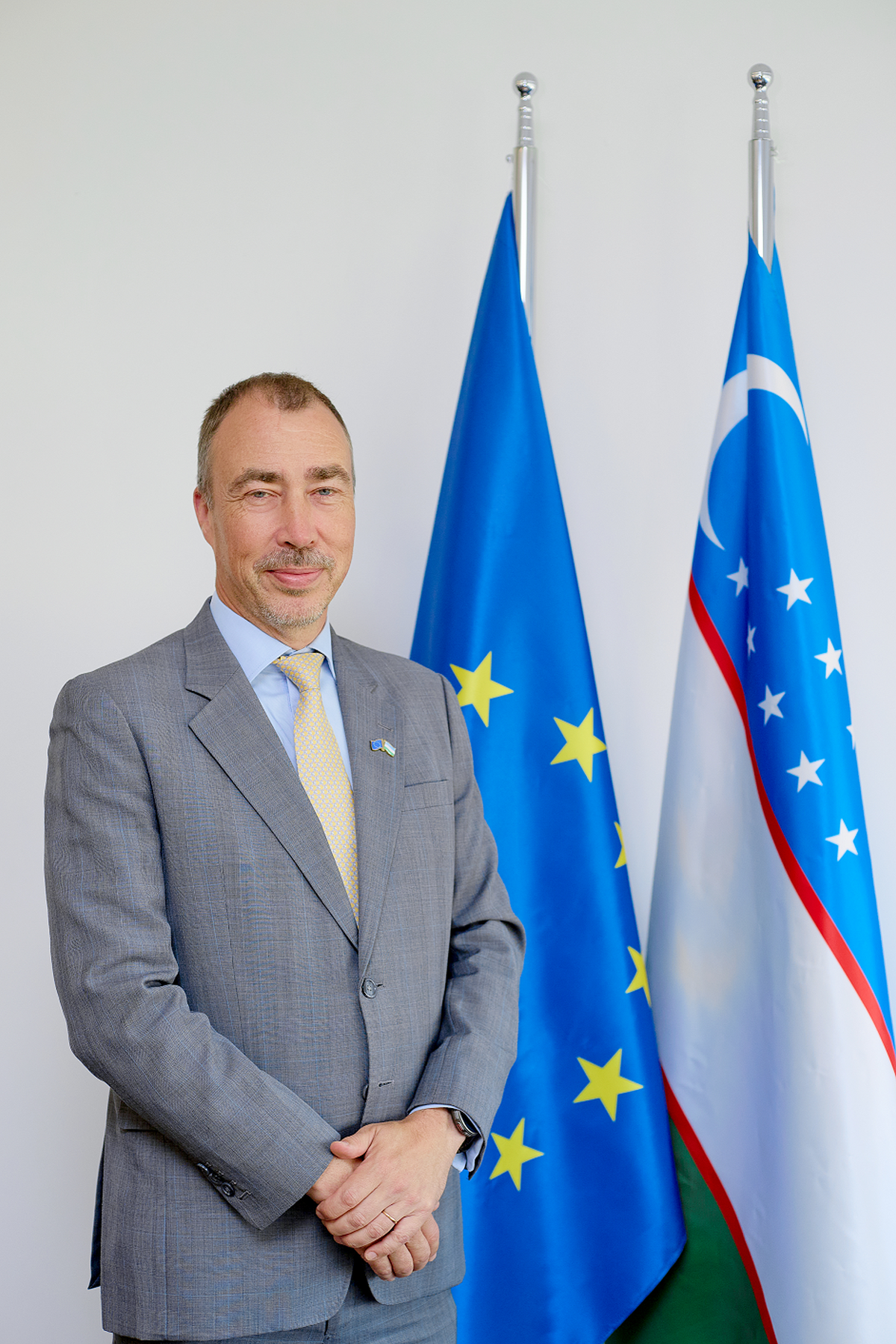

BAKU, Azerbaijan, October 2. The European Union is working with international financial institutions and development partners to develop an investment pipeline for Uzbekistan’s railway, road and logistics infrastructure along the Trans-Caspian Transport Corridor (TCTC), EU Ambassador to Uzbekistan Toivo Klaar told Trend in an exclusive interview.
According to Klaar, railway projects are expected to receive particular attention given the sector’s role in establishing a high-capacity, reliable, energy-efficient and climate-friendly transport link between Central Asia and Europe.
"In concrete terms, discussions will focus on railway rehabilitation and modernisation, including upgrades to core rail infrastructure, improvements at border-crossing points, and related logistics connectivity," Klaar said.
Road and logistics investments aimed at strengthening multimodal connections and improving freight movement along the corridor will also be addressed, he said.
The ambassador noted that it is too early to estimate the overall investment volume associated with the priority project pipeline.
"It is too early to give any indication of investment amounts – based on today’s discussions, we will work with the IFIs to determine the next steps with a view towards putting together a financing package," Klaar said.
Under the EU’s Global Gateway Strategy, the development of a reliable and competitive TCTC is a key priority. The EU is working with Team Europe partners, international financial institutions and development organizations through the TCTC Coordination Platform to identify and advance priority investments.
Klaar said the EU has three main tools for supporting priority investments: technical assistance, blending and guarantees.
"We can mobilise technical assistance to undertake preparatory studies such as feasibility studies and environmental and social impact assessments, and it can also be used for institutional support to create the right legal framework for, for example, public-private partnership projects," he said.
For projects financed through loans from the European Investment Bank, the EU can provide guarantees to reduce interest rates, while grants can support blended finance operations with the European Bank for Reconstruction and Development, according to Klaar.
The EU also provides grants for trade facilitation, customs efficiency and harmonization of transport regulations, which Klaar said helps create an enabling environment for private-sector investment.
"Recently we also created the Investment Hub, through which we can support European private sector projects through grants, loans, equity, guarantees and various de-risking instruments," Klaar said.
The comments were made in connection with the second National Conference on the Trans-Caspian Transport Corridor that will be held on Sept 30, which brings together government representatives, international financial institutions, development partners and private-sector participants to discuss investment and reform priorities for the corridor.
The conference is part of the EU-supported TCTC Coordination Platform under the Global Gateway framework, which aims to improve connectivity, mobilize investment and strengthen the efficiency and competitiveness of the corridor.



