


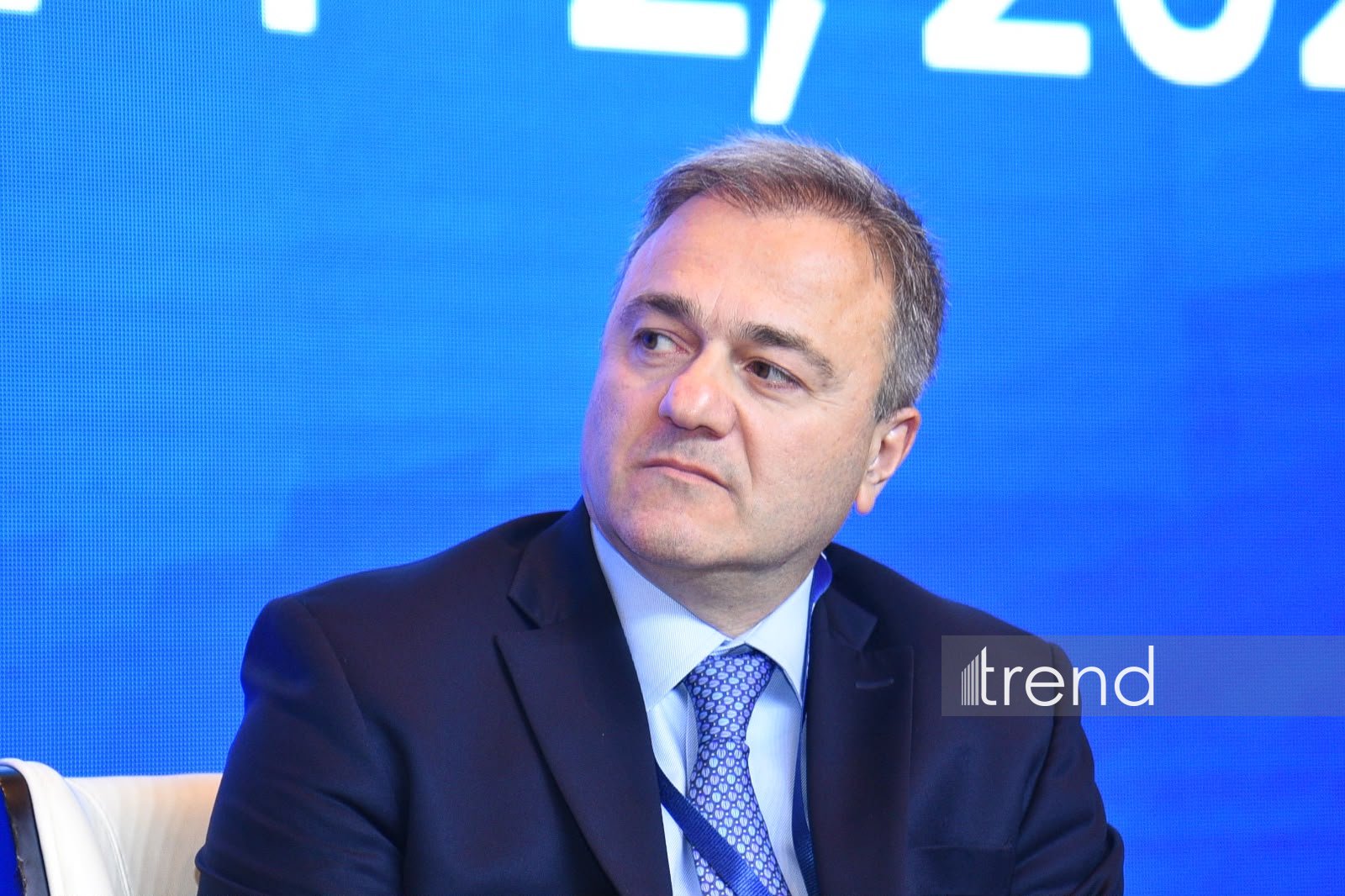
BAKU, Azerbaijan, October 2. The Middle Corridor should contribute to economic development and regional cooperation, rather than being viewed solely as a transit route between China and Europe, the president of the consulting firm PMCG, Alexi Aleksishvili, said at the CAMCA 2026 Regional Forum in Baku, Trend's correspondent reports from the event.
According to him, historically, regional cooperation and transport corridors have been shaped not only by geographical location but also by specific historical circumstances. “Of course, geographical location exists, but we need to utilize it and apply it as wisely as possible. The countries of the Caucasus and Central Asia previously lacked an institutionalized model for regional cooperation. We never had any institutionalized model for this, only individual projects. The project of the century, which remains so to this day, is the Baku–Tbilisi–Ceyhan pipeline. It was truly a very interesting and important breakthrough in terms of economic cooperation,” he said.
Aleksishvili noted that in the 21st century, many changes are taking place in this area, particularly concerning the development of coordination among the countries of Central Asia and the Caucasus. “The concept of the ‘Middle Corridor’ can sometimes be misleading, as it raises the question of whether its purpose is solely to connect points of origin and destination and to facilitate the transit of containers between China and Europe. Is that the economic value of such cooperation? Definitely not,” said the PMCG president.
He cited Georgia as an example, noting that it takes about seven hours to cross the country: “Even taking into account the driver’s stops and everything else, ultimately this is not of significant value if viewed solely as a transit route. The added value created through the corridor’s operation should serve to further develop the economy. That is why I believe that it is connectivity and economic cooperation that matter, not the corridor itself. Of course, the corridor is very important, and physical infrastructure is very important, but that is not enough.”



