


BAKU, Azerbaijan, June 17. Uzbekistan and Germany are focused on expanding comprehensive industrial cooperation and trade relations, following a steady economic upward trend that saw bilateral trade turnover exceed $1.4 billion.
This was reflected in the statement by the press service of the Uzbek president.
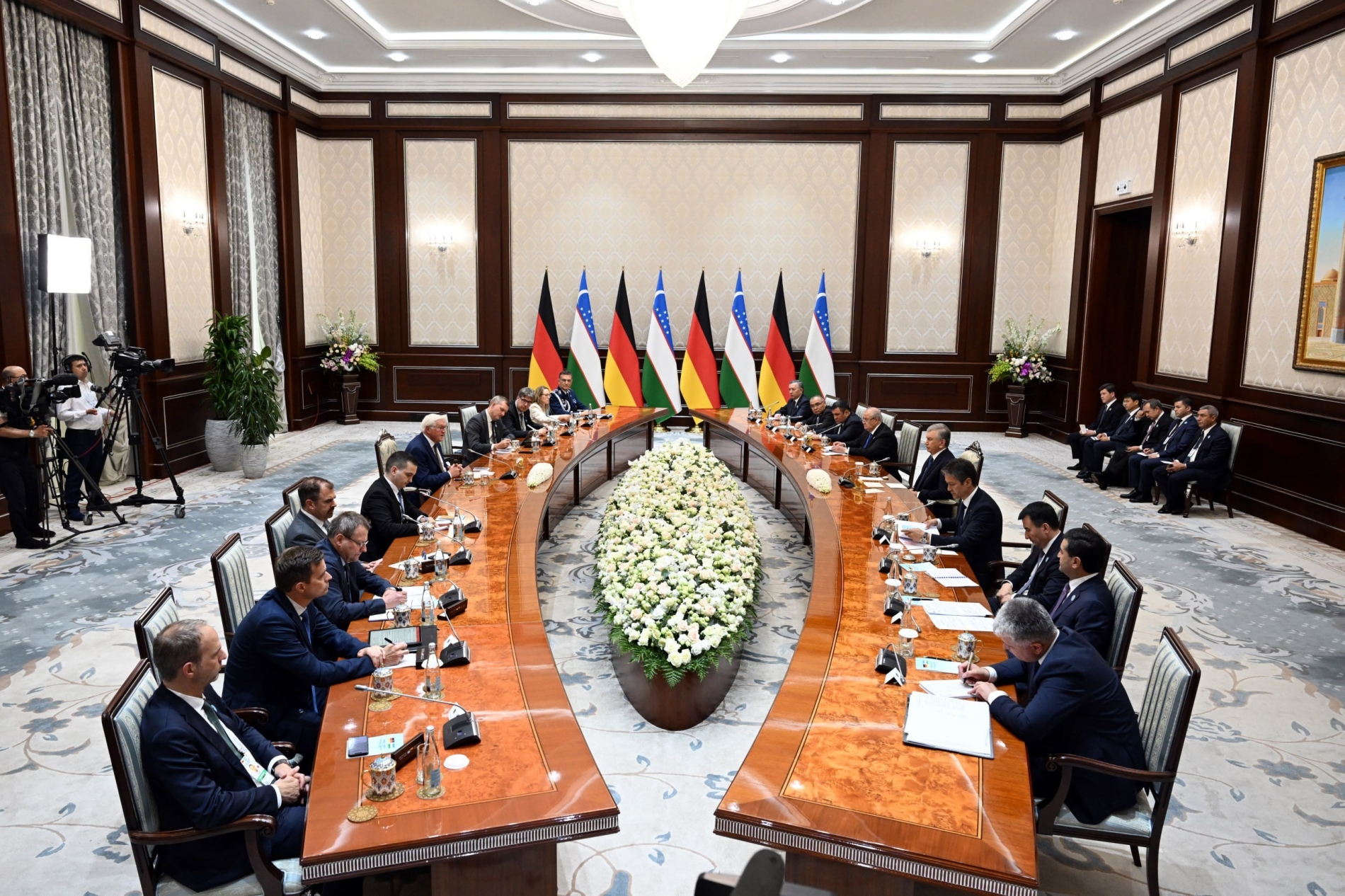
The cooperation framework was announced during high-level talks between Uzbek President Shavkat Mirziyoyev and German Federal President Frank-Walter Steinmeier at the Kuksaroy Presidential Palace in Tashkent.
"The current visit of the Federal President of Germany will open a new stage in the development of Uzbek-German relations and will contribute to the further expansion of mutually beneficial cooperation across the entire spectrum of the bilateral agenda," the press service noted.
According to the Uzbek presidency, trade between the two nations has increased by another 5% since the beginning of this year, while the volume of German investments into Uzbekistan's economy reached $2 billion over the past year. The leaders highly commended the outcomes of the Days of German Economy and the 10th meeting of the German-Uzbek Business Council held in Tashkent in May, which yielded a package of new investment and trade agreements worth over $1 billion. The heads of state reaffirmed their mutual interest in deepening long-term cooperation across several strategic vectors, including the green economy, transport, logistics, renewable energy, and advanced manufacturing.
Furthermore, the bilateral briefing focused heavily on the expansion of educational and humanitarian links between the two countries.
"An important step in the development of educational cooperation was the signing last week of an agreement with a consortium of German universities to open the Uzbek-German University of Applied Sciences in Samarkand," the official statement underscored, adding that over 400,000 young people are currently studying the German language in Uzbekistan.
The state leaders welcomed the launch of new joint initiatives in the automotive and chemical industries and expressed strong support for the upcoming "Central Asia – Germany" multilateral platform event to address broader regional economic synchronization.



