


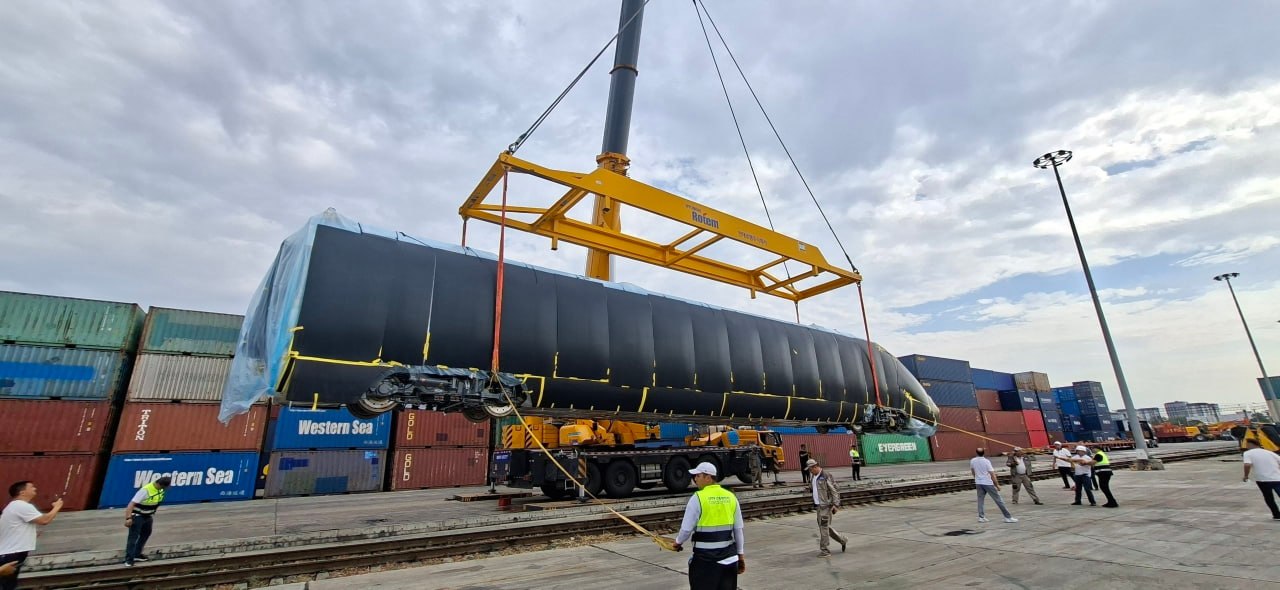

BAKU, Azerbaijan, June 22. Uzbekistan has received its third Hyundai Rotem high-speed passenger train as part of ongoing efforts to modernize the country’s railway infrastructure and improve transportation services.
This was reflected in the statement by the Ministry of Transport of Uzbekistan.
The train, manufactured by South Korea’s Hyundai Rotem, was delivered by Temiryulkargo JSC, Uzbekistan’s rail freight and logistics operator.
"The train was transported via the “South Korea–China–Kazakhstan–Uzbekistan” multimodal transport corridor. During the implementation of the project, the capabilities of maritime, road, and rail transport were integrated into a single logistics chain." the ministry noted in the statement.
The shipment was transported via a multimodal corridor linking South Korea, China, Kazakhstan and Uzbekistan. The delivery combined maritime, road and rail transportation into a single logistics chain to ensure the train’s arrival at its final destination.
Temiryulkargo organized the shipment on a door-to-door basis, overseeing the transportation process from the manufacturing facility in South Korea to Uzbekistan.
The arrival of the third high-speed train marks another step in Uzbekistan’s railway modernization program, which aims to enhance passenger services, expand transport capacity and support the development of domestic tourism.
Uzbekistan has been investing in new rolling stock and infrastructure upgrades as demand for fast and efficient rail transportation continues to grow across the country.
According to Temiryulkargo, the delivery formed part of a complex intercontinental logistics operation requiring specialized transport equipment, coordinated customs and insurance procedures, and advanced handling technologies for oversized rail cars. The company developed a dedicated South Korea–China–Kazakhstan–Uzbekistan transit corridor, integrating sea, road and rail transportation into a single multimodal supply chain. The arrival of the new train is expected to support Uzbekistan's railway modernization efforts, improve passenger services and contribute to the development of domestic tourism.



