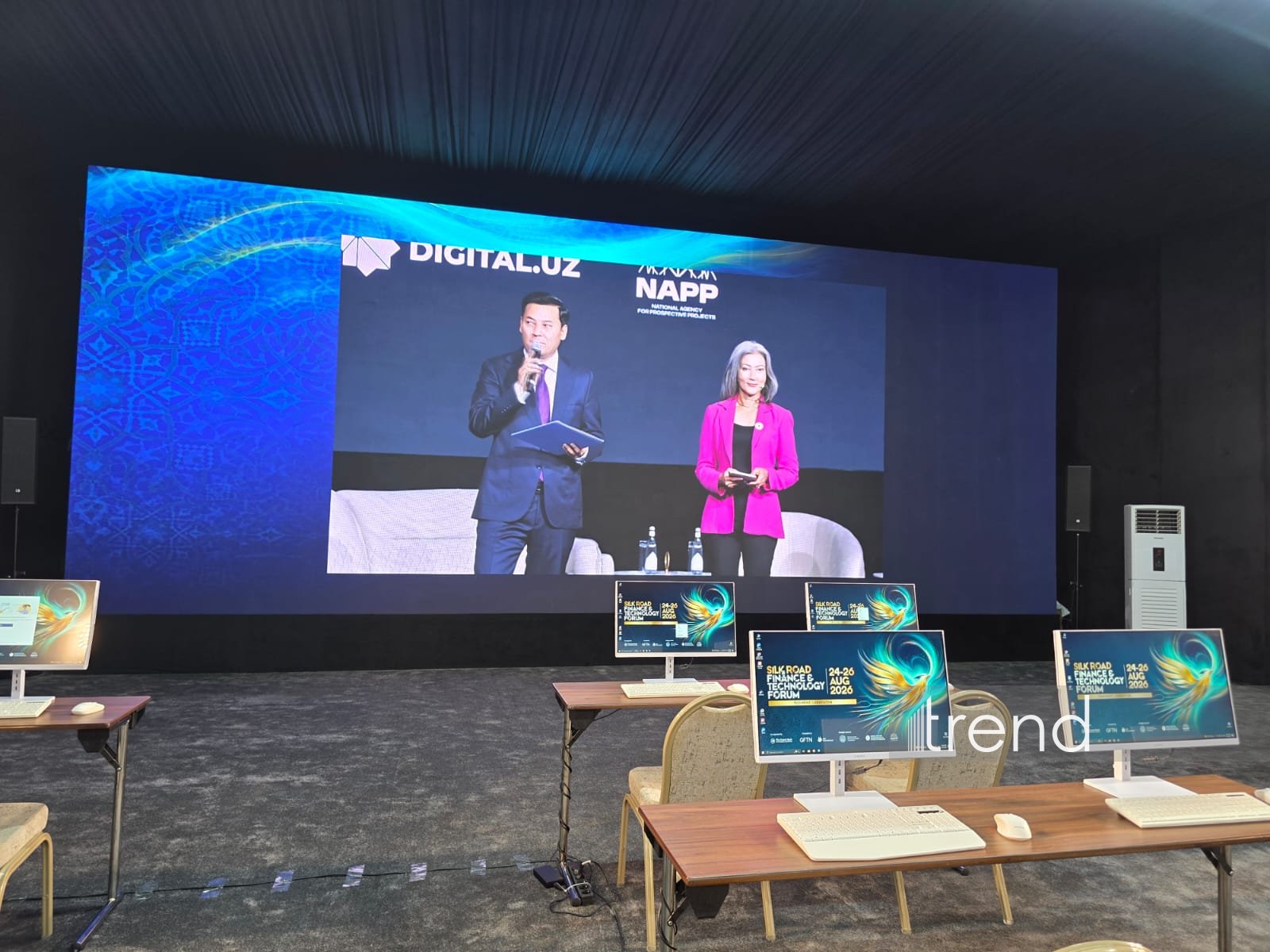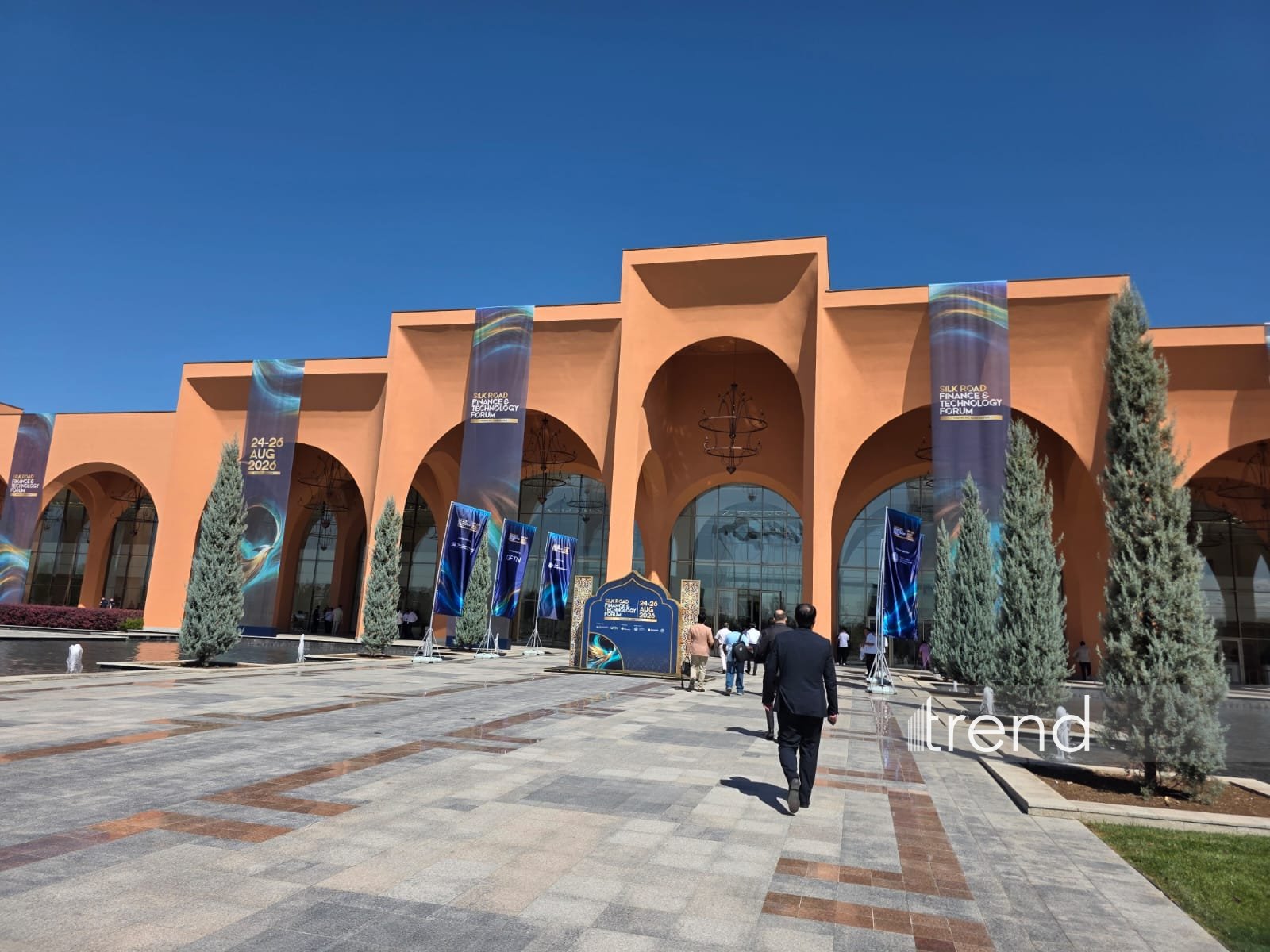

TASHKENT, Uzbekistan, August 25. The second day of the Silk Road Finance & Technology Forum has concluded in Tashkent, Trend's special correspondent reports.
The second day of this large-scale event was devoted to the practical implementation of digital currencies, the development of cross-border fintech corridors, and the promotion of investment cooperation in the Great Silk Road region.
The forum was organized by the Central Bank of the Republic of Uzbekistan in collaboration with the Singapore-based Global Finance & Technology Network (GFTN).
The event brought together over 6,000 participants and about 200 speakers from 74 countries, including heads of regulatory agencies, representatives of relevant ministries, international financial institutions, and investors with a combined total of more than $4 billion in assets under management.
During the key sessions on the second day, delegates and experts discussed practical steps for transitioning from traditional banking to digital financial ecosystems, the development of open banking, and the regulatory frameworks for stablecoins and central bank digital currencies (CBDCs).
Among the main topics were the launch by the Uzbek regulator of an updated international “regulatory sandbox” (Regulatory Sandbox 2.0), the implementation of venture capital programs, and legislative initiatives in the field of Islamic finance.
Forum participants paid special attention to cybersecurity and personal data protection amid the active adoption of artificial intelligence in the financial sector, as well as to creating a favorable environment for attracting international technology startups.
Speaking at the event, Rajesh Sabari, Chief Commercial Officer of Liminal Custody, noted that blockchain can help address cross-border liquidity issues, increase the mobility of collateral assets, and expand access to financing for small and medium-sized businesses in emerging markets.
According to him, small and medium-sized businesses, as well as the B2B segment, face primarily constraints related to compliance and anti-money laundering (AML) requirements. “With the emergence of regulated stablecoin issuers and fully reserve-backed instruments, such as Circle, we are seeing growing interest. However, the ‘last-mile’ problem in terms of cross-border liquidity in emerging markets has not yet been fully resolved,” Sabari said.
He noted that the stated fee for a cross-border transaction may reflect only the cost of services in the local market, whereas it is necessary to account for costs at all stages of the transaction.
According to Sabari, liquidity solutions are designed to address this issue precisely. When working with regulated payment service providers, the transaction chain must incorporate pre-transaction verification, sanctions screening, AML controls, and compliance with the Travel Rule.
He identified institutional participants—including banks, financial institutions, traditional trusts, and capital market players—as another area of focus.
According to him, for this category of participants, the primary use case for blockchain may not be cross-border payments, but rather increasing the liquidity of collateralized assets. “From the perspective of a CFO or treasurer, a significant amount of capital is pre-funded and effectively locked up, which creates a need for greater liquidity of collateralized assets,” Sabari noted.
He added that blockchain could increase the mobility of such assets. In particular, tokenized debt instruments can be transferred more quickly and utilized through programmable logic.
Sabari identified lending to small and medium-sized businesses in emerging markets as another potential area of focus, particularly providing foreign institutional investors with access to such assets. “Entering these markets often involves significant administrative barriers. This does not mean that blockchain immediately eliminates all liquidity issues. However, it simplifies the process of posting identification and other necessary data on the network, helping to reduce the risk premium that institutional investors factor into foreign assets,” he said.
According to Sabari, Liminal Custody is also working on transferring control mechanisms familiar to institutional participants to the blockchain, including the management of whitelists of permitted assets and addresses, key management, and asset segregation. “The goal is to create an infrastructure on the network comparable to the one within which they operate under a banking license or a payment service provider license,” Sabari concluded.
Mirzabek Bobojanov, head of the CERT-CBU division at the Cybersecurity Center of the Central Bank of Uzbekistan, announced that the Central Bank of Uzbekistan plans to implement a new system next year to assess the maturity level and cyber risks of financial institutions.
According to him, the new system will differ from current regulatory requirements and will allow the Central Bank to assess financial institutions based on their individual levels of cyber risk and maturity. “We have developed a new cybersecurity system that we will launch and implement next year. It will be completely different from regulatory requirements,” Bobozhanov said.
He noted that the new system will include four levels of cybersecurity maturity. “A systemically important bank will have to comply with the most stringent requirements. A bank with fewer customers and a lower level of digitalization will be subject to less stringent requirements,” he explained.
According to Bobojanov, this approach will allow the regulator to focus its resources on organizations with the most significant cyber and fraud risks. “We cannot cover all organizations and audit each one. Therefore, our approach will be more focused on risk level and maturity,” he noted.
He added that prior to the assessment, the regulator will request the necessary documents and information from financial institutions regarding their cybersecurity systems and processes.
Afterward, organizations with lower performance indicators will become priority targets for Central Bank inspections.
Meanwhile, Vyacheslav Pak, First Deputy Director of the National Agency for Prospective Projects, stated that Uzbekistan is exploring new approaches to regulating stablecoins and tokenized securities, taking into account the specific characteristics of digital financial instruments and international experience.
According to him, the development of digital financial instruments requires an adaptation of existing regulatory approaches, as such instruments can significantly accelerate the flow of value. “We cannot use traditional financial instrument regulations and apply them to stablecoins, as they operate on a completely different basis,” Pak said.
He noted that, unlike traditional payments, which can take several days or even a week, transactions involving digital assets can be completed in seconds or minutes.
According to Pak, when developing appropriate regulations, it is necessary to consider issues related to anti-money laundering (AML), monetary policy, the integration of stablecoins into the traditional banking system, and their reflection in monetary statistics. “We need to understand how to manage these risks from the perspective of AML and monetary policy—for example, how to integrate stablecoins into the traditional banking system and how to reflect them in monetary statistics,” he noted.
Speaking about the tokenization of securities, Pak noted that international experience in this area is still evolving, which creates opportunities for developing various regulatory approaches. “When we began studying international experience, we found that there are no established practical models in this area yet. I don’t think there is currently any country in the world with a fully regulated market for the tokenization of securities,” he said.
According to him, one possible approach could be the creation of a digital counterpart to a traditional stock or bond. At the same time, the issuance of tokenized securities requires the establishment of rules for accounting, payments, and the exercise of holders’ rights.
Park separately highlighted issues related to tokenized stocks, including ensuring shareholders’ rights to participate in voting and corporate governance. “There are many important issues, and I think that platforms like this one are precisely trying to find new solutions and figure out how to quickly establish new regulations,” Park concluded.
The forum will resume on August 26.