


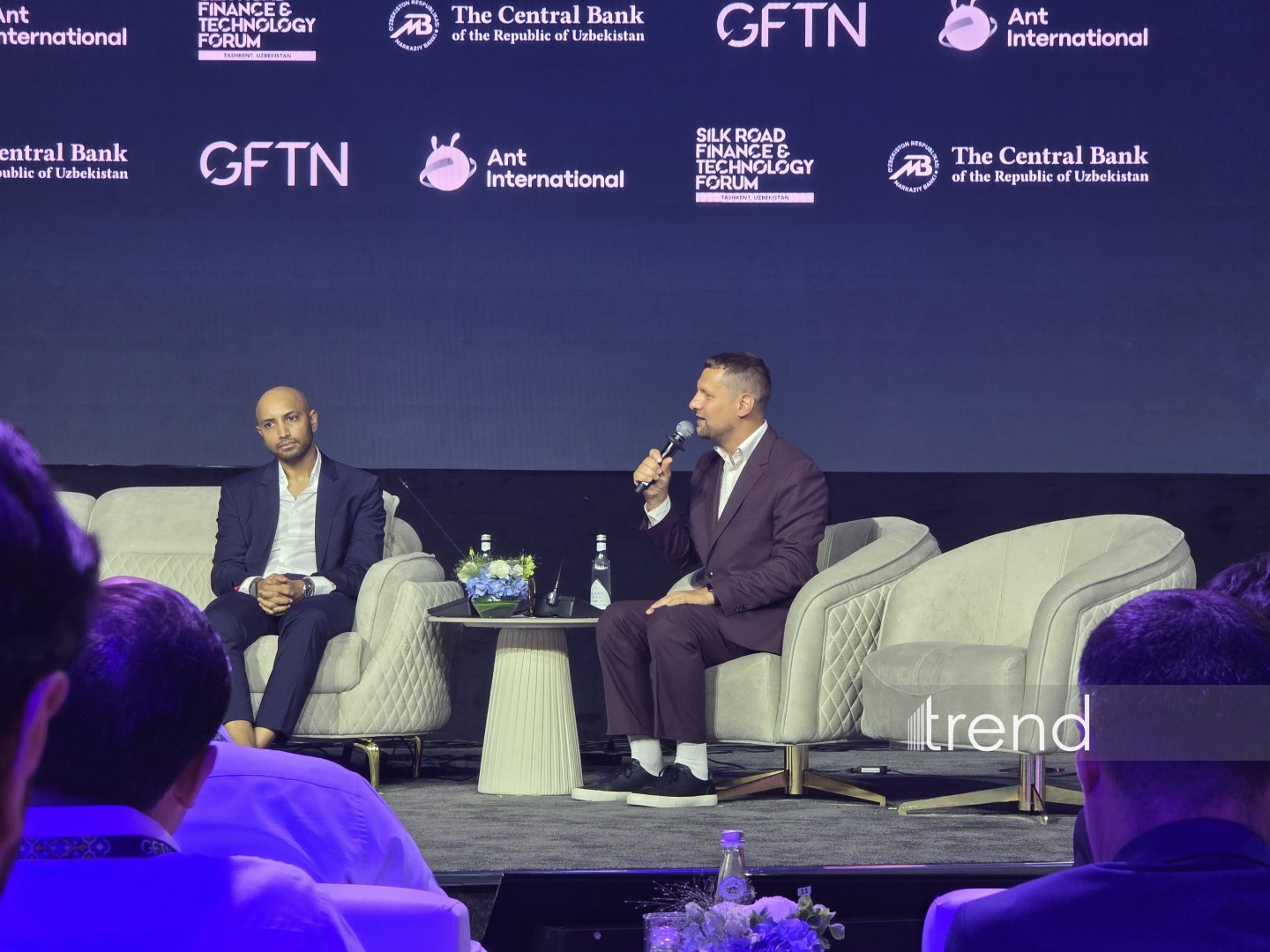

TASHKENT, Uzbekistan, August 24. Financial institutions need to strengthen fraud prevention while ensuring that security measures do not undermine the customer experience, Yevgen Lisnyak, Vice President and Head of Strategic Partnerships, Fintech, Acquiring & Merchants for the CISSEE region at Visa, said, Trend’s special correspondent reports from Tashkent.
He made the remark while speaking at the Silk Road Finance & Technology Forum.
According to Lisnyak, fraudsters are constantly adapting to technological developments and new security measures, making fraud prevention an ongoing process that requires both awareness and proactive action. “The turning point, and where we need to pay attention always, is to be informed and to be aware of what's going on with them, to be able to protect from them. This is first of all some kind of preemption. And the second is, of course, proaction,” Lisnyak said.
He noted that proactive protection requires financial institutions to maintain robust anti-money laundering (AML) and know-your-customer (KYC) systems. At the same time, he stressed the importance of avoiding excessive security barriers that could make digital financial services unnecessarily complicated for customers. “If we build too many walls, people will not go through it. And this is also this challenging task — to be secured from one way, but also keeping the customer experience smooth and seamless from the other side,” he said.
Lisnyak said Visa works with its partners to address both aspects, using technologies including artificial intelligence to identify and anticipate fraudulent activity.
He noted that information on fraud attempts detected in different markets can be used to help protect financial institutions in other countries. “We collect all the fraud attempts across the world and actually bring it here to Uzbekistan and say, ‘Hey guys, there is in Colombia such type of fraudsters who is trying to cheat you. Here is the rule that will protect you,’” he said.
According to Lisnyak, the global scale of payment networks allows information about emerging fraud patterns to be shared across markets, helping local financial institutions strengthen their defenses.
At the same time, he emphasized that not all fraud results from weaknesses in technological security, with social engineering and human behavior also playing a significant role. “Plenty of frauds happen not with broken security level, but because of social engineering, just because of people,” Lisnyak said.
In this regard, he highlighted the importance of financial literacy initiatives and cooperation with regulators and central banks.
He said Visa has been working with the Central Bank of Uzbekistan and other partners on financial literacy programs, noting that educating consumers can serve as an additional layer of protection against fraud. “We believe that we need to work on this layer too,” Lisnyak said.



