


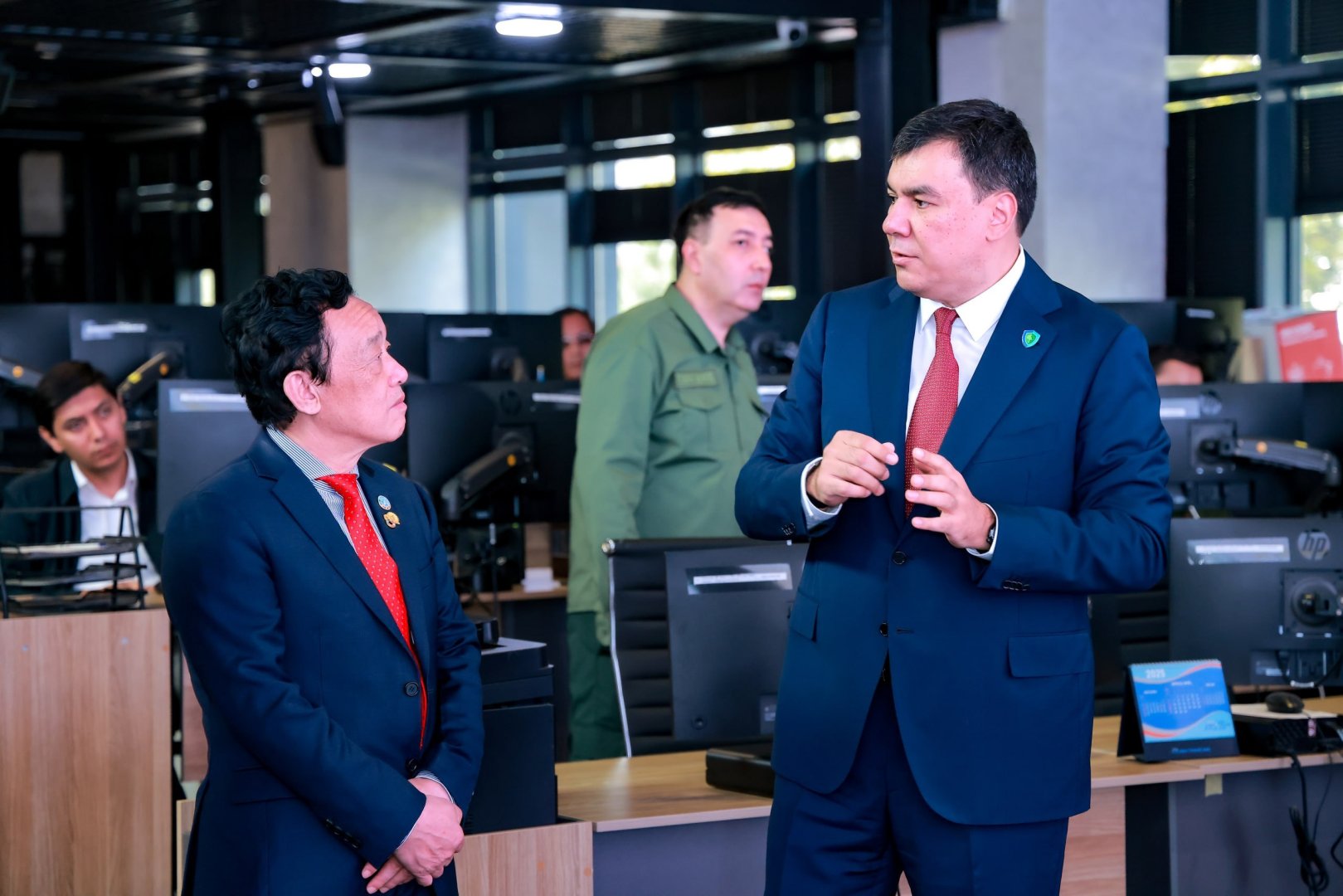

BAKU, Azerbaijan, October 9. Uzbekistan and the Food and Agriculture Organization of the United Nations (FAO) agreed to advance projects on land restoration, water management, desertification control and sustainable urban development during a meeting in Samarkand on Oct. 7.
This was reflected in the statement by the National Committee on Ecology and Climate Change of Uzbekistan, following a meeting between Committee Chairman Aziz Abduhakimov and FAO Director-General Qu Dongyu to discuss expanding cooperation on environmental protection, climate financing, forest restoration, soil conservation and chemical safety.
"Aziz Abduhakimov stressed the need to move from political initiatives and agreements to concrete projects with clear timelines, financing sources and measurable results," the statement said.
A key focus of the meeting was the Green Shield of Central Asia initiative, which aims to establish regional protective forest belts and green barriers to combat land degradation, desertification and sand and dust storms. The parties discussed developing a regional project with defined priority areas, performance indicators and financing mechanisms.
Uzbekistan’s cooperation with FAO currently includes more than 10 projects with total grant funding exceeding $33 million. These include a €3.9 million FAO-European Union project on the sound management of hazardous chemicals. Tashkent and Samarkand have also joined the FAO Green Cities Network.
Additionally, the sides discussed developing the Regional Research Institute for Combating Desertification and Developing Desert Economies at Green University, preparations for the United Nations Decade on Afforestation and Reforestation for 2027–2036, and the Central Asia Water and Land Nexus (CAWLN) regional program.
To strengthen regional coordination, the Uzbek side proposed considering the establishment of a CAWLN program office at Green University in Tashkent.
Another priority was developing Samarkand as a pilot green and sustainable city for Central Asia. Proposed measures include establishing microforests and small botanical gardens in residential neighborhoods, expanding water-efficient urban greening, and using mulching and other nature-based solutions that could be replicated in other cities.
Qu Dongyu shared China’s experience in forest restoration, combating land degradation and improving water-use efficiency. Uzbekistan also expressed interest in approaches used in China’s Xinjiang Uyghur Autonomous Region to restore arid areas. The FAO chief emphasized the importance of maintaining healthy, fertile soils for sustainable agriculture and the restoration of degraded land.
Moreover, the meeting covered workforce development for the green transition, pesticide and chemical safety, and preparations for a major climate project in Karakalpakstan.
The parties agreed to continue developing a pipeline of projects aimed at attracting international climate financing, including funding from the Green Climate Fund, the Global Environment Facility and other mechanisms.
Abduhakimov also invited the FAO director-general to attend Eco Expo Central Asia 2027 in Tashkent, which will take place as part of the Tashkent International Investment Forum. Uzbekistan proposed considering an FAO pavilion to showcase advanced solutions and joint projects across the country and Central Asia.
The discussions reflect Uzbekistan’s efforts to turn regional environmental initiatives into projects with defined implementation plans and financing arrangements, particularly in areas affected by desertification, water stress and land degradation.



