


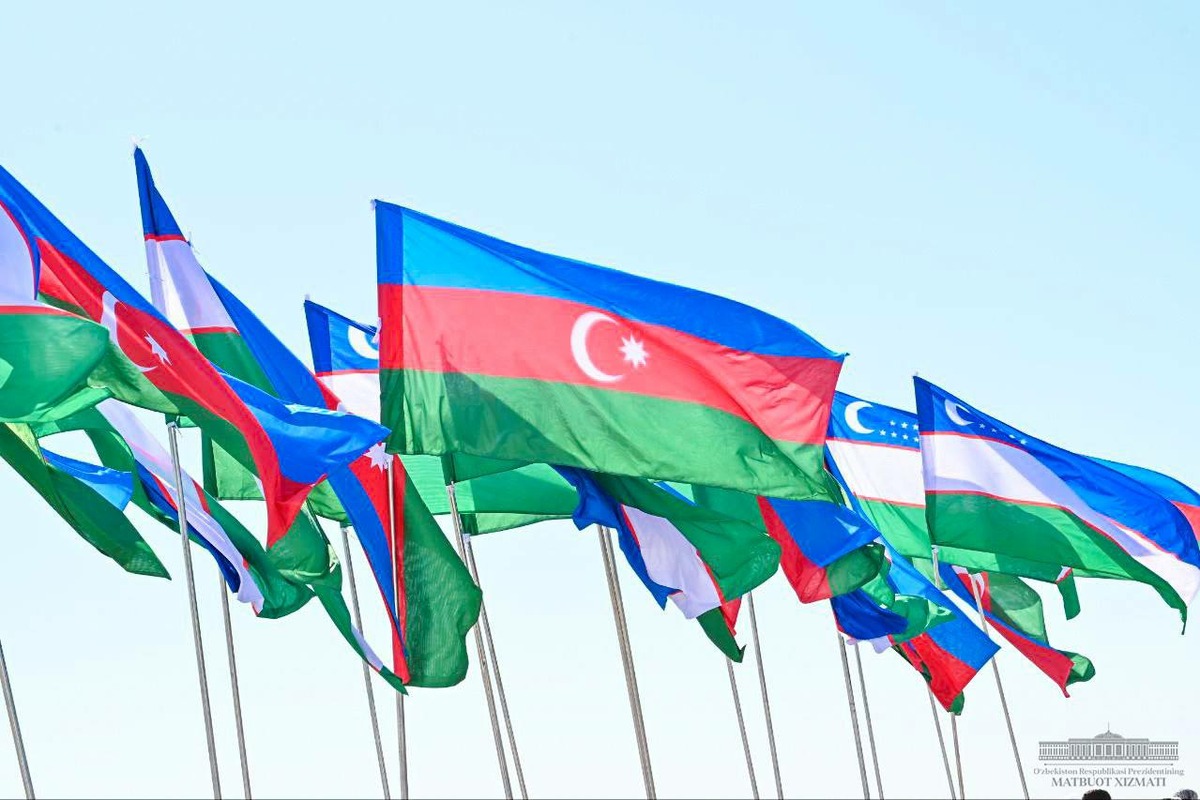

BAKU, Azerbaijan, October 8. Uzbekistan sees Azerbaijan’s participation in the Consultative Meetings of the Heads of State of Central Asia as creating a basis for a unified transport space across Eurasia.
The Uzbek Foreign Ministry provided the assessment in an exclusive interview with Trend ahead of the meeting of the Council of Foreign Ministers of the Commonwealth of Independent States (CIS), addressing environmental challenges in the Caspian region, regional cooperation and Uzbekistan's ties with Azerbaijan.
“The accession of Azerbaijan to the Consultative Meetings of the Heads of State of Central Asia creates a basis for a unified transport space in the Eurasian region,” the ministry said.
Caspian Sea decline
Uzbekistan is closely monitoring changes in the environmental situation in the Caspian Sea, according to the ministry.
"Uzbekistan is following the changes in the environmental situation in the Caspian Sea with serious concern," it said.
According to the UN Environment Programme (UNEP), the sea level has declined by about two meters since the 1990s, while forecasts allow for a further decline of 8-21 meters.
Studies by the Institute of Oceanology of the Russian Academy of Sciences, the Geophysical Center of the Russian Academy of Sciences and Tver State University, conducted with the participation of the Impuls NGO, found that the Caspian Sea level declined at an average rate of 8.2 centimeters per year in 2005-2019. The rate increased to 22.7 centimeters per year in 2020-2024.
The ministry also said that the area of the Caspian Sea has decreased by 7.4% over the past 30 years.
According to the ministry, the shallowing of the Caspian is driven by a combination of factors, including climate warming, increased evaporation and declining river inflows into the sea.
Uzbekistan said the trend could have serious consequences, including changes in the coastline, ecosystem degradation, threats to Caspian seal and sturgeon populations, a risk of dust storms from exposed seabeds, and increased pressure on coastal communities and the regional economy.
For Uzbekistan, the issue also has a direct economic dimension because the Trans-Caspian Transport Corridor carries part of the country's cargo traffic to Europe.
"The shallowing of the Caspian Sea limits the permissible draft of vessels and prevents them from being fully loaded, resulting in an average underloading of 35%," the ministry said.
"This reduces the carrying capacity of the fleet, increases the unit cost of cargo transportation and requires dredging and the extension of berths," it added.
Uzbekistan backs joint Caspian action
Uzbekistan supports Kazakhstan's initiative to develop an Interstate Program for the Conservation of the Caspian Sea's Water Resources, which was reflected in the outcome documents of the seventh session of the Conference of the Parties to the Tehran Convention held in Tehran in September 2026.
"In our view, priority attention in developing the program should be given to creating a unified system for monitoring the sea level, its water balance and the condition of ecosystems, with regular data exchange," the ministry said.
The program should also focus on joint scientific research and forecasting, reducing pollution and preserving biodiversity, according to Uzbekistan.
"Important areas also include adapting port infrastructure and shipping to changes in sea levels, attracting expertise from UN institutions and securing financial support from international financial institutions," the ministry said.
Uzbekistan also pointed to the "Central Asian Environmental Solidarity" declaration signed by the presidents of Uzbekistan, Kazakhstan, Kyrgyzstan, Tajikistan and Turkmenistan at a regional environmental summit in Astana on April 22, 2026.
The declaration highlights the need to protect major water bodies in the region, including the Caspian and Aral seas and Lake Issyk-Kul.
Uzbekistan, Azerbaijan prepare new environmental agreement
Uzbekistan and Azerbaijan are working on a new intergovernmental agreement on environmental cooperation and the creation of a joint working group, the ministry said.
"Environmental partnership between our countries is based on the Agreement on Cooperation in Environmental Protection concluded in 2008. Today, the sides are working on a new intergovernmental agreement and the establishment of a joint working group," it said.
The two countries have also been exchanging experience at international conferences, including within the CIS, the Economic Cooperation Organization (ECO) and the Organization of Turkic States (OTS).
"Special momentum was given to this work by the Conferences of the Parties to the UN Framework Convention on Climate Change, COP28 and COP29," the ministry said.
During COP29 in Baku, environment ministers from OTS member states signed a Declaration of Intent to strengthen coordination in the environmental sector.
The ministry also highlighted the Asian Development Bank's regional "Glaciers to Farms" program, launched with partners during COP29 to strengthen climate resilience and food security across Central Asia, the South Caucasus and Pakistan.
The program envisages mobilizing up to $3.5 billion for sustainable water management and agriculture, including improving irrigation efficiency, water storage and the rational allocation of water, watershed management and support for vulnerable communities.
The program is scheduled to run from 2026 through 2035 and is aimed at strengthening regional cooperation on climate change adaptation.
Another major development during COP29 was the signing by the presidents of Uzbekistan, Kazakhstan and Azerbaijan of an agreement on strategic partnership in the development and transmission of green energy.
Under the project, wind and solar energy will be exported, which "will allow for mitigating the impact on the climate," the Uzbek ministry said.
Youth engagement and environmental education have also become important areas of cooperation between Uzbekistan and Azerbaijan.
In June 2024, an International Youth Environmental Camp was held in Samarkand and Tashkent, bringing together environmental activists from Central Asian countries as well as representatives of Azerbaijan, Hungary and Türkiye.
The event focused on engaging young people in the climate agenda, exchanging experience and developing environmental initiatives. It resulted in the launch of the international volunteer network "Young Climate Champions" and a platform for promoting environmental awareness.
The cooperation continued with Azerbaijan's participation in the Samarkand Climate Forum on April 4-5, 2025.
Azerbaijan's special representative of the President for climate issues participated in the forum, while Azerbaijani youth activists took part in a special youth session titled "Youth: Optimistic About the Future."
"This contributed to expanding direct dialogue and exchange of experience between the two countries on climate change, environmental education and youth engagement in the implementation of climate initiatives," the ministry said.
Uzbekistan calls for stronger Caspian environmental mechanisms
Uzbekistan also highly values the existing legal framework for protecting the Caspian Sea, according to the ministry.
"Uzbekistan highly values the existing legal framework for the Caspian Sea. Its foundation is the Tehran Framework Convention for the Protection of the Marine Environment of the Caspian Sea, which this year marked 20 years since its entry into force," the ministry said.
Three protocols are currently in force under the convention: the Aktau Protocol on combating pollution from oil, which has been in force since 2016; the Moscow Protocol on protection from pollution from land-based sources, in force since 2023; and the Protocol on Environmental Impact Assessment in a Transboundary Context, which entered into force in November 2025.
The ministry also highlighted agreements covering:
-
cooperation on security in the Caspian Sea;
-
cooperation in Caspian Sea hydrometeorology;
-
prevention and response to emergencies in the Caspian Sea;
-
conservation and rational use of aquatic biological resources;
-
transport cooperation among the Caspian littoral states;
-
trade and economic cooperation among the Caspian littoral states.
"Although Uzbekistan is not a Caspian littoral state, it respects the key role of the Caspian countries in this area. At the same time, the shallowing of the sea is a challenge of a new scale that requires further development of these mechanisms," the ministry said.
According to Uzbekistan, the effectiveness of regional cooperation could be improved through the full implementation of existing agreements and by discussing the Caspian agenda on multilateral platforms.
"Improving the effectiveness of cooperation would be facilitated by the full implementation of the above-mentioned agreements, as well as discussion of this agenda on multilateral platforms, including with the involvement of the United Nations and international financial institutions," the ministry said.
Uzbekistan also said it could contribute to these efforts through its experience in addressing environmental challenges in the Aral Sea.
"Uzbekistan, for its part, could contribute to this work, including through the exchange of scientific and practical experience accumulated in addressing the environmental problems of the Aral Sea," the ministry said.
Baku Port key link for Uzbek cargo
Uzbekistan also sees significant potential for expanding regional transport and economic connectivity with Azerbaijan.
Relations between the two countries, based on strategic partnership and alliance, are gaining practical momentum, according to the ministry.
"The relations of strategic partnership and alliance, enshrined in the Treaty on Allied Relations of August 23, 2024 and the Treaty of Eternal Friendship of August 23, 2026, are being filled with practical content," the ministry said.
Bilateral trade has tripled over the past five years, while the two countries have set a target of increasing trade turnover to $1 billion by 2030. A joint investment company with capital of $500 million is also operating between the two countries.
"Azerbaijan (the Port of Baku) is a key link of the Middle Corridor for Uzbek cargo," the ministry said.
Uzbek cargo transportation along the Middle Corridor doubled over five years to 1.2 million tons in 2025.
The corridor's share of Uzbekistan's freight turnover with the European Union has also more than doubled, rising from 12% in 2021 to 28% currently, according to the ministry.
"Priority areas of cooperation include the accelerated launch of a joint fleet in the Caspian Sea, the integration of the China-Kyrgyzstan-Uzbekistan railway with the Middle Corridor, and further digitalization of transportation through e-Permit, e-CMR and eTIR," the ministry said.
The ministry also highlighted Azerbaijan's participation in the Consultative Meetings of the Heads of State of Central Asia.
According to the Uzbek side, Azerbaijan's participation "creates a basis for a unified transport space across the Eurasian region."



