


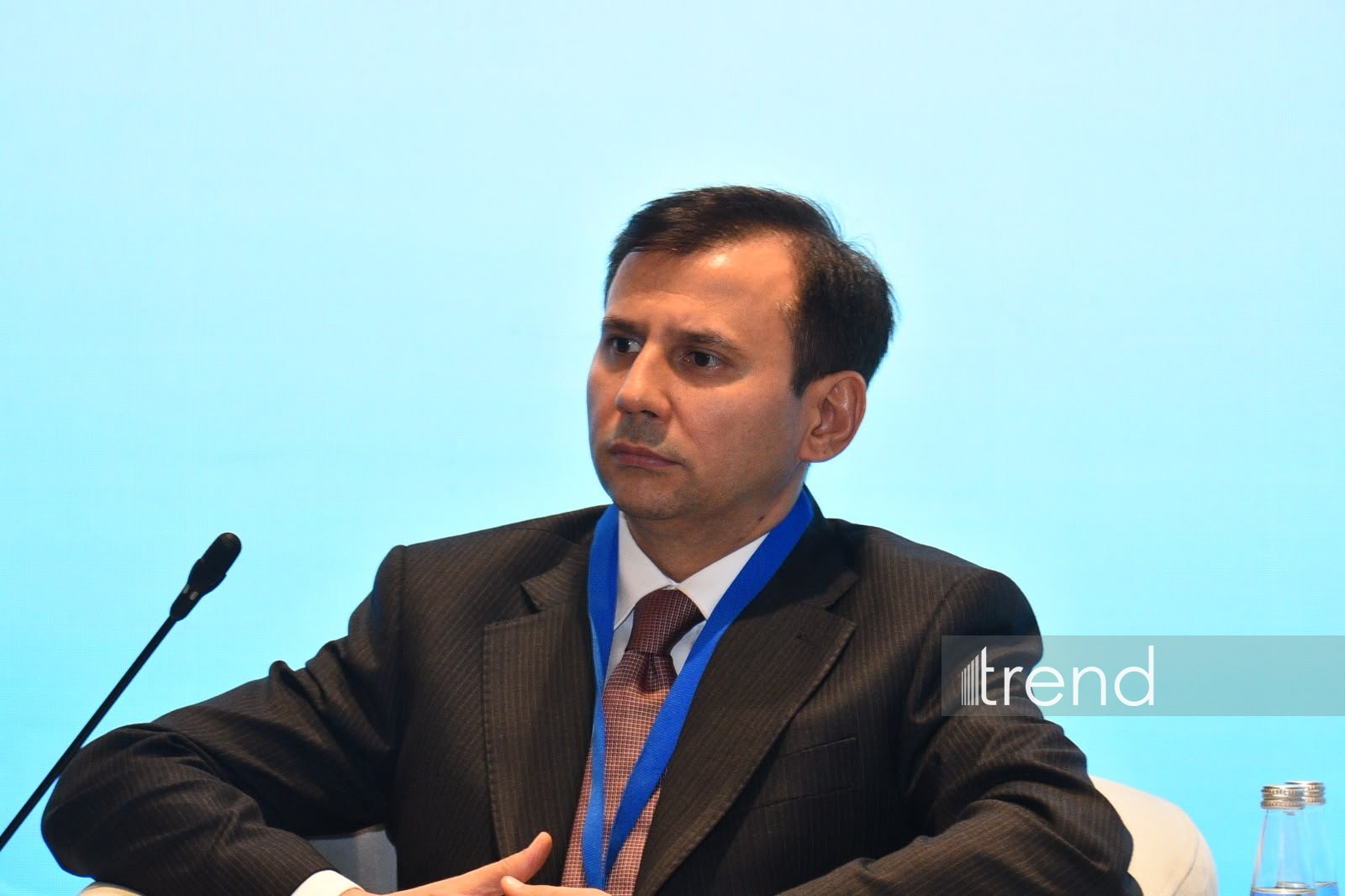

BAKU, Azerbaijan, November 23. Developing the Middle Corridor is one of the key priorities of Azerbaijan's national economic strategy, Fariz Aliyev, Head of the Transport Policy Department at Azerbaijan's Ministry of Digital Development and Transport, said at the Azerbaijan-Italy Business Forum in Baku on Monday, Trend's correspondent reports.
According to him, the country aims to transform the route from a transit corridor used solely for cargo transportation into an integrated economic corridor that generates high added value.
He added that developing the Middle Corridor is among the priorities of Azerbaijan's state policy, and the process is not limited to the efforts of a single ministry or institution. All relevant government agencies have been mobilized to help Azerbaijan become one of Eurasia's leading logistics and industrial hubs.
Fariz Aliyev said that amid major changes in global supply chains, the Middle Corridor has evolved from an alternative route into a strategically important, faster, more diversified and resilient transport link between Asia and Europe.
He noted that the World Bank's latest assessment of the Trans-Caspian International Transport Route (TITR) also confirms the corridor's significant potential. Coordinated investment and trade facilitation measures could more than triple trade volumes along the route by 2040 while significantly reducing transit times.
"The key question is no longer whether the Middle Corridor has potential, but how to improve its quality," he emphasized.
According to the ministry official, Azerbaijan's approach to the Middle Corridor no longer considers transit cargo volumes the sole measure of success. The main objective is to generate additional economic value at different stages of the supply chain for both Azerbaijan and its international partners.
"Our goal is not simply to transport cargo. It is to receive cargo, process it, add industrial and logistics value, and then export finished products to regional and international markets," Fariz Aliyev said.
He added that implementing this strategy requires sustained strategic investment in railways, highways, port infrastructure and the Caspian Sea fleet.
Aliyev also noted that Azerbaijan has a comprehensive and concrete action plan for developing the country's transit potential in 2027–2030. According to him, the plan covers infrastructure development, capacity expansion, fleet enlargement, improvements to the legal framework, alignment with international standards and harmonization of procedures with corridor partners.
He said that synchronizing development among participating countries and strengthening coordination mechanisms are also essential for the efficient operation of the Middle Corridor.
"A joint venture involving corridor participants has already been established at the corporate level in this regard. In addition, an intergovernmental committee on the Middle Corridor has been set up. Its main purpose is to ensure faster and more efficient decision-making along the route," he said.
The ministry official described digitalization as one of the key pillars of Azerbaijan's transit strategy and broader state policy. He recalled that Azerbaijan had improved its position in the United Nations Department of Economic and Social Affairs (UN DESA) E-Government Development Index, rising from 74th to 38th place.
Fariz Aliyev emphasized that this progress reflects significant advances in e-government services, digital solutions and digitalization in the transport and logistics sectors.
According to him, the adoption of digital technologies, infrastructure modernization and stronger coordination among participating countries will help increase the Middle Corridor's competitiveness and strengthen Azerbaijan's position in the Eurasian transport and logistics system.


