


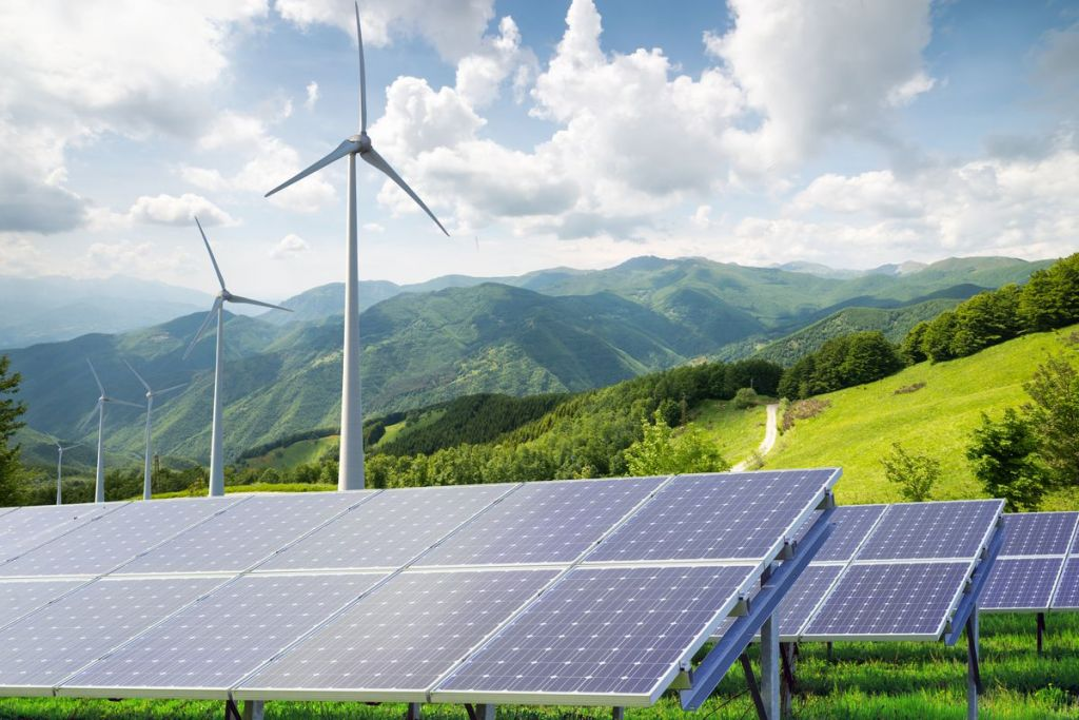

BAKU, Azerbaijan, August 24. Kazakhstan’s renewable energy sector is expanding rapidly, with the share of renewables in the country’s electricity mix approaching 8% as new wind and solar capacity comes online and grid infrastructure is upgraded.
This was stated by the Ministry of Energy of the Republic of Kazakhstan.
According to the Ministry, over the past six years, the share of electricity generated from renewable energy sources (RES) has increased fourfold, from around 2% to nearly 8%.
The Ministry notes that RES accounted for 7% of total electricity generation at the end of 2025, producing 8.6 billion kWh out of approximately 123.1 billion kWh generated nationwide. With additional capacity commissioned in 2026, the current share is approaching 8%.
The expansion has been supported by government policy measures, renewable energy auctions, investment attraction, and the commissioning of new generating capacity. Kazakhstan currently has 172 RES facilities with a combined capacity of more than 3.8 GW. The portfolio includes 71 wind farms, 54 solar power plants, 44 hydropower plants and three biogas facilities.
In 2025, renewable facilities generated 8.6 billion kWh, equivalent to approximately 8.6 TWh and around 7% of Kazakhstan’s total electricity generation. During the year, nine new RES facilities with a combined capacity of 503.5 MW were commissioned. These included five wind farms totaling 387 MW, three solar plants totaling 90 MW, and one hydropower plant of 26 MW. The expansion has continued in 2026. Another 10 RES facilities with a total capacity of 245 MW are planned for launch, including four wind farms, five solar plants and one hydropower plant.
As of mid-August, seven facilities totaling 212 MW had already been commissioned, meaning approximately 87% of the planned 2026 capacity has entered operation. Renewable electricity generation is expected to reach 8.8 billion kWh by the end of the year.
The project pipeline extends considerably beyond these additions. Approximately 100 projects with a combined capacity of 3.6 GW are planned for implementation, while another 4 GW of large-scale RES projects are under development, including 1 GW of projects with energy storage systems. The growing volume of variable renewable generation is also increasing the importance of transmission infrastructure and energy storage.
In an exclusive interview with Trend, EBRD Director and Head of Energy Eurasia Sule Kılıc said the bank has mobilized 4.2 billion euros for Central Asia’s energy sector and financed more than 6.5 GW of installed renewable energy capacity in the region.
"We are the largest investors in renewable energy in Central Asia, having financed more than 6.5 gigawatts of installed renewable capacity to date and mobilised 4.2 billion euros for the region’s energy sector," Kılıc said.
According to her, the EBRD’s involvement goes beyond renewable generation to include modernization of electricity grids, which is necessary to integrate growing volumes of solar and wind power into national systems.
For Kazakhstan, the bank’s key partners include national grid operator KEGOC. Since the 1990s, the EBRD has supported seven KEGOC projects, most recently the Integration of the West Zone Project, which connects the previously isolated western power zone with the rest of the country through more than 600 kilometres of high-voltage transmission lines. Kılıc also said the EBRD is considering projects under Kazakhstan’s National Project for Modernisation of Electricity and Municipal Infrastructure.
A major new investment platform was launched in April 2026, when the EBRD and Kazakhstan signed a memorandum of understanding on the Just Energy Transition Investment Platform (QaJET). The platform is expected to mobilize up to 20 billion euros to deploy 10 GW of renewable capacity by 2035.
The first project under the platform is the 1-GW Mirny Wind project, developed by TotalEnergies and local partners. The project includes a 300-MW battery energy storage system with 600 MWh capacity. "The Bank mobilised around $550 million for the project. The inclusion of the battery storage component is a critical element in ensuring the sustainable integration of the project into Kazakhstan’s energy system," Kılıc said.
International companies are already playing a significant role in Kazakhstan’s renewable energy expansion, including TotalEnergies, China Power, Masdar and China Energy. Their participation is bringing additional capital and technologies into a sector where the development of generation capacity increasingly needs to be accompanied by investment in grids and storage.
Trend’s calculations show that the 212 MW of renewable capacity already commissioned in 2026 represents approximately 87% of the 245 MW planned for the full year. At the same time, the projected 8.8 billion kWh of renewable generation in 2026 would be about 2.3% higher than the 8.6 billion kWh generated in 2025. The combination of new generation, transmission upgrades, and storage is important for Kazakhstan’s longer-term energy targets. The country aims to increase the share of renewable energy to 15% by 2030 and up to 50% by 2050, including alternative energy sources.
The EBRD’s regional approach indicates that achieving these targets will depend not only on adding wind and solar capacity, but also on expanding the infrastructure needed to move and balance that electricity. For Kazakhstan, the parallel development of generation, high-voltage transmission and battery storage is therefore becoming a central part of the transition toward a more diversified power system.



