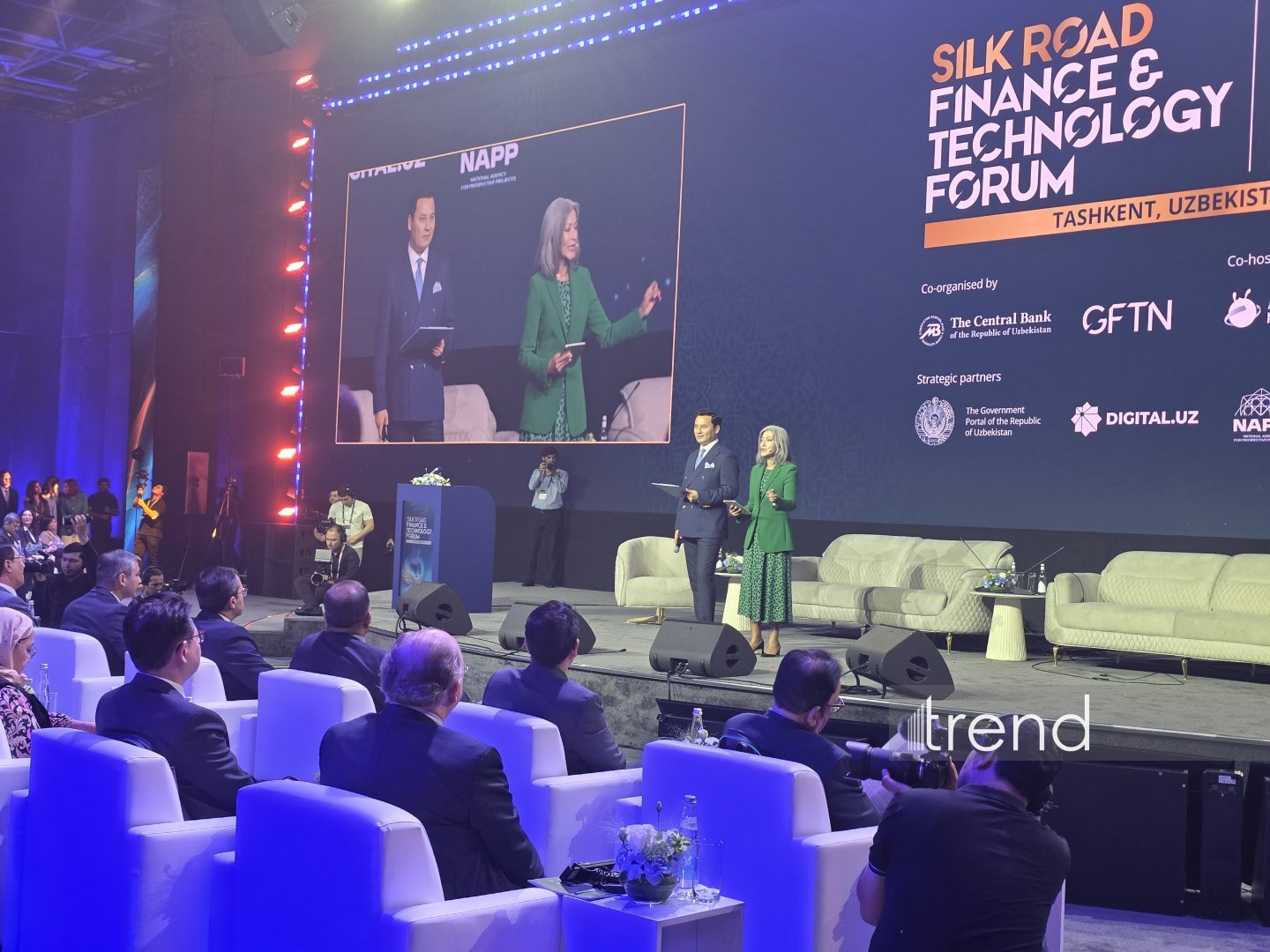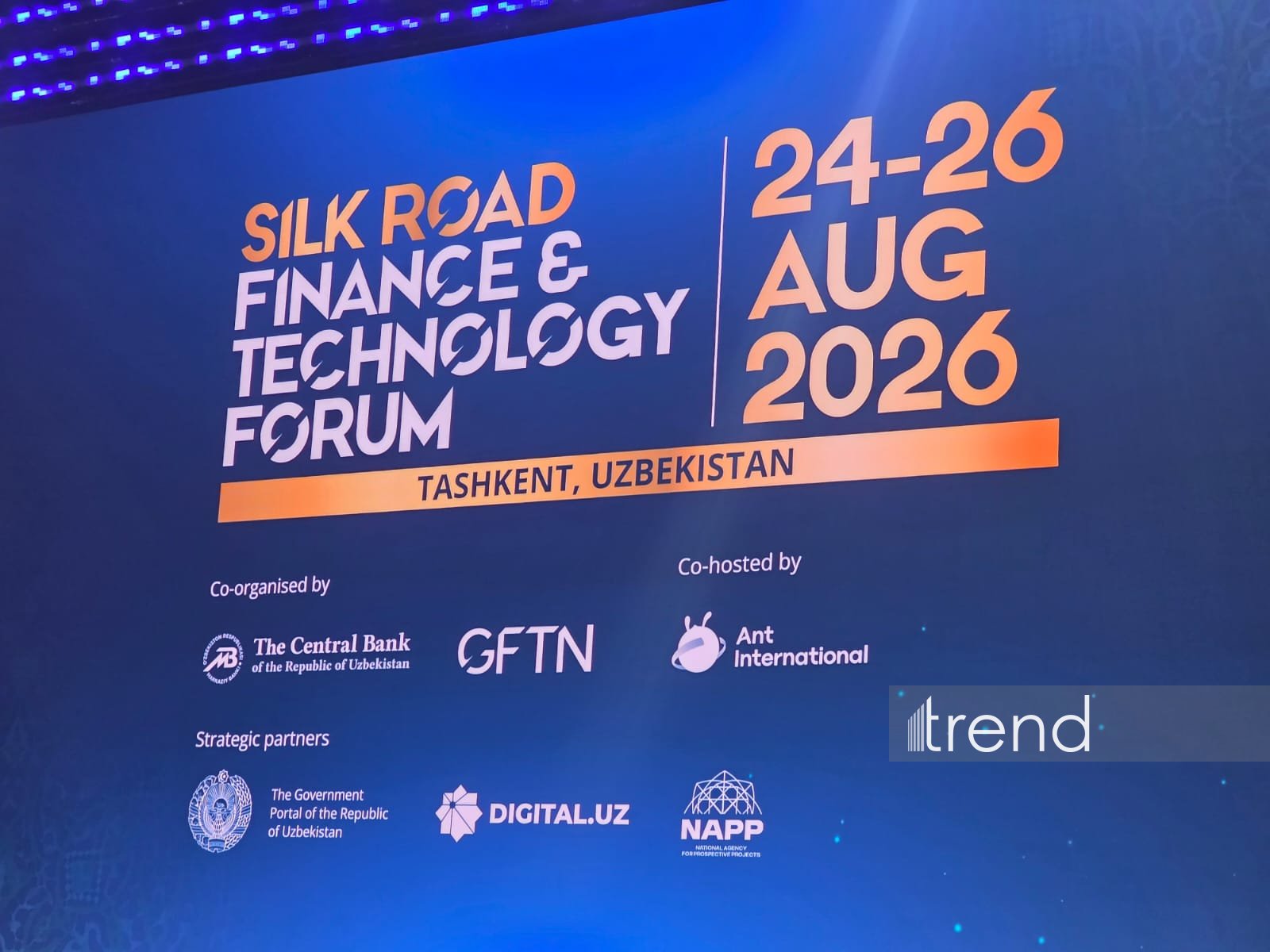

TASHKENT, Uzbekistan, August 24. The first day of Silk Road Finance & Technology Forum has concluded in Tashkent, focusing on the development of financial technologies, digital transformation, and capital market integration across the Great Silk Road region, Trend's special correspondent reports from Tashkent.
The event brought together heads of central banks, representatives of relevant ministries and agencies from Central Asia, the Caucasus, the Middle East, and Eastern Europe, as well as key global fintech industry players and leading international experts.
Among the participants were heads of major regional banks, top executives from international payment systems, venture fund managers, and representatives from the International Monetary Fund (IMF) and the World Bank.
In addition, developers of innovative artificial intelligence solutions for banking, cybersecurity specialists, investors, and representatives of startup ecosystems attended the forum.
Forum participants were discussing strategies to accelerate banking sector digitalization, introduce Central Bank Digital Currencies (CBDCs), expand cross-border payment systems, and broaden access to financial services for small and medium-sized enterprises.
Special attention has been paid to developing unified standards for regulating digital assets and strengthening regional cooperation in cybersecurity and data protection.
Furthermore, participants were focusing on attracting foreign direct investment into the region's technology sector, establishing favorable regulatory sandboxes for fintech startups, and driving joint initiatives for IT and finance talent development.
Speaking at the event, Uzbek Deputy Prime Minister and Minister of Economy and Finance Jamshid Kuchkarov said that Uzbekistan’s average annual GDP growth has remained at around 6–7%, while the size of the country’s economy has tripled from around $60 billion to $180 billion.
According to Kuchkarov, GDP per capita has also increased significantly, from approximately 4,600, bringing Uzbekistan into the group of upper-middle-income countries.
The deputy prime minister noted that Uzbekistan has also made significant progress in reducing inflation. After remaining in double digits several years ago, inflation has now declined to single-digit levels. “Inflation is expected to be around 6.5% this year, with the aim of reaching the 5% target next year,” he said.
Kuchkarov said that Uzbekistan has maintained external public debt at around 27% of GDP, while budget deficits have remained below 3% of GDP in recent years.
He also highlighted improving external assessments of Uzbekistan’s economy, noting that the country’s credit ratings have been upgraded by Fitch and other rating agencies, while foreign direct investment inflows have increased annually. “Going forward, we will take all necessary measures to bring inflation down to the target level, maintain fiscal discipline, and ensure prudent and sustainable public debt,” Kuchkarov said.
He stressed that the Uzbek government would take all necessary steps to ensure that Uzbekistan maintains a favorable and predictable environment for investors and market participants over the next decade. “We will work to achieve an investment-grade sovereign credit rating, complete Uzbekistan’s accession to the World Trade Organization, further reduce the state’s presence in the economy, and continue market-oriented reforms,” Kuchkarov said.
In turn, Governor of the Uzbek Central Bank Timur Ishmetov announced that Central Bank of Uzbekistan is launching a number of new initiatives to develop the country’s fintech ecosystem, including a Fintech Innovation Hub, a dedicated venture fund and a program to train 5,000 young people.
According to Ishmetov, the Fintech Innovation Hub will begin accepting its first cohort of residents in the fourth quarter of 2026. The hub will provide a pathway for fintech startups through incubation and acceleration, regulatory guidance and pilot testing to assess market readiness. “We have established a dedicated venture fund. We are discussing with experienced international fund managers while building a direct pipeline from the Innovation Hub to international scaling, with the aim of providing larger ticket sizes and attracting international co-investments,” Ishmetov said.
He noted that the Central Bank will also take its policies on payments, payment systems, open banking and operational resilience to the next level. The core framework, governance model and technical architecture are already in place, according to the governor. “This policy enhancement will make the financial system future-proof,” he said.
Another initiative will be a program to train 5,000 young people in fintech by 2028. The first cohort will begin training by the end of this year under a program being developed with the participation of universities in Singapore and GFTA, combining academic foundations with practical fintech skills.
Ishmetov also announced that Uzbekistan will publish a white paper on a central bank digital currency (CBDC) as part of its broader fintech framework. “The paper will address the assessment of potential use cases, design options, key trade-offs, and implications for the financial system,” he said.
The Central Bank governor stressed that the initiatives form part of a unified strategy focused on innovation, appropriate regulation, modern financial infrastructure, access to talent and capital, and positioning Uzbekistan as a gateway for fintech growth across Central Asia.
Sergio Mello, Global Head of Stablecoin Solutions at Anchorage Digital, said that stablecoins and traditional correspondent banking are not mutually exclusive and can be used together to improve the speed and efficiency of cross-border payments.
According to Mello, Anchorage Digital is developing solutions that allow foreign correspondent banks to use stablecoins alongside traditional correspondent accounts. “Stablecoins and correspondent banking are not on opposite ends of the spectrum. In fact, what we offer is a product called Stablecoin Correspondent Banking, which enables foreign correspondent banks to fund their correspondent accounts with stablecoins alongside traditional funds, having the benefit of both systems,” Mello said.
He noted that this approach allows banks to use the traditional banking system to settle dollars outside the US while benefiting from the speed of stablecoins.
According to Mello, stablecoins can also help address liquidity challenges and improve treasury management and payment operations.
He cited Anchorage Digital’s cooperation with Western Union and participating banks in its banking network as an example. According to Mello, the solutions enable real-time payouts, which were not possible through older infrastructure. “This doesn't mean that Western Union no longer partners with banks all over the world. In fact, what we're doing with Western Union and participating banks on our banking network is helping them do real-time, 24/7 payouts, something they couldn't do with an older system,” he said.
Mello stressed that financial technology should not be viewed as an alternative to the traditional banking system. “What I would recommend is not to look at the problem as mutually exclusive technology or growth, but technology with growth,” he concluded.
The forum will continue through August 25-26.