


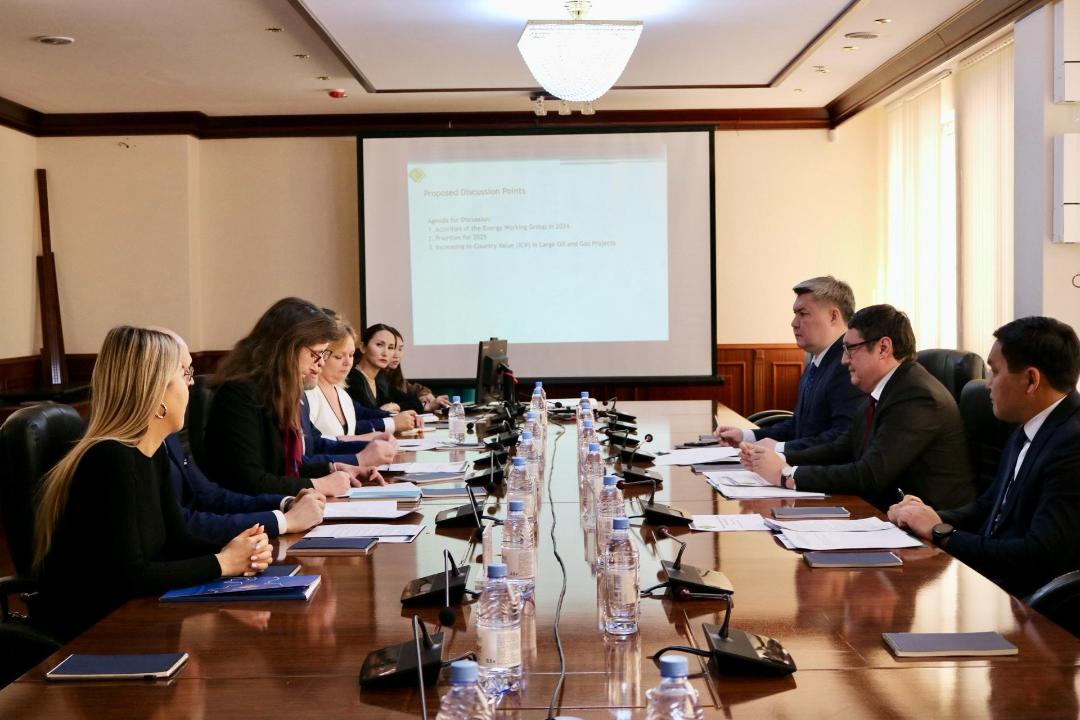

ASTANA, Kazakhstan, March 7. Kazakhstan's Minister of Energy, Almassadam Satkaliyev, discussed the optimization of oil production and the improvement of the investment climate during a meeting with foreign investors, Trend reports.
A meeting of the joint working group on energy, ecology, and the oil and gas industry of the Foreign Investors Council (FIC) under the President of Kazakhstan took place in Kazakhstan's capital, Astana. The meeting was chaired by Minister of Energy Almassadam Satkaliyev and Managing Director of ExxonMobil Kazakhstan Inc. and co-chair of the working group on energy, ecology, and the oil and gas industry from the foreign side, Ms. Cecile Rollin.
The meeting focused on summarizing the work done in 2024 and setting priorities for the current period. The parties discussed a wide range of issues, including the implementation of the 2024-2025 Plan aimed at improving the investment climate, ensuring environmental safety, and introducing advanced technologies in the energy and oil and gas sectors. Special attention was paid to the decarbonization of Kazakhstan’s economy, including reducing methane emissions.
In addition to the environmental agenda, the participants of the meeting thoroughly reviewed the parameters for optimal oil production volumes in Kazakhstan, taking into account the interests of both the state and investors, as well as the global market situation.
"Interaction with the Foreign Investors Council is strategically important for us. We highly value the open dialogue and constructive partnership, which allow us to jointly find effective solutions to the most complex issues. Today's meeting confirms our mutual interest in deepening cooperation and implementing the planned objectives," said Satkaliyev.
The participants also discussed issues related to the development of the new Water Code of Kazakhstan and the improvement of regulatory requirements for project and estimate documentation in line with international standards.
As part of further work together with foreign partners and relevant ministries, several important tasks will need to be addressed. Specifically, efforts will continue to optimize the regulation of technologically inevitable raw gas flaring, ensure an effective transition to comprehensive environmental permits, and implement the best available techniques. Special attention will be given to developing a comprehensive strategy to address the problem of falling water levels in the Ural River and the Caspian Sea, as well as studying international practices related to the carbon border adjustment mechanism (CBAM) and increasing the implementation of technical inspections, considering risk factors for pipelines.
Work on all areas outlined in the 2024-2025 Plan will continue in close collaboration with all stakeholders. Joint efforts will lead to significant progress in solving the set tasks and ensure the sustainable development of Kazakhstan's energy and environmental sectors.
The meeting also highlighted the significant progress Kazakhstan has made in reducing the volumes of associated gas flaring. Thanks to consistent government policies and the responsible stance of subsoil users, the volume of gas flared at flare installations decreased from 3.1 billion cubic meters in 2006 to 0.3 billion cubic meters in 2024.



