


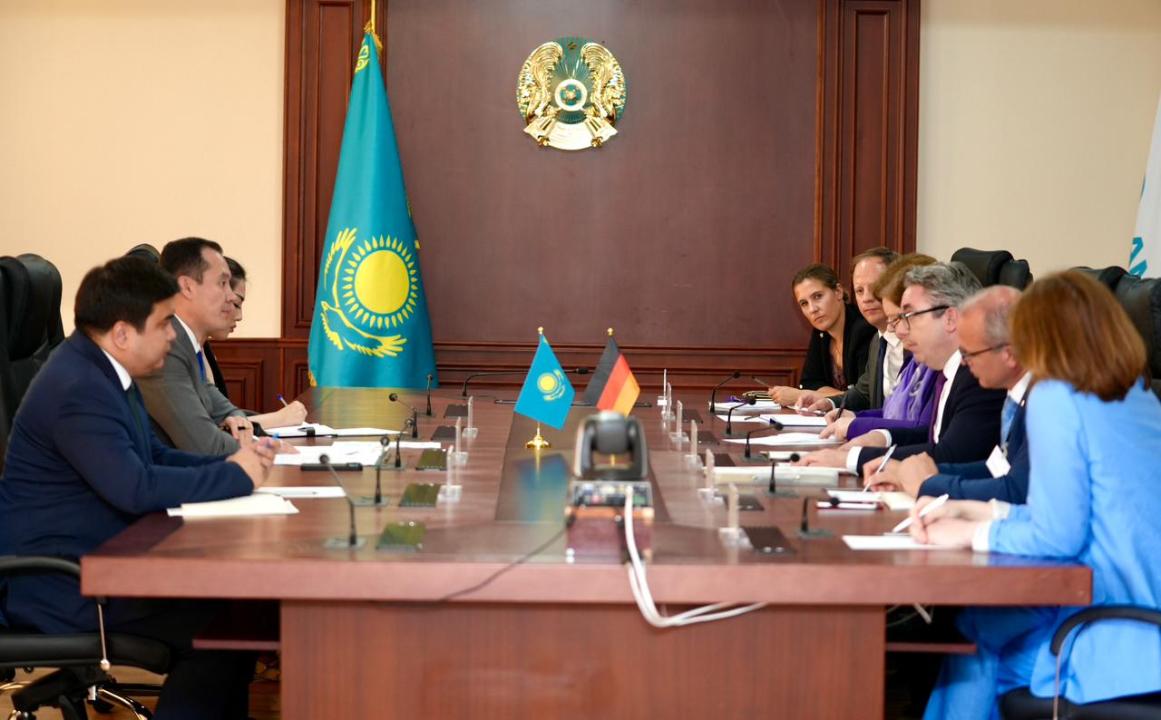

BAKU, Azerbaijan, June 16. Kazakhstan and Germany have discussed cooperation in the energy sector, including supplies of Kazakh oil to the German market.
This was announced by Kazakhstan's Ministry of Energy in a press release following a meeting between Vice Minister of Energy Sanzhar Zharkeshov and State Secretary of Germany's Federal Ministry for Economic Affairs and Energy Stefan Rouenhoff.
"Sanzhar Zharkeshov, Deputy Minister of Energy of the Republic of Kazakhstan, held a meeting with Stefan Runhoff, State Secretary of the Federal Ministry for Economic Affairs and Energy of the Federal Republic of Germany," the ministry said.
According to the ministry, particular attention was paid to cooperation in the oil industry, including the current status and prospects of Kazakh oil exports to Germany.
The sides emphasized the importance of maintaining the reliability of their energy partnership and exchanged views on global energy security and stable supplies to international energy markets, the report says.
The ministry noted that representatives of German business informed the Kazakh side about the interest of Koch Solutions in participating in projects at Kazakhstan's coal enterprises through the supply of technological solutions and equipment.
The parties also reaffirmed their mutual interest in advancing cooperation on green hydrogen projects, with Kazakhstan highlighting its readiness to implement relevant initiatives and the availability of necessary conditions for their development, the ministry outlined.
For reference, energy cooperation between Kazakhstan and Germany has intensified since 2023, when Kazakhstan began supplying crude oil to Germany via the Druzhba pipeline system. According to KazMunayGas, Kazakhstan exported 2.1 million tons of oil to Germany in 2025, with plans to increase supplies to 2.5 million tons in 2026. Kazakh crude is delivered primarily to the PCK refinery in Schwedt, which has become an important destination for Kazakhstan's exports to the European market. Alongside oil cooperation, Astana and Berlin have been advancing joint initiatives in renewable energy and green hydrogen, including the Hyrasia One project in western Kazakhstan.



