


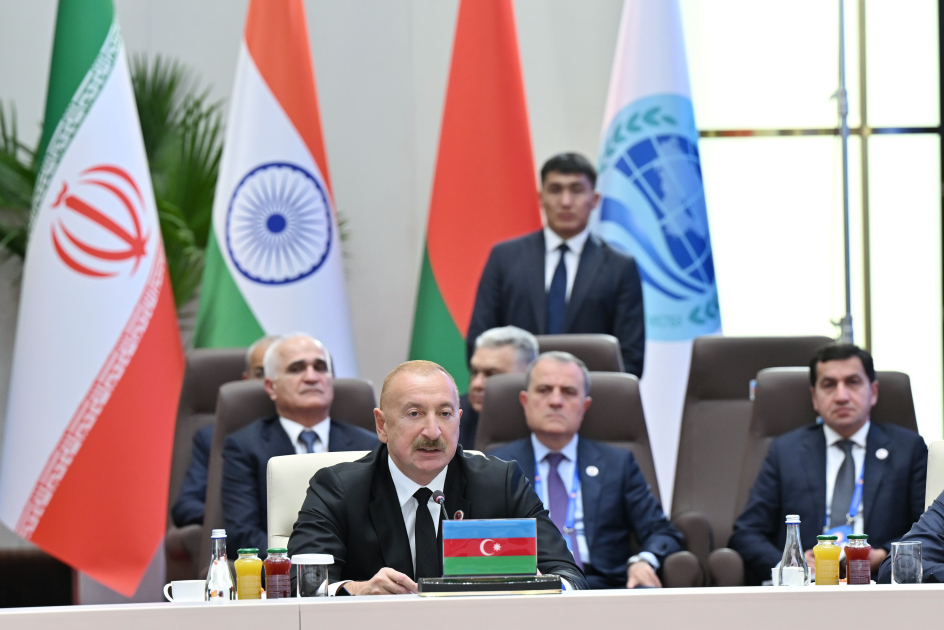

BAKU, Azerbaijan, September 1. The necessity of reforming the United Nations once again took center stage on the international agenda at the “SCO Plus” meeting in Bishkek. Against the backdrop of protracted conflicts, geopolitical tensions, and growing divisions within the UN Security Council, the question is being raised more and more frequently: to what extent is the existing system capable of effectively responding to contemporary challenges and ensuring the implementation of its own decisions?
One of the most striking examples of the limited effectiveness of the U.N. system was the failure to implement four Security Council resolutions adopted in 1993 in connection with the Armenian-Azerbaijani conflict. Although the resolutions called for a cessation of hostilities and the withdrawal of forces from Azerbaijan’s occupied territories, no effective mechanism for their implementation was established for decades.
Ultimately, the restoration of Azerbaijan’s territorial integrity and sovereignty was achieved by the state itself. It is precisely this experience that once again raises the fundamental question of what practical significance Security Council resolutions have if the international system lacks effective tools to ensure their implementation.
Speaking at a “SCO Plus” meeting in Bishkek, the capital of the Kyrgyz Republic, President Ilham Aliyev of the Republic of Azerbaijan emphasized that the development of appropriate mechanisms is required for the swift implementation of UN Security Council resolutions.

"A little over a year ago, Azerbaijan and Armenia initialed the text of the peace agreement, putting an end to a 30-year conflict. Thus, the South Caucasus region, which was a long-standing conflict zone, is becoming a zone of peace.
Four resolutions adopted by the UN Security Council in 1993 were implemented three years ago, 30 years later. Azerbaijan is already supplying petroleum products to Armenia and providing transit for third-country cargo. Together with Armenia, we are working to increase the volume of mutual trade, expand the range of goods, and create new overland transport links. However, unfortunately, the UN played no role in the implementation of these resolutions. Azerbaijan entirely restored its sovereignty and territorial integrity on its own. The development of appropriate mechanisms is required for the swift implementation of UN Security Council resolutions. If implemented, this would serve to enhance the UN's prestige and the organization's role in conflict resolution,” the head of state said.
However, the problem is by no means limited to a single conflict. The history of recent decades shows that the UN has repeatedly faced situations where the decisions it adopted proved insufficient to halt hostilities, protect the civilian population, or prevent humanitarian disasters.
One of the most tragic examples remains Rwanda in 1994, where the international community was unable to prevent the genocide despite the presence of a UN peacekeeping mission. Another symbol of the failure of the collective security system was Srebrenica in 1995, which the UN Security Council had declared a “safe area” but failed to protect from mass murder.
In Syria, the problem manifested itself in a different form – the paralysis of the Security Council amid deep divisions among its permanent members. The long-standing conflict has shown just how difficult it is for the UN to develop a unified international position when the interests of the major powers directly clash.
The challenges of peacekeeping have also repeatedly highlighted the limitations of the existing system. In South Sudan, the UN operation—initially focused on supporting the establishment of a new independent state and protecting the civilian population—faced a new round of civil war, forcing peacekeepers to concentrate not only on fulfilling their mandate but also on their own safety.
In Mali, the peacekeeping mission came under attack by extremist groups. In the Democratic Republic of the Congo, the long-standing UN operation faced the threat of collapse amid regional and local conflicts. In Darfur, the hybrid UN-African Union mission was also unable to fully implement its original peacekeeping mandate as the conflict reignited.
All these examples point to a single common problem: there is a significant gap between the scale of the tasks entrusted to the UN and the tools the organization has at its disposal to carry them out.
At the same time, the United Nations itself acknowledges the existence of systemic problems. A review of the implementation of UN mandates, prepared as part of the organization’s 2025 reform agenda, highlights overlapping mandates among various entities, insufficient coordination in their implementation, fragmentation of activities, a growing gap between mandates and available resources, and inconsistent mechanisms for reviewing mandates.
The document specifically notes that effective management of mandate implementation is of fundamental importance for achieving the goals of Member States. “Any shortcomings in this regard will hinder the achievement of Member States’ goals and ultimately lead to diminished results,” the review states.
The authors of the document also draw attention to the inefficient division of labor within the UN system. According to the review, existing processes and practices do not allow for a clear allocation of responsibilities among the organization’s entities. Coordination in the preparation of budgets and programs remains limited, and existing oversight mechanisms are largely focused on individual entities rather than on ensuring strategic coherence across the entire system.
The scale of the bureaucratic apparatus is also telling: within the UN Secretariat, departments cite nearly 4,000 sources of mandates as the basis for their proposed program budgets. At the same time, many units cite the same mandates, and about 50 references pertain to mandates that, according to the authors of the review, can be considered defunct.
The need for change is articulated even more directly in the UN80 Initiative’s Progress Report, published in May 2026.
The document describes the current state of affairs as “unacceptable.” The UN points out that the organization effectively faces two paths: “change through a thoughtful and measured reform process adopted by Member States in accordance with established procedures,” or change brought about by external pressure.
At the same time, the document emphasizes that inaction also carries serious risks: existing weaknesses will remain unresolved, and the system’s capabilities may gradually erode. “The status quo may seem like a comfort zone, but in the end, it may turn out to be more of a trap,” the report states.
Thus, the need for reform is now recognized not only by states that criticize certain aspects of the UN’s work, but also by the organization itself.
At a meeting in Bishkek, Kyrgyz President Sadyr Japarov stated that existing shortcomings in the work of the United Nations should not serve as a pretext for weakening its role or bypassing the organization. According to him, on the contrary, they underscore the need to work together to strengthen the UN, enhance its effectiveness, and improve its mechanisms in line with contemporary realities.
“Kyrgyzstan supports the reform of the United Nations, including its Security Council. Such reform must be carried out through broad consensus,” Japarov said.
Kazakh President Kassym-Jomart Tokayev also emphasized the need to strengthen the organization and enhance its effectiveness, noting that the UN must remain the core of the international system, and its Charter—the universal foundation of international law. According to him, amid acute geopolitical tensions, it is particularly important to preserve and strengthen the UN’s central coordinating role.
UN Secretary-General António Guterres, for his part, has repeatedly spoken of the need for international institutions to adapt to modern realities.
"Our relationships are changing, but multilateral organizations still largely reflect the realities of 1945. We must reform our multilateral institutions, including the United Nations and the Bretton Woods system, so that they reflect today’s realities and increase the representation and influence of developing countries in order to build a just world order,” he said.
Russian President Vladimir Putin also spoke of the need to improve the UN’s effectiveness, expand representation in its bodies—including the Security Council—to include countries from the Global South and East, and adapt the organization to fundamental changes in global politics and the economy.
Pakistani Prime Minister Shehbaz Sharif was even more unequivocal: “Today, the UN is in dire need of reform. It must become more accountable and more responsive.”
However, the issue is not merely one of expanding representation or redistributing seats on the Security Council. It concerns a more fundamental problem—whether the entire architecture of the international organization is aligned with the contemporary world order.
As Matthew Bryza, former U.S. ambassador to Azerbaijan, said in an interview with Trend, the most serious flaw with the United Nations is its original design, based on the political reality of the immediate post-World War II era, where five countries have a monopoly on authority.
"These are the countries that were the five most powerful in
1945, 1946, 1947. So that's the United States, the Soviet Union,
now Russia takes the seat of the Soviet Union, China, France, and
the United Kingdom.
The world has evolved dramatically since that period, and there are
other countries with much more power than some of those countries",
he said.
In addition, the former ambassador noted that other countries are influential in other regions of the world and perhaps deserve to have an equal say.
"So those include countries like Türkiye, Germany, Japan, Brazil. Maybe the whole idea of a Security Council that has excess authority simply doesn't make sense. So that's the big reform I think that needs to take place in the United Nations overall structure. Turkish President Erdogan often echoes that need by claiming that the world is bigger than five."
According to Bryza, the second shortcoming and structural flaw of the United Nations is that it has no enforcement mechanism.
"Everybody in Azerbaijan knows about the four United Nations Security Council resolutions that went unenforced and unimplemented for decades," the former U.S. ambassador added.
He also noted that a third reform that's needed is to reduce the size of the bureaucracy of the United Nations.
"The United Nations bureaucracy is enormous. Its peacekeeping operations, because of a lack of enforcement, can't really accomplish often the tasks that they're set out to do. There are many other UN agencies that are much too bloated in terms of staff, and then other agencies that do a great job, especially on humanitarian assistance, but there probably should be more resources allocated to them than many of the other United Nations agencies," Bryza concluded.
As a result, the UN faces a paradoxical challenge today. On the one hand, the organization remains the primary universal institution through which states can discuss global issues, coordinate positions, and seek diplomatic solutions. On the other hand, it is precisely during the most critical moments that the collective security system reveals its limitations.
International law retains its formal force, yet its application increasingly clashes with the political interests of states. The Security Council adopts resolutions that may go unenforced, and in other cases proves incapable of reaching a decision at all. The veto power is transforming from a tool for maintaining a balance among the great powers into a factor capable of blocking collective action. Against this backdrop, accusations of double standards and the selective application of the principles of international law are growing louder.
That is precisely why today’s discussion on UN reform goes far beyond the question of the number of seats on the Security Council. At stake is trust in the very system of international relations and its ability to provide predictable rules for all states.
The world has indeed changed since 1945. The centers of economic, political, and military power have shifted, new influential states have emerged, and the nature of conflicts has become significantly more complex. However, the institutional architecture of the United Nations remains largely unchanged.
If the organization fails to adapt to these changes, there is a risk that the gap between its stated principles and its actual ability to uphold them will only widen. In that case, the UN’s crisis will become not merely a crisis of a single international organization, but a crisis of the entire multilateral system.
At the same time, the world still needs a global platform for dialogue and cooperation, and so far no other structure has been able to fully replace the UN. Therefore, the question today is not whether the world needs the United Nations, but whether it is capable of reforming itself sufficiently to meet the needs of the 21st-century world.



