


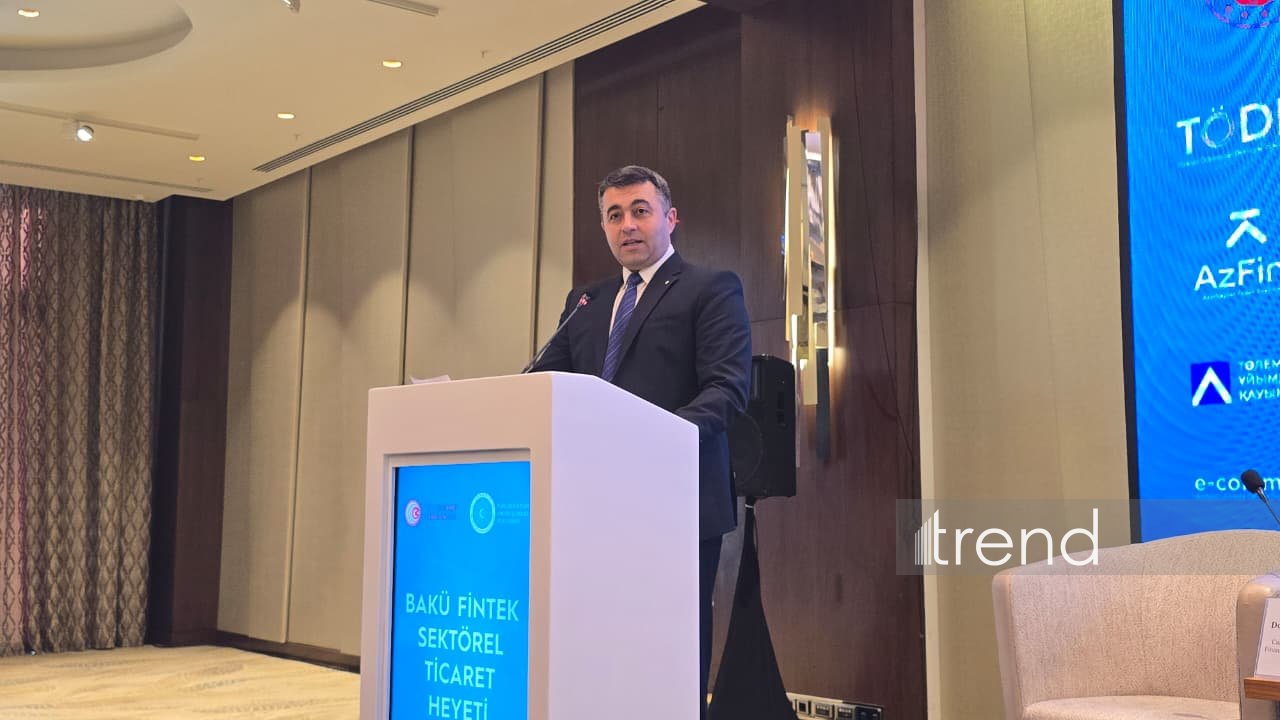
BAKU, Azerbaijan, October 13. Turkic states should begin implementing joint fintech solutions through pilot projects in two or more countries and then expand successful practices to other markets, the Chairman of the Board of the Azerbaijan Fintech Association, Edgar Abdullayev, said during a fintech mission involving representatives of Turkic states, organized by the Turkic States Fintech Alliance (TÜRKFİN) in Baku, Trend's correspondent reports from the event.
"Türkiye is one of the largest and most developed fintech markets in the region. As of the end of last year, 24 payment organizations and 62 e-money institutions were operating under the supervision of the Central Bank of Türkiye. Türkiye’s experience, particularly in the areas of acquiring, e-money, e-wallets, open banking, and the commercialization of digital payment products, holds great practical value for the region," he noted.
According to him, by the end of 2025, the number of bank cards issued in Uzbekistan exceeded 68 million, and the number of active POS terminals reached 430,000.
"In Kazakhstan, payment organizations have become significant players in the economy. In 2024, the total volume of transactions processed by payment organizations reached 8.2 trillion tenge. In the second quarter of 2026, the volume of transactions using electronic money exceeded 684 billion tenge," Abdullayev added.
In Kyrgyzstan, he said, the legal and technological infrastructure for electronic money, QR payments, and API-based financial platforms is steadily developing.
"Although the level of development and models in our countries differ, we are moving in the same direction," he said.
In this regard, Abdullayev proposed moving from conferences and reciprocal visits to practical cooperation in five areas.
"The first area is ensuring the interoperability of national payment systems, instant payment systems (IPS), and QR infrastructure. We need to work on creating a common payment platform and ecosystem for the Turkic states so that electronic money accounts, wallets, and bank accounts opened in one country can be used seamlessly and conveniently in other countries in the region.
The second priority is to develop common technical standards and approaches to APIs, as well as to work on ISO 20022 standards, open banking, QR payments, and digital identification. This will significantly reduce the costs of cross-border integration," he said.
According to him, the third area is regulatory passporting, which provides for the mutual recognition of licenses and simplifies access to other countries’ markets.
“I’m not saying that a single license should be in effect in all Turkic states starting tomorrow. This is a long-term process that must, of course, take into account each country’s sovereign authority in the regulatory sphere. However, at the very least, if an electronic money institution or payment organization licensed in one Turkic country enters the market of another Turkic country, the licensing process could be simpler and more flexible,” he explained.
"The fourth area is cooperation in the fields of anti-money laundering (AML), know-your-customer (KYC), combating fraud, and ensuring cybersecurity.
Unfortunately, just as payments know no borders, fraud and financial crimes also know no borders. And we, the Turkic states, can fight them together," Abdullayev noted.
Abdullayev emphasized that the fifth area of focus is the creation of a common regulatory sandbox and the implementation of regional pilot projects.
"Rather than rolling out the new model simultaneously in all five countries, it makes more sense to start with pilot projects in two or more countries and then expand the successful model to other markets," he added.
The "Baku Fintech Sector Trade Mission" program, organized by the Turkic States Fintech Alliance (TÜRKFİN), is taking place in Baku. Representatives from the financial and fintech sectors of Azerbaijan, Türkiye, and Kazakhstan are participating in the event.
The program includes discussions on the prospects for the development of digital payments in Turkic states, the harmonization of approaches to the regulation of financial technologies, and new technological trends in payment systems.



