


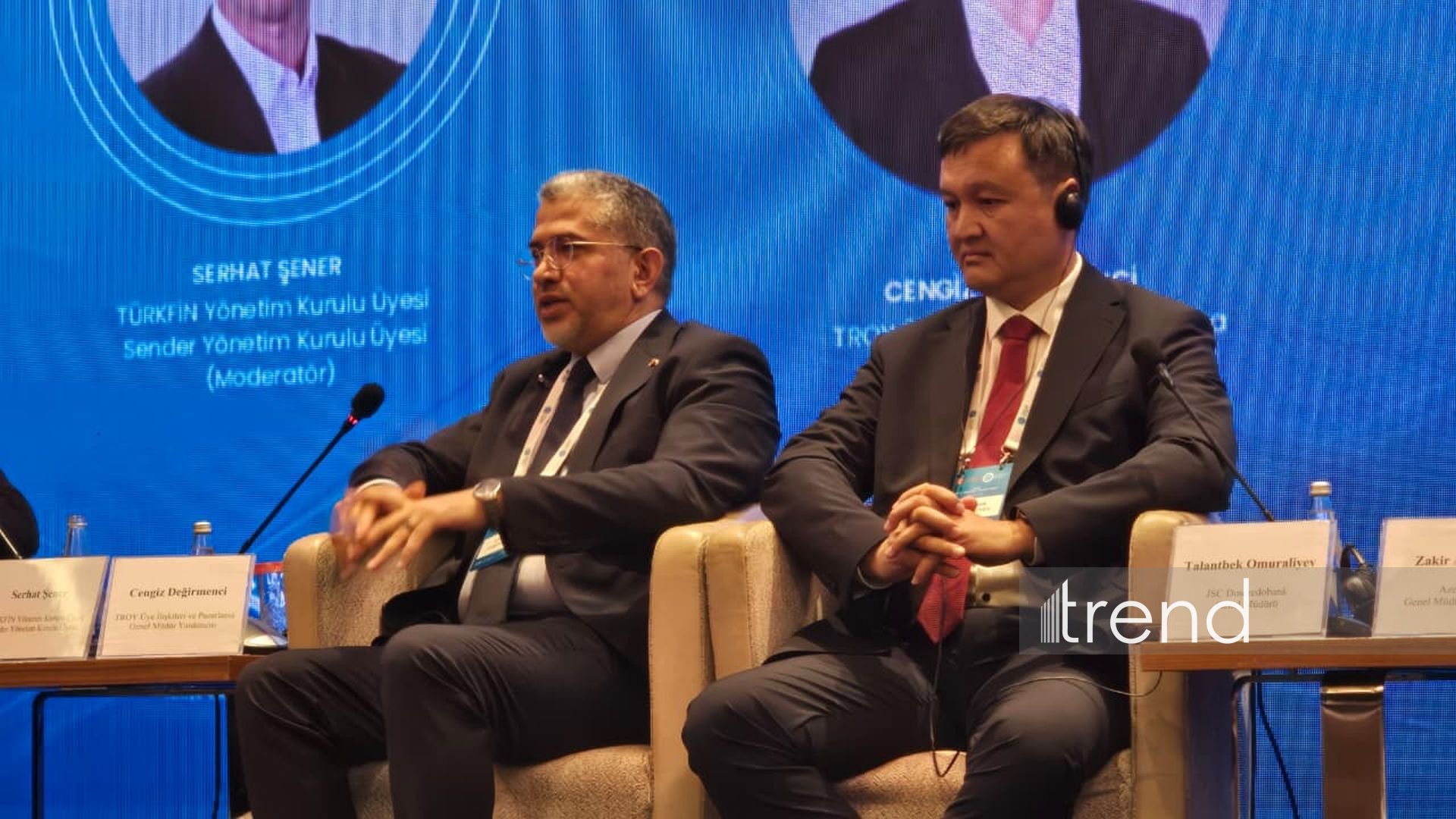

BAKU, Azerbaijan, October 13. Card payments account for more than 80% of retail trade in Türkiye, reflecting the expansion of e-commerce and growing demand for digital payment services, Deputy General Manager for Member Relations and Marketing at Türkiye’s national card payment system TROY, Cengiz Değirmenci, said on Tuesday at the Baku Fintech Sector Trade Mission Program, Trend’s correspondent reports from the event.
According to Değirmenci, cooperation among banks and the development of a unified infrastructure have played an important role in the growth of Türkiye’s payment ecosystem. Established with the participation of 13 banks, the system forms a key part of the country’s payment infrastructure.
He said that since its launch, the system has provided card transaction processing, clearing and settlement services. In subsequent stages, various additional services have been integrated into the infrastructure to enhance security, simplify transactions and meet the needs of banks and fintech companies.
“The main goal in the payment ecosystem is to make transactions more efficient and simplify processes. To achieve this, technological solutions and value-added services are being developed to meet the needs of banks and fintech companies,” he said.
Değirmenci emphasized that a key feature of Türkiye’s payment infrastructure is the processing of transactions across different card systems through a unified, centralized infrastructure. According to him, this approach simplifies transaction management and improves the efficiency of the payment ecosystem.
He divided the development of card payment systems in Türkiye into three broad stages.
In the first stage, banks played the leading role in establishing and expanding the market. The main priorities during this period were increasing card adoption, speeding up payments, ensuring security and making transactions more convenient for users.
In the second stage, the focus shifted to organizing the retail sector and increasing the number of customers using cards. Expanding the ability of retail outlets to accept card payments helped the market grow.
According to Değirmenci, customer behavior and preferences began to play a greater role in the development of card payments in the subsequent stage.
“Users now know that cards are a secure, fast and widely accepted means of payment. They also recognize the economic benefits of using cards,” he said.
He added that the expansion of e-commerce, particularly after the COVID-19 pandemic, accelerated the growth of card payments. This trend has become more pronounced over the past five years, with card payments now accounting for more than 80% of retail trade in Türkiye.
Addressing new payment technologies, the TROY representative said QR codes and near-field communication (NFC) should be viewed as methods of executing payments rather than separate payment methods. Account-based payments, meanwhile, are developing as an alternative model to traditional card payments.
“QR codes and NFC are technologies used to execute payments, while account-based payments represent a different payment model. For these models to work efficiently, technical, financial and operational processes must be properly coordinated,” he said.
Değirmenci noted that NFC use has expanded in Türkiye, while QR-code payments are available at retail outlets through various payment infrastructures. QR codes can facilitate transactions through both card-based infrastructure and Türkiye’s instant payment system.
According to him, one advantage of QR-code technology is its potential to connect different devices and payment infrastructures within a unified framework. While device compatibility is important for NFC, QR codes can provide a common solution for users with different technological capabilities.
The TROY representative emphasized that the shift from card payments to instant payments depends on more than technology alone. Funding costs, users’ payment habits and the extent to which debit cards are used across different sectors also influence the process.
Değirmenci said the main challenge in developing new payment models was not simply introducing new technologies, but ensuring coordination across the entire payment ecosystem. This approach could help create a more efficient, secure and accessible payment environment for banks, fintech companies, retailers and consumers.



