


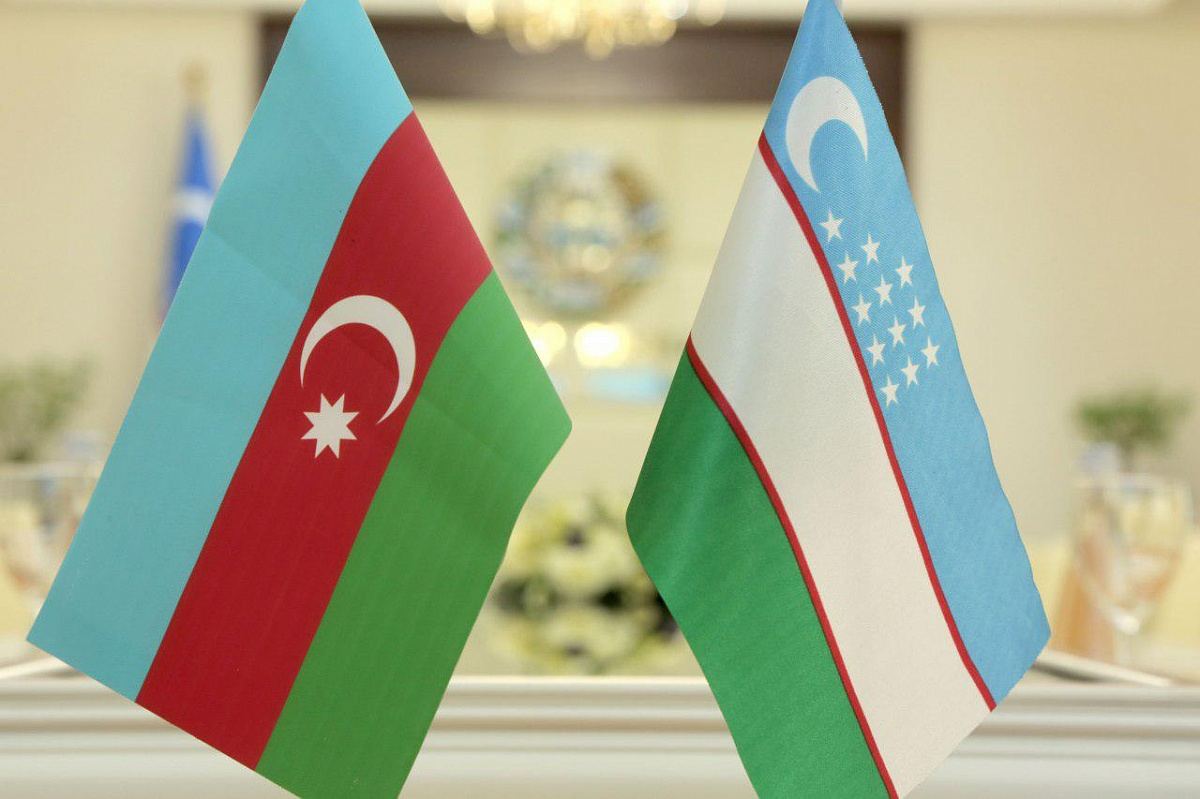

BAKU, Azerbaijan, August 21. Uzbekistan and Azerbaijan have significantly accelerated the implementation of previously reached agreements in recent weeks, turning their political alliance into concrete trade, investment and regional projects.
Recent contacts between Baku and Tashkent show that the current momentum goes well beyond high-level meetings. In August, the two sides have simultaneously advanced new trade targets, prepared an interregional forum, discussed industrial and investment projects, expanded cooperation in technology and security, and stepped up media and regional ties.
The economy remains one of the main drivers of this process. According to Uzbekistan’s Ministry of Investment, Industry and Trade, trade turnover with Azerbaijan reached $307.3 million in 2025, up 14.6%. In January-June 2026, trade amounted to $170.3 million, 30.8% higher than in the same period a year earlier. Tashkent and Baku have now set a longer-term target of raising bilateral trade to $1 billion by 2030. A dedicated program and roadmap are being prepared to implement the agreements reached toward this goal.
Significantly, this target is being pursued alongside other areas of cooperation. The fourth Uzbekistan-Azerbaijan Interregional Forum will be held in Tashkent on August 22, with the aim of expanding direct contacts between the countries’ regions and business communities and helping launch new trade and investment projects.
The interregional dimension has become one of the most visible elements of the current agenda. The presidents of Azerbaijan and Uzbekistan had previously agreed to place greater emphasis on cooperation between their regions, and that commitment is now being translated into practical initiatives.
During a 2024 press statement in Tashkent alongside President Ilham Aliyev, Uzbek President Shavkat Mirziyoyev stressed that the two countries were not limiting themselves to political declarations. “We don't just talk; we work meticulously in every direction. Our ministries and agencies have also embraced the expectation that we must fulfill everything we plan with Azerbaijan,” he said.
The current momentum reflects that approach. On August 19, another round of political consultations between the foreign ministries of the two countries was held in Tashkent. Deputy Foreign Ministers Bobur Usmanov and Samir Sharifov discussed the state and prospects of bilateral relations within the framework of strategic partnership and alliance. The talks also covered trade and investment, industry, transport, logistics, energy and culture. Uzbekistan’s Foreign Ministry emphasized the need to bring practical cooperation to a qualitatively new level and make maximum use of the existing potential to expand trade.
The economic agenda continued the following day at the level of the relevant ministry. Uzbekistan’s Minister of Investment, Industry and Trade Laziz Kudratov and Azerbaijan’s Ambassador Rashad Mammadov discussed documents aimed at expanding economic ties, advancing investment initiatives and strengthening interregional cooperation. Investment remains one of the key instruments. The Azerbaijan-Uzbekistan Investment Company has $500 million in capital and focuses on projects in industry, trade, transport, construction, agriculture and services. More than 440 enterprises with Azerbaijani capital are already operating in Uzbekistan.
At the same time, cooperation is increasingly taking the form of industrial integration. A good example is Tashkent’s Technopark, which comprises seven production facilities and is implementing 18 projects with a combined value of $465 million. The enterprise manufactures a broad range of industrial and consumer products, from refrigerators and elevators to pumps, radiators, copper pipes and climate-control equipment.
Igor Em, an export specialist at Technopark, told Azerbaijani media representatives during a press tour of Uzbekistan that the company already exports between 12,000 and 15,000 steel panel radiators to Azerbaijan each year. The sides are now negotiating supplies of elevator equipment, escalators and climate-control systems. “We have significant potential and a strong desire to cooperate with Azerbaijan. We will do everything we can on our side to make that happen,” he said.
Projects like these could become an important source of further trade growth. Reaching the $1 billion target will require not only higher volumes of existing exports but also a broader range of goods, new industrial linkages and greater access for companies from both countries to each other’s markets.
Another fast-growing area is the digital economy. During the Azerbaijani media press tour in Uzbekistan, the delegation visited IT Park Uzbekistan, where they were briefed on the country’s technology, startup and digital services ecosystem. According to IT Park, the organization works with companies from 104 countries, including Azerbaijan. The ecosystem brings together around 3,800 technology companies, while Uzbek IT firms export digital services to more than 100 countries. This provides a foundation for expanding cooperation beyond trade in physical goods into digital services, startups, workforce development and investment.
The press tour itself, involving 20 representatives of leading Azerbaijani media outlets, has also become part of the broader expansion of bilateral ties. On August 18, the journalists visited the Media Content Production Center under the Administration of the President of Uzbekistan, where they discussed joint media projects, professional exchanges and the development of shared information content. Uzbekistan also invited Azerbaijani representatives to participate in Tashkent Content Market 2027, which is expected to bring together professionals from the film, television, animation and digital media industries from more than 50 countries. The humanitarian dimension of bilateral relations is therefore increasingly being reinforced by concrete professional ties.
Security is another area of cooperation. On August 20, Uzbekistan’s Interior Minister Aziz Tashpulatov met with Azerbaijani Ambassador Rashad Mammadov. The sides discussed the exchange of experience in combating crime, terrorism and extremism, transnational organized crime, drug trafficking and cybercrime. This suggests that the allied relationship is gradually developing into a broader institutional framework covering not only the economy but also public security.
The significance of the bilateral partnership is also growing in the regional context. Following Azerbaijan’s accession as a full participant in the Consultative Meetings of the Heads of State of Central Asia, Baku and Tashkent gained an additional platform for coordinating their approaches. At the recent informal Central Asia-Azerbaijan Consultative Meeting in Cholpon-Ata, Kyrgyzstan, President Shavkat Mirziyoyev said: “Azerbaijan's accession to the Central Asian countries' consultative meetings format takes cooperation to a qualitatively new macro-regional level.”
This is particularly important for Azerbaijan and Uzbekistan given the growing importance of transport connectivity. Freight traffic between the two countries increased by 28.3% in 2025 and by a further 88% in the first quarter of 2026. The sides are discussing the creation of a joint trans-Caspian cargo fleet and a logistics hub near the Port of Baku, which could improve Uzbekistan’s access to European markets. “Today, the region of Central Asia and the South Caucasus, along with the Caspian Sea, is turning into a single geopolitical region, and positive developments in our regions largely depend on effective cooperation between Azerbaijan and Uzbekistan,” President Ilham Aliyev said in a 2024 press statement in Tashkent.
This work is also supported by regular high-level political dialogue. On May 18, 2026, President Ilham Aliyev met with President Shavkat Mirziyoyev in Baku on the sidelines of the 13th session of the World Urban Forum. Aliyev noted that Mirziyoyev’s participation in the forum demonstrated the brotherly and friendly relations between the two states and their peoples. The sides also emphasized that projects discussed during previous meetings between the leaders were being successfully implemented. Particular attention was paid to the construction of Uzbekistan Park in Baku. Mirziyoyev, meanwhile, highlighted the large-scale transformation taking place in Azerbaijan, including the reconstruction of cities and villages in Karabakh. For bilateral relations, the practical nature of this support is also significant.
Aliyev highlighted Uzbekistan’s contribution to the reconstruction of Karabakh, specifically noting the Mirza Ulugbek School No. 1 built by Uzbekistan in Fuzuli. He described it as “the first gift in the process of rebuilding Karabakh” and a symbol of brotherhood, support and solidarity between the two countries. During the May meeting, the leaders also reviewed economic projects being implemented under their instructions, including cooperation in energy, mining, agriculture, machinery, pharmaceuticals and other sectors.
Against this backdrop, Baku-Tashkent relations are emerging as one of the practical channels connecting the two regions. Trade generates demand, investment enables production, transport opens markets, and political coordination creates the conditions for long-term projects. Ultimately, the current momentum shows that Uzbekistan-Azerbaijan relations are developing across several interconnected tracks, with each reinforcing the others. Political alliance has created a foundation of trust, while the work of governments, regions and businesses is giving that foundation concrete substance.
If trade growth, investment activity, industrial cooperation and transport links continue to strengthen, the $1 billion target for 2030 could prove to be not an endpoint but the next stage of deeper economic integration. For Uzbekistan, this means broader access to the Caspian and European markets; for Azerbaijan, stronger economic ties with Central Asia; and for both countries, new opportunities to develop joint projects and enter third-country markets. This is why the marked acceleration of bilateral activity in recent months matters beyond the relationship itself. It is helping build a broader economic and transport link between Central Asia and the South Caucasus while simultaneously deepening political, business and people-to-people ties between the two countries.



