BAKU, Azerbaijan, Sept. 2
Trend:
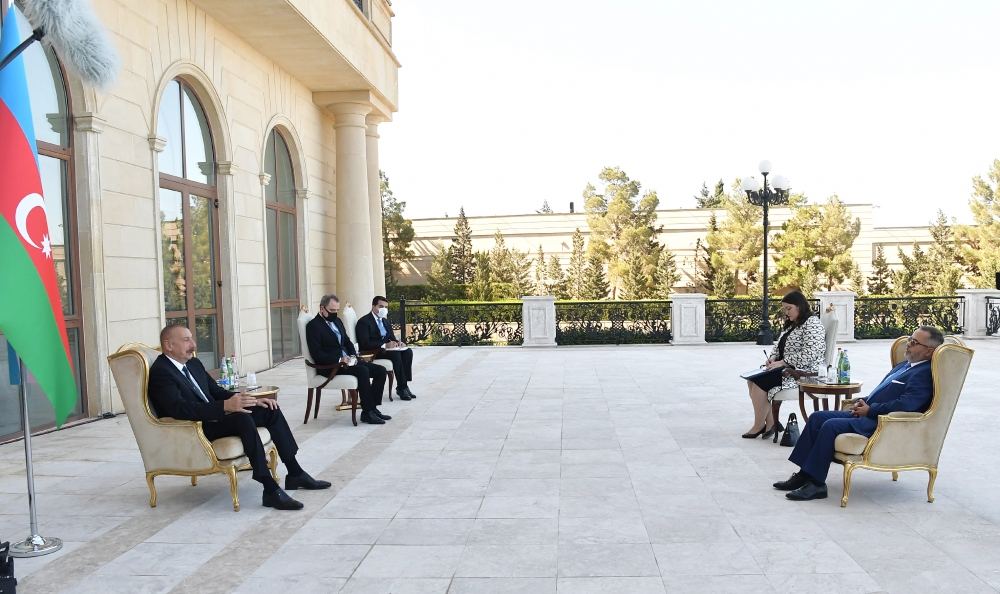
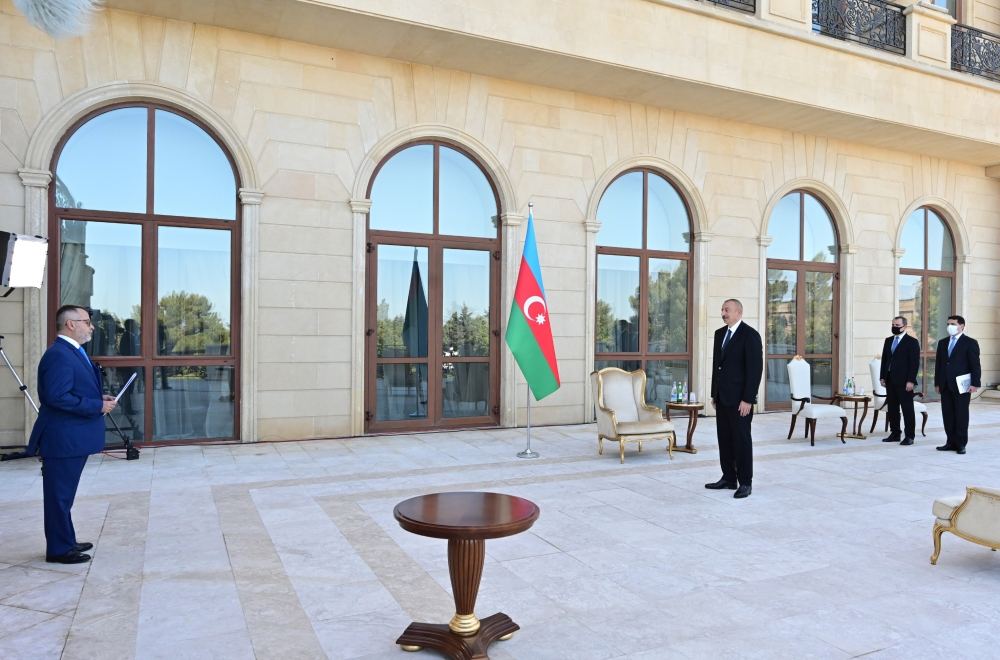
President of the Republic of Azerbaijan Ilham Aliyev has received credentials of the newly appointed Ambassador Extraordinary and Plenipotentiary of Greece Nikolaos Piperigos.
Ambassador Nikolaos Piperigos presented his credentials to President Ilham Aliyev.
President of Azerbaijan Ilham Aliyev then spoke with the ambassador.
Ambassador Nikolaos Piperigos: Your Excellency, I would like to take this opportunity to convey to you my President's best wishes and Greece's strong intention to expand our cooperation in all areas of mutual interest.
President Ilham Aliyev: Thank you, Mr. Ambassador. Please also convey my greetings to the President of your country. As far as I know, you have been in our country for more than two weeks but have already learned some Azerbaijani. Therefore, thank you for addressing us in our language. I hope you have had time to get acquainted with our city and that you will have the chance to travel around the country while working in Azerbaijan. The climate in Azerbaijan is very similar to that of Greece. I think you will find it similar to yours. So I hope you feel comfortable in Azerbaijan. I also hope that during the period of your activity in Azerbaijan, we will identify areas of cooperation, which will allow us to focus on specific issues.
Frankly speaking, I think the last few years have seen very low levels of cooperation between us. We had more active contacts in the past. As you know, I have paid an official visit to your country, two presidents of Greece have paid official visits to Azerbaijan, and so has the prime minister of your country. However, these contacts stopped after the previous Greek government came to power, and this was initiated by the Greek government. So there are almost no active contacts at present. There is no exchange of delegations. We need to think about how to plan on our cooperation in the future. Mr. Ambassador, I will speak to you quite frankly. Of course, diplomats have their own style of communication. I studied at an institute that trains diplomats, so I know what diplomatic language is like. But I think that in order to have a clear idea of where we are, what we want and how we can move forward, it would be good if we know each other's positions.
I believe there have been several issues that negatively affected our cooperation. One of them is related to the Greek gas company DESFA. I can say that our energy company SOCAR joined the bidding for the purchase of DESFA at the request of the Greek government. Former Prime Minister of Greece Mr. Samaras personally asked me for SOCAR to participate in the tender. As a result of an open tender, SOCAR made the best offer and won the right to own DESFA. This was also important in terms of our plans to build the Southern Gas Corridor. That was about six years ago. At that time, of course, we were simply planning to build a connection between Azerbaijan and Europe, and we thought that if Azerbaijan was to supply gas to Greece, it would be good to have a company that would distribute this gas. In any case, we made a down-payment of 40 million euros, which constituted 10 percent of the price, and for four years – from 2014 to 2018 – the money was at the disposal of the Greek government. Unfortunately, the previous government of Greece did everything to deprive SOCAR of this right. I would like to reiterate that we originally obtained this legitimate right at the suggestion of the Greek prime minister, in an open and competitive tender, but were deprived of this legitimate right for political reasons due to the negative attitude of the previous government of Greece towards Azerbaijan. This certainly had a serious negative impact on the already low-level relations between us. Frankly, we then decided that if the government of Greece was treating us like that, we would have to think about how we could respond. Our response was actually to do nothing. We did not make any demarche. We did not take any diplomatic steps. We simply said: well, if they don't want us, if they prefer other companies to become shareholders of DESFA, then this is their right and there is nothing we can do about it. However, I can tell you that I repeatedly raised this issue in Brussels with two former leaders of the European Union - Mr. Barroso and Mr. Tusk. I raised this question because it had been dragging on for four years. I said to them, Look, we are talking about trust, about a new agreement between the European Union and Azerbaijan, which the European Union is actively promoting. How can we build trust if our company wins the tender to buy a company from a member state of the European Union, from Greece, but then the government of Greece takes these steps? That step was taken as a result of the adoption of a new law in your parliament, which made this deal impossible. And then the European Commission did not approve this deal for four years. I said, say “no” to us, say “we do not want you”. But to keep us in this situation for four years is not a sign of partnership.
So this was a very disappointing issue and, of course, I think it had a serious impact on our relations. But let me say again that this wasn’t done on the initiative of Azerbaijan. Azerbaijan has always supported the development of relations. In fact, you certainly know that TAP was not the only option for the transportation of Azerbaijani gas. There were several options for the transportation of Azerbaijani gas after it reached the territory of Turkey. It could have gone in a different direction. However, the choice of TAP was also a decision made by investors, foreign oil companies and Azerbaijan. In other words, for our part, we made a positive gesture towards Greece. But after the previous government came to power – I want to emphasize this because before the former Syriza government came to power, we had very good relations with the government of Greece.
The second issue I want to raise with you, so that you hear it from me personally, not from other sources, is our concern about military cooperation among Armenia, Greece and Cyprus. As you know, Armenia is a country that has occupied our territories. It has committed an act of genocide in Khojaly, made one million Azerbaijanis homeless, destroyed our historical, cultural and religious monuments, carried out a policy of ethnic cleansing in the occupied territories, is violating international law and does not comply with the resolutions of the UN Security Council and other organizations. In fact, two years ago, the European Union and Azerbaijan initialed a document called “Partnership Priorities”. In that document, the European Union unequivocally supports the territorial integrity, sovereignty and inviolability of Azerbaijan's internationally recognized borders.
In other words, Armenia is acting aggressively. The latest tensions on the state border were provoked by Armenia. An Armenian officer was recently detained while trying to cross the line of contact in an attempt to commit a terrorist act, and he has already made a confession that his group intended to attack our servicemen and civilians. In short, Armenia is the enemy of Azerbaijan, and this was their decision.
Of course, Armenia's close military cooperation with any country is a matter of concern for us. You are probably aware of our reaction to the intense supply of weaponry from Russia to Armenia immediately after Armenia’s provocation on the border. Active clashes were stopped on 16 July, and from 17 July until yesterday – yesterday was the last flight – there were numerous cargo flights from Russia to Armenia through the airspace of Caspian littoral states. I am saying this not only to you. We have also raised this issue with our Russian partners: we are concerned about military cooperation with Armenia because this poses a major threat to Azerbaijan because they are using these weapons to kill our servicemen and civilians.
We are concerned about this tripartite format of cooperation. Of course, every country does what it thinks is right. Therefore, we are not in a position to block or prevent it in any way. But I think that it would be good if you hear from me that this is an issue that worries us, and I have explained why it happened. It is not Azerbaijan that has occupied the territory of Armenia – Armenia has occupied Azerbaijani territory. This is reflected in the documents of all international organizations.
The last issue I want to touch upon is the recent tension between Turkey and Greece in the Eastern Mediterranean region. I can tell you, and it is no secret, that Turkey is not only our friend and partner, but also a brotherly country for us. Without any hesitation whatsoever, we support Turkey and will support it in any circumstances. We see the same support from our Turkish brothers. They support Azerbaijan in all issues, and we support them in all issues, including the issue of exploration in the Eastern Mediterranean. I want you to know our position. This position has already been officially communicated by the Azerbaijani government on my instructions. I can tell you again that Turkey is not only a friendly but also a brotherly country for us and the Turkish people are our brothers. So we will be with them in all matters.
I want to find something positive to touch upon but, unfortunately, I can't find anything. We hope that the new government of Greece, which came to power relatively recently, will probably reconsider the policy of the previous government against Azerbaijan and we will be able to restore contacts and discuss issues that create a positive dynamics. Of course, this will depend on the policy and position of the government of Greece. This concludes my speech and now the floor is yours to say what you think is right.
Ambassador Nikolaos Piperigos: Your Excellency, thank you for your remarks related to the state of the Greek-Azerbaijani relations. I have listened to you very carefully and will communicate your words to my government. The government was changed last year. There are many issues across all sectors that our government needs to address. This government has a good outreach. I believe that there are many more aspects that bring Greece and Azerbaijan together. For example, respect for international law, as it is well known that Greece has long been a strong supporter of international law.
Of course, several years ago our cooperation was developing well. However, the new government will do whatever is necessary to find the best ways to reach out to you. I also want to note that, in our opinion, your country and our country are very interesting countries carrying out trilateral and bilateral cooperation. You have ample experience, you even have experience in trilateral diplomacy. We also have very successful trilateral diplomacy with many important countries, in particular in the Eastern Mediterranean region. Always and fully observing international law, we try not to harm relations with Azerbaijan, and we would like to see the same from your side as much as possible. However, it seems to me that since our new government has been given time to find opportunities to improve relations with your government, the future of our cooperation may be more successful. I can say this much for now.
President Ilham Aliyev: Thank you.