


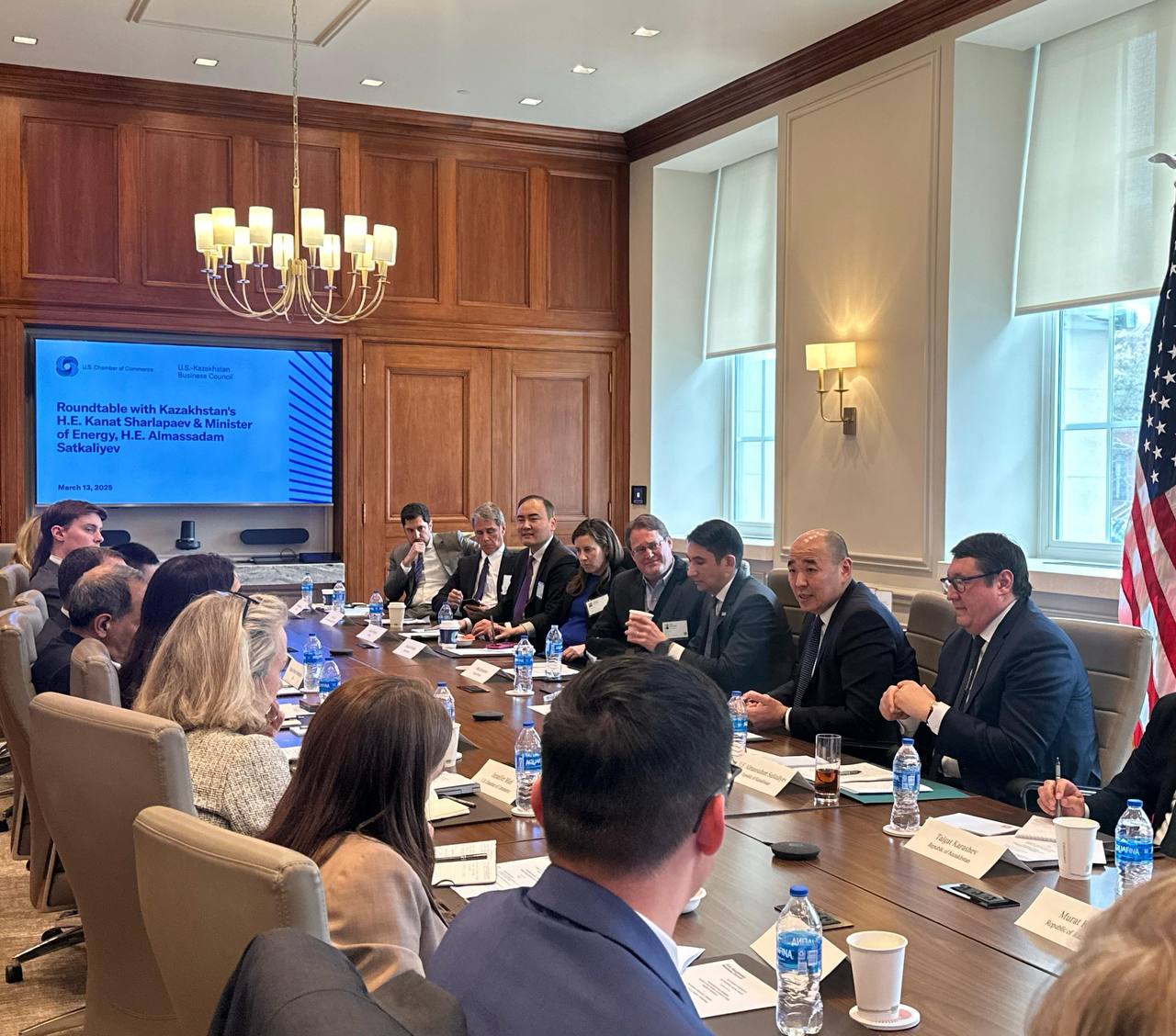

ASTANA, Kazakhstan, March 15. Throughout a visit to the US, a delegation from Kazakhstan met with representatives of the U.S. Chamber of Commerce, the country's largest business association, to discuss prospects for trade and economic cooperation, Trend reports.
The meeting was attended by the Senior Vice President of the U.S. Chamber of Commerce for the Asia-Pacific region, Khush Choksy. Kazakhstan's Minister of Energy, Almassadam Satkaliyev, also participated in the talks.
On the course of the meeting, a wide range of issues were discussed concerning the development of trade and economic relations between Kazakhstan and the US, including investment cooperation, improving the business climate, expanding trade, and supporting American companies operating in Kazakhstan.
Special attention was given to prospects for cooperation in the energy sector. Minister Satkaliyev informed the U.S. Chamber of Commerce representatives about the projects being implemented in Kazakhstan in the areas of oil and gas extraction, petrochemicals, renewable energy, and nuclear energy, as well as measures being taken by the government to attract foreign investment and create favorable conditions for doing business.
The representatives of the U.S. Chamber of Commerce, in turn, expressed interest in further developing cooperation with Kazakhstan and noted the positive dynamics of economic reforms in the country.
“Kazakhstan is an important trade and economic partner of the US in Central Asia. We see significant potential for expanding our cooperation, especially in the energy sector, and we are ready to support American companies interested in working in the Kazakhstani market,” underscored Minister of Energy Almassadam Satkaliyev.
The meeting was constructive and both sides agreed to continue
dialog on specific areas of cooperation.
The U.S. Chamber of Commerce is the largest trade association in
the US, representing the interests of businesses of all sizes
across the country. It was founded in 1912 and works to promote the
economic interests of the private sector, supports the development
of a free market, protects the rights of entrepreneurs, and
improves the business climate in United States.



