


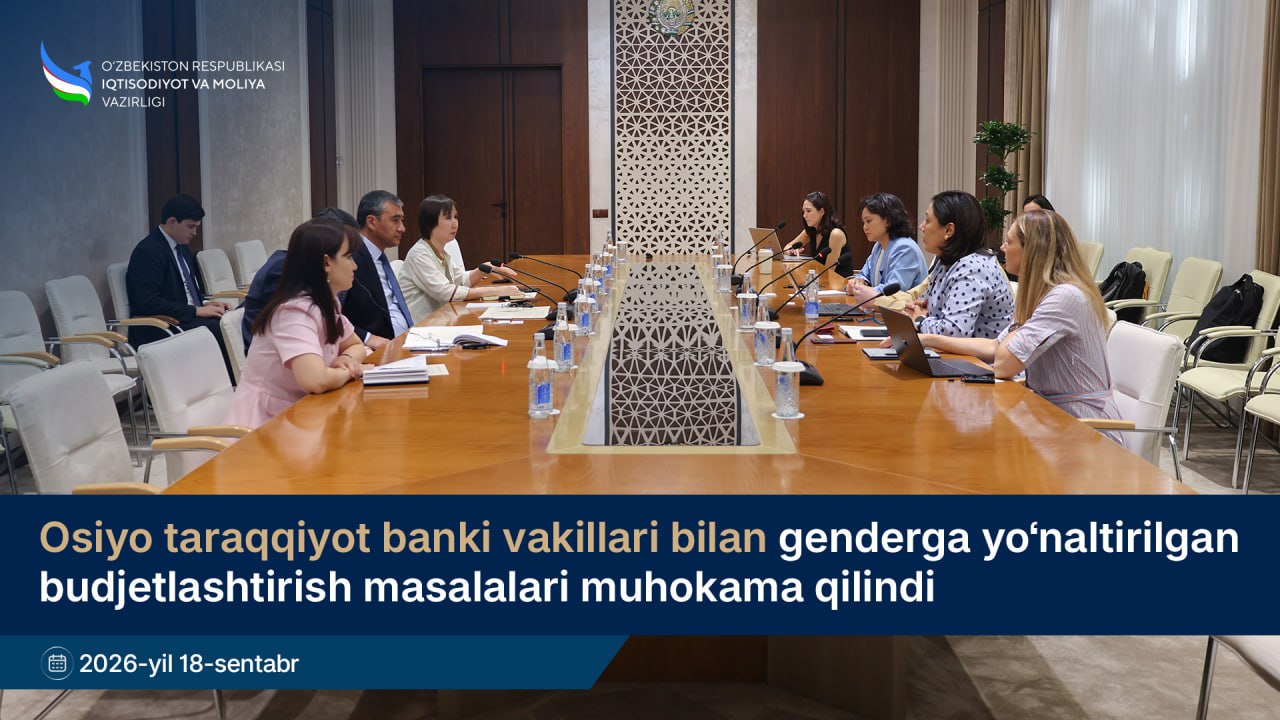

BAKU, Azerbaijan, September 21. Uzbekistan and the Asian Development Bank discussed steps on Sept. 18 in Tashkent to advance gender-responsive budgeting and more systematically integrate gender considerations into public financial management.
This was reflected in the statement by the Uzbekistan’s Ministry of Economy and Finance, following a meeting between Deputy Minister of Economy and Finance Axadbek Khaydarov and representatives of the Asian Development Bank.
The sides reviewed Uzbekistan’s ongoing efforts to introduce gender-responsive budgeting into practice, as well as current priorities and potential areas for further cooperation.
Particular attention was given to strengthening gender-responsive approaches in education, healthcare and social protection, while also improving the knowledge and practical skills of government officials responsible for budget planning and implementation.
The participants discussed the development of a practical, easy-to-understand guide for civil servants explaining the objectives, principles and application of gender-responsive budgeting.
“The further development of gender-responsive approaches in public spending requires not only appropriate budget mechanisms, but also stronger institutional capacity and practical knowledge among government officials,” the ministry said.
The meeting also covered plans for training and professional development programs for government employees, as well as the preparation of a practical roadmap to advance gender-responsive budgeting in Uzbekistan.
The sides agreed to identify additional measures based on the country’s current two-year strategy and work already carried out in the area.
They also agreed to organize working meetings involving relevant ministries and government agencies, as well as international organizations, to coordinate further steps and develop practical approaches to gender-responsive budgeting.
The discussions are part of Uzbekistan’s broader efforts to strengthen gender considerations in public policy and ensure that budget planning takes into account the differing needs and priorities of women and men across key areas of public services.



