


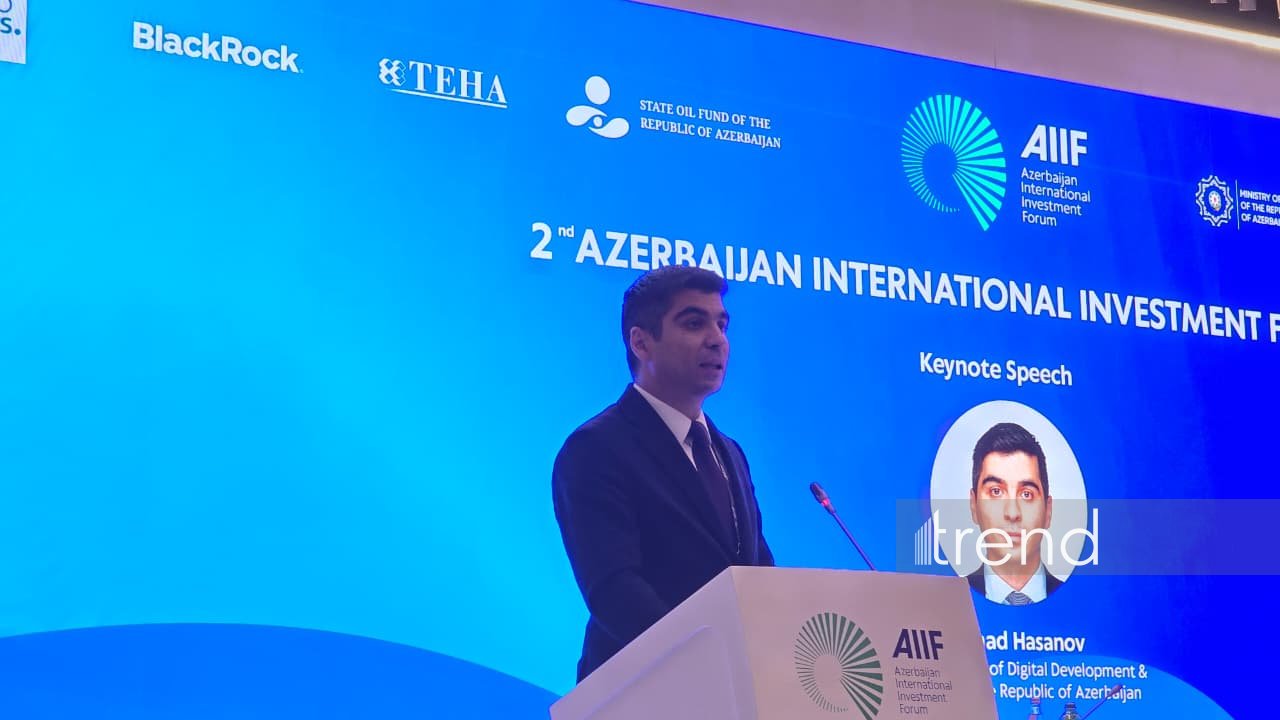

BAKU, Azerbaijan, September 25. Azerbaijan possesses the necessary infrastructure, energy, and digital connectivity capabilities for the development and application of artificial intelligence (AI), Deputy Minister of Digital Development and Transport Rashad Hasanov said during the 2nd Azerbaijan International Investment Forum held in Baku today, Trend's correspondent reports from the event.
He noted that alongside the rapid adoption of artificial intelligence, it’s also crucial to create an appropriate environment for the safe and responsible development and use of these technologies.
"This requires a coordinated approach encompassing infrastructure, human capital, cybersecurity, regulation, and, of course, investment," Hasanov pointed out.
The deputy minister explained that countries are increasingly focusing on developing AI strategies.
According to him, while approximately 30 countries worldwide had AI strategies in 2019, the number of countries that have adopted such strategies now exceeds 100.
"Today, it’s not just about having a strategy. The key issue is the speed and quality of its implementation. Thus, the discovery phase is gradually giving way to the implementation phase," he emphasized.
Hasanov also noted that Azerbaijan is currently entering a new stage in the fields of artificial intelligence and digital transformation.
"The timing is right for Azerbaijan. We are entering a phase where investments in infrastructure and artificial intelligence are converging into a unified agenda," the deputy minister said.
He noted that any strategy or transformation begins, first and foremost, with a vision and a high-level strategy. According to him, Azerbaijan has adopted a number of important national strategy documents regarding digitalization and development in recent years.
Hasanov announced that the digital development action plan encompasses four main areas and 56 initiatives.
"Our task now is to translate this strategy into action. It is gratifying that we are not starting from scratch; we have significant and strong foundations in place," he added.
According to the deputy minister, the digitalization of the public and social sectors in Azerbaijan is already at a high level. He noted that the number of users on the myGov platform exceeds 4 million.
"For a country with a population of 10 million, having 4 million users on the myGov platform represents a very good start in terms of the digitalization of government services. We plan to increase this figure to 5 million by the end of the year," Hasanov said.
He noted that a number of government services have already been digitized, and work is ongoing to digitize others.
The deputy minister shared that government agencies, in collaboration with the Ministry of Digital Development and Transport, have adopted roadmaps for digitalization, and work is currently underway to implement them.
According to him, the migration of government information technology systems to the "G-Cloud" government cloud is also proceeding, with the process scheduled for completion by the end of 2027.
"This will be a significant step toward ensuring the integrated resilience of government information systems," Hasanov emphasized.
The deputy minister noted that Azerbaijan is not merely discussing artificial intelligence but has already begun implementing the technology within government agencies.
"We are moving beyond talking about artificial intelligence to actually applying it. There are already real-world examples of AI usage in government agencies. These include student management systems in education, an AI-based cybersecurity center, crop disease forecasting in agriculture, and the myGov AI assistant that responds to citizen inquiries," he noted.
Hasanov said that establishing high-performance computing capabilities to advance AI research is also a key priority.
"High-performance computing capabilities require reliable energy, connectivity, and physical space. Azerbaijan possesses capabilities in each of these three areas," the deputy minister clarified.
According to him, Azerbaijan's strategic location between Europe and Asia, the extensive coverage of the country's fiber-optic network, and a surplus electricity generation capacity of approximately 2 GW create significant opportunities for the development of AI and data centers.
Hasanov also noted that work is underway to establish a data center in the Alat Free Economic Zone.
"We are currently in the final stages of negotiations regarding the establishment of a data center in the Alat Free Economic Zone. To realize this initiative, we have held extensive, long-term discussions with numerous hyperscale data center and cloud companies," he mentioned.
The deputy minister also said that the underlying logic of this approach is the transformation of energy into computing power, computing power into AI and digital services, and those capabilities into high-value-added exports.



