


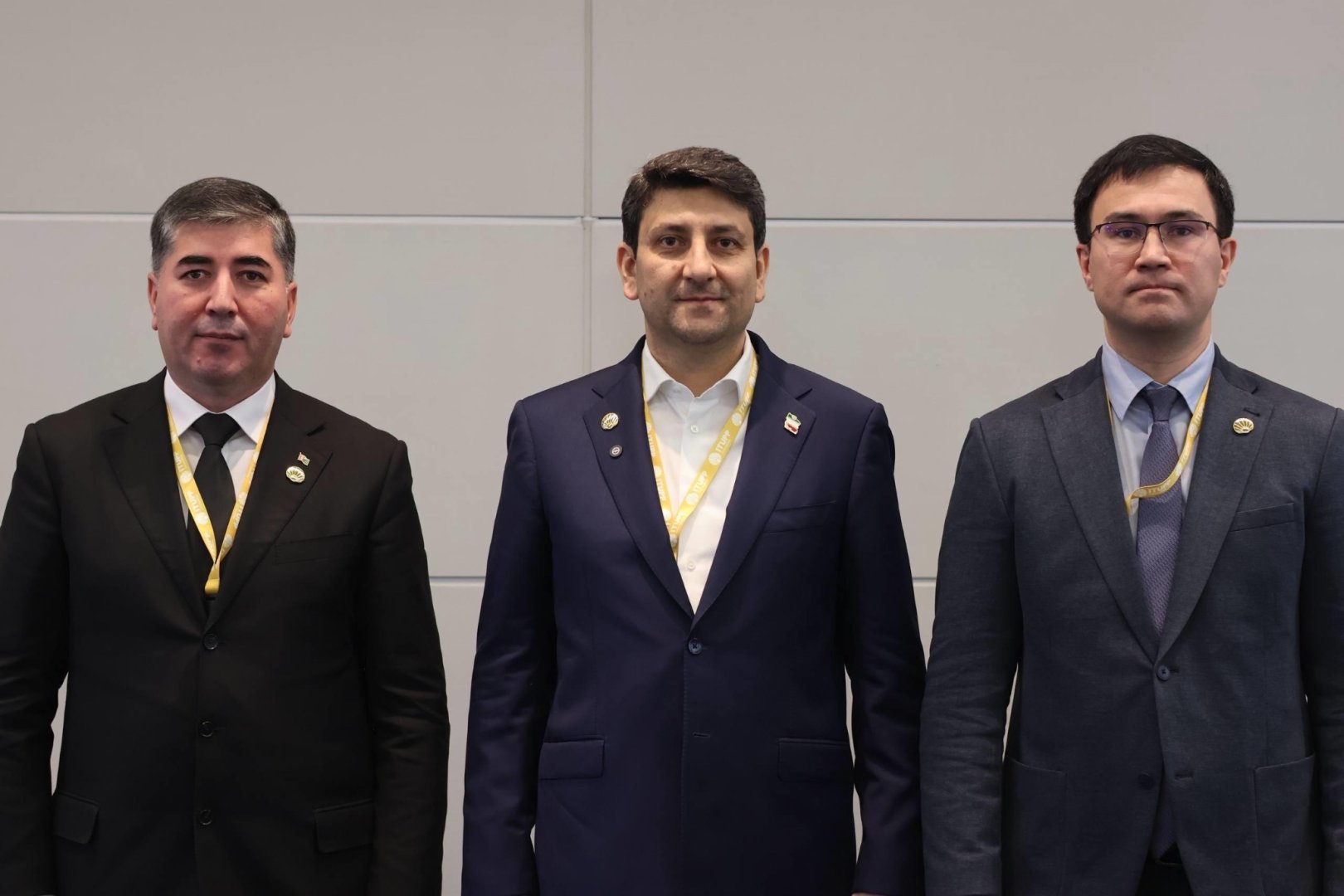

BAKU, Azerbaijan, November 10. Iran, Turkmenistan and Kazakhstan have reached an initial agreement to establish a joint digital corridor connecting Central Asia with the Persian Gulf and neighboring countries, the press service of the Iranian government reported.
According to the report, Iran's Minister of Communications and Information Technology Sattar Hashemi met with his Turkmen and Kazakh counterparts in Doha, Qatar.
"The three sides reached an initial agreement to establish a joint digital corridor linking Central Asia to the Persian Gulf and neighboring countries," the report says.
The Kazakhstan-Turkmenistan-Iran railway, inaugurated in December 2014, provides Central Asian countries with a direct rail connection to Iran and access to the Persian Gulf through the port of Bandar Abbas. The route is not merely a proposed initiative: it is coordinated by the Economic Cooperation Organization (ECO) through a Tripartite Coordination Committee. In November 2021, the railway administrations of the three countries signed a memorandum of understanding on the implementation of the KTI freight corridor, while a commercial working group was envisaged to attract additional cargo.
Efforts to expand the corridor have continued in recent years. In July 2024, Kazakhstan, Russia, Iran and Turkmenistan signed a roadmap for the coordinated development of the eastern branch of the International North-South Transport Corridor (INSTC), while Kazakhstan, Turkmenistan and Russia also discussed establishing a single logistics operator and harmonizing tariffs. In September 2025, Turkmenistan and Iran held talks on increasing transit cargo volumes and activating the China-Kazakhstan-Turkmenistan-Iran railway.
The proposed digital corridor fits into Iran's broader ambition to position itself as a transit and connectivity hub linking Central Asia with the Persian Gulf and the Indian Ocean. Speaking at the Turkmenistan Investment Forum in Ashgabat in October 2026, Iranian Deputy Minister of Economy and Finance Mehdi Heydari emphasized the importance of transport infrastructure investment in connecting Central Asian markets with southern trade routes. For Kazakhstan and Turkmenistan, closer cooperation with Iran offers an opportunity to diversify access to international markets, while Tehran seeks to strengthen its role in regional trade and logistics. The digital initiative could complement existing physical routes, although the initial agreement announced in Doha does not yet establish a fully operational corridor.


