


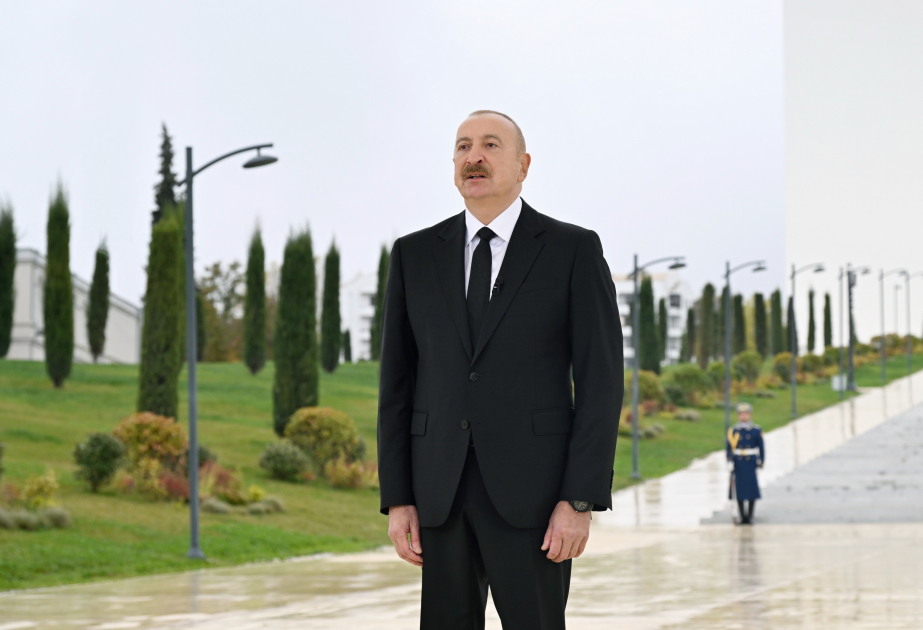

BAKU, Azerbaijan, November 8. The address delivered by President of Azerbaijan and Supreme Commander-in-Chief of the Armed Forces Ilham Aliyev in front of the Victory Arch in Khankendi on November 8, marking Victory Day, highlighted not only the military outcomes of Azerbaijan's historic victory in Karabakh but also its political and moral significance.
Key points in President Ilham Aliyev's speech show that, for Azerbaijan, Victory did not end with the liberation of its territories. It has continued through the restoration of sovereignty, the elimination of separatism, and the transformation of former sites of occupation into new symbols of statehood.
President Ilham Aliyev's decision to deliver his address in Khankendi, in front of the Victory Arch, carries particular political and symbolic significance. Once presented as the center of separatism, the city has now become a place where the restoration of Azerbaijan's sovereignty and state authority is being demonstrated.
In this regard, the location itself forms part of the message. Khankendi is no longer being presented in the context of conflict and separatism, but rather as part of Azerbaijan's historic victory and post-conflict reconstruction.
The symbolic fulfillment in Khankendi on September 20, 2023, of President's earlier declaration that "Karabakh is Azerbaijan, an exclamation mark" is also particularly significant in this context. It demonstrates how a political statement was subsequently translated into concrete events and outcomes. In other words, the political resolve expressed in 2020 entered a new phase in 2023 with the restoration of Azerbaijan's sovereignty throughout Karabakh.
One of the most striking messages in the President's address was his announcement that the building once occupied by the former separatist entity would eventually house a Victory Museum.
The head of state recalled that when he visited the building in October 2023, he opened its windows and said he wanted the "evil spirit" to leave the premises. He then emphasized that a Victory Museum would be established there, giving the site profound symbolic meaning.
This is not simply a matter of changing the building's function. Transforming a site that once served as the center of separatist administration into a museum preserving Azerbaijan's historical memory creates a symbolic dividing line between the past and the future.
The central message is that the legacy of the occupation period is being replaced not only physically but also in the realm of public and historical memory. A building that once symbolized the past will become a place where future generations can learn about the history of Victory.
The President's remarks that war criminals are now serving their sentences in Baku prisons also complete the legal dimension of this message. Thus, the address draws attention both to the fate of the political center of separatism and to the accountability of those who led it.
The figures cited by the President regarding the outcome of the 44-day war were among the key points illustrating the scale and results of Azerbaijan's military operations.
More than 300 cities and villages were liberated on the battlefield during the war, while the liberation of Shusha on November 8 marked a decisive stage in the military campaign. The liberation of Shusha demonstrated Azerbaijan's military and political superiority and played a crucial role in the process leading to the end of the war.
In this context, Shusha's historical and geographical significance should be considered alongside its status as Azerbaijan's cultural capital. Its liberation carried meaning far beyond the military outcome, representing an important moment in the restoration of national memory and historical justice.
The return of other territories to Azerbaijan without a single shot being fired or a single casualty being suffered, following Armenia's signing of the act of capitulation, illustrates the distinction between the military phase of the war and the subsequent political agreements. This was an important demonstration of how Azerbaijan's battlefield advantage shaped the developments that followed.
Another point highlighted in the President's address was the comparison between the Azerbaijani and Armenian armies during the war.
According to the head of state, not a single Azerbaijani serviceman deserted during the fighting. Armenia, meanwhile, acknowledged that nearly 12,000 of its soldiers had deserted.
This comparison underscores that wars are not fought solely with weapons and technology. The fighting spirit, discipline, and confidence of military personnel in their mission also influence the outcome. The combat capability, military preparedness, and determination of Azerbaijani servicemen are presented as among the key factors behind the results of the 44-day war.
Taken together, these points in the President's address reflect several stages of Azerbaijan's path in Karabakh: military victory in 2020, the full restoration of sovereignty in 2023, and the ongoing reconstruction of the liberated territories.
The address delivered in front of the Victory Arch in Khankendi, the plan to establish a Victory Museum in the former separatist building, and the particular emphasis on the liberation of Shusha are all elements of the same political and historical narrative.
Its central message is that, for Azerbaijan, Victory is not limited to the memory of a past war. It continues through the consolidation of state sovereignty, the preservation of historical memory, and the building of Karabakh's future.


