


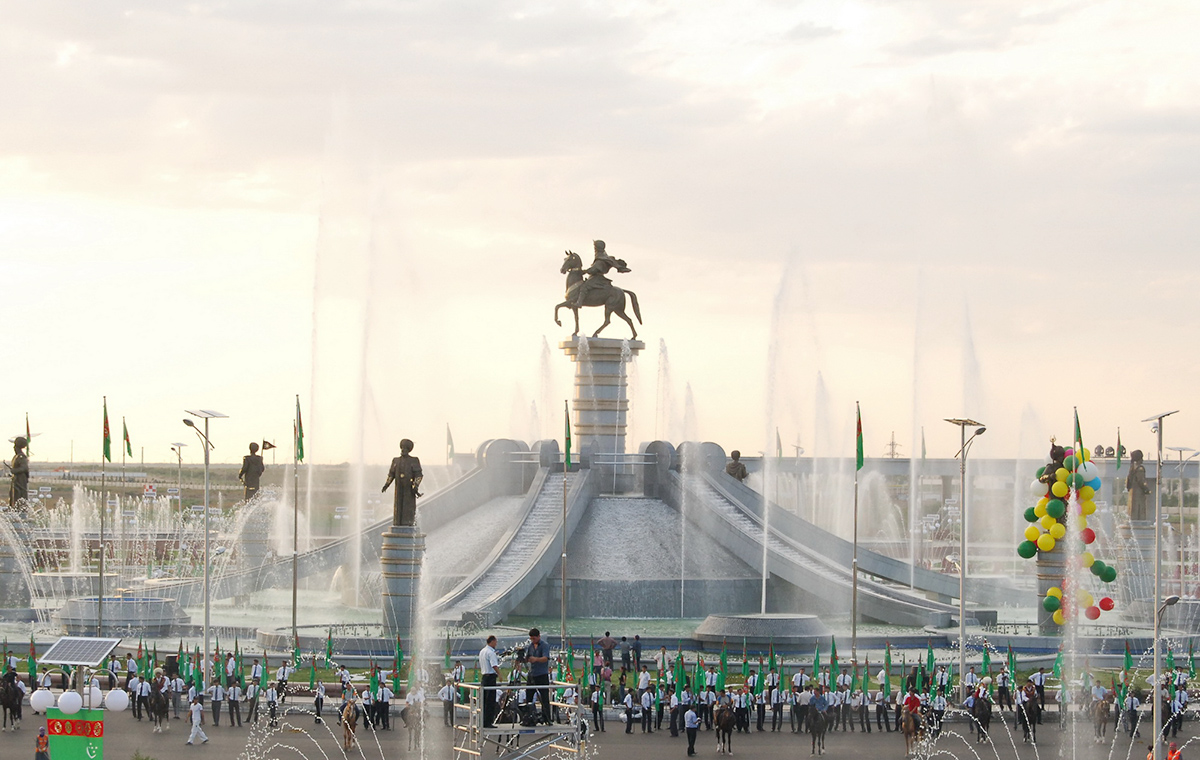

BAKU, Azerbaijan, September 25. Turkmenistan will mark 35 years of independence on September 27, as the country approaches a new stage of its development.
The anniversary comes amid active government efforts across key areas of socio-economic development. On September 23, the Halk Maslahaty of Turkmenistan held a meeting in Ashgabat chaired by Chairman of the Halk Maslahaty Gurbanguly Berdimuhamedov, making it one of the key events ahead of the 35th anniversary of independence.
The meeting addressed important issues of state and public life, as well as further socio-economic development. President of Turkmenistan Serdar Berdimuhamedov highlighted ongoing efforts to develop the country and outlined further tasks in his address.
Over 35 years of independence, Turkmenistan’s economy has retained the oil and gas sector as one of its key industries while expanding its industrial and production base. While the country’s economy relied heavily on natural gas production and exports in the early 1990s, gas is now also used as a foundation for developing petrochemicals, power generation, and other industries. The infrastructure of the gas sector has also changed significantly, while the areas of raw material use have expanded.
One of the most notable projects has been the development of the Galkynysh field, one of the world’s largest gas fields. At the same time, Turkmenistan has developed petrochemical capacities, including the production of polyethylene, polypropylene, urea and other higher value-added products.
“One of the key tasks is to modernize the activities of the oil and gas sector based on advanced achievements. Large-scale projects are being implemented on a programmatic basis for the production, processing and export of hydrocarbon resources, as well as the development of new fields,” President Serdar Berdimuhamedov said during his speech at the September 23 meeting of the Halk Maslahaty.
Another area of development has been transport infrastructure. The country has built the Turkmenbashi International Seaport, new railway lines and other facilities designed to expand its capacity for cargo transportation and access to international markets.
The scale of the economy is also reflected in current indicators. According to the World Bank, Turkmenistan’s GDP stood at about $68.7 billion in 2024, while the economy grew by 6.3% in 2025. Thus, the country’s economic base has expanded significantly over the years of independence, with new industrial production, energy capacities and transport infrastructure developing alongside extractive industries.
One of the most notable elements of Turkmenistan’s foreign policy over the years of independence has been its status of permanent neutrality. The UN General Assembly first recognized Turkmenistan’s permanent neutrality in 1995 and reaffirmed the status through a separate resolution in 2015. In March 2025, the UN General Assembly adopted a resolution on Turkmenistan’s permanent neutrality for the third time, recognizing the country’s contribution to strengthening peace and security in the region.
Neutrality has become not only a foundation of the country’s foreign policy but also an important area of its diplomatic activity. In particular, Turkmenistan has promoted preventive diplomacy, peaceful dialogue and international cooperation.
Over the years of independence, Ashgabat has also hosted international meetings and negotiations on regional issues. The 2025 UN General Assembly resolution specifically noted Turkmenistan’s role in the inter-Tajik negotiations in 1995-1996 and its efforts to facilitate dialogue on the situation in Afghanistan.
The country’s international activity has also developed within the UN framework. Turkmenistan has initiated international resolutions focusing on neutrality and its role in maintaining peace, security and sustainable development. In May 2026, the UN General Assembly unanimously adopted another resolution on the subject, co-sponsored by 47 countries.
Ahead of the 35th anniversary of independence, Turkmenistan’s authorities have outlined not only achievements but also tasks for the coming years. Speaking at the September 23 meeting of the Halk Maslahaty, President Serdar Berdimuhamedov said that the country needed to bring its socio-economic development to a new level.
Further industrialization remains one of the key priorities. Turkmenistan plans to adopt a National Industrial Development Strategy for 2030-2045, which is expected to establish long-term development priorities for the industrial sector.
The implementation of major energy and infrastructure projects will also continue. These include the fourth phase of development of the Galkynysh field, construction of new oil and gas facilities, road development, and modernization of existing infrastructure.
At the same time, the government plans to expand the use of modern technologies and develop digitalization, science and entrepreneurship. In the social sphere, further plans include the construction and modernization of education and healthcare facilities, as well as the development of new residential complexes and settlements.
Against this backdrop, the Asian Development Bank (ADB) maintained its September forecast for Turkmenistan’s GDP growth at 6.3% in 2026 and 6.2% in 2027.
Speaking at the September 23 meeting of the Halk Maslahaty, President Berdimuhamedov said: “As a result of increased production across the sectors of the economy, the GDP growth rate remains at the established level. It is expected that by the end of the current year, this macroeconomic indicator will amount to 6.3%.”
Turkmenistan enters its 35th anniversary of independence with accumulated experience and projects implemented over the past decades. The continued implementation of the priorities outlined by President Serdar Berdimuhamedov in industry, energy, transport, and digitalization is reflected in the expansion of the country’s economic and infrastructure base and creates a foundation for the next stage of development.



