


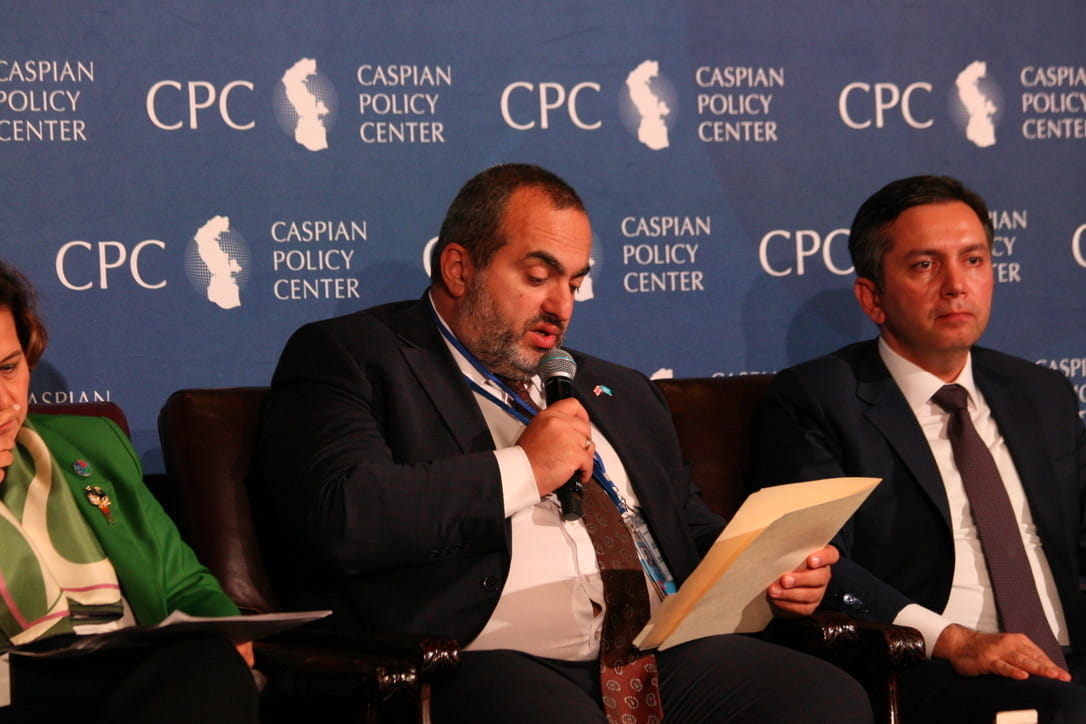

BAKU, Azerbaijan, September 23. The Middle Corridor is an essential component of Eurasian connectivity architecture, said Lasha Darsalia, Deputy Minister of Foreign Affairs of Georgia.
He made the remarks during the seventh annual Caspian Business Forum held by the Caspian Policy Center (CPC) in New York.
Darsalia highlighted Georgia’s efforts to strengthen its role as a regional connectivity hub through economic and infrastructure reforms and closer cooperation with neighboring countries, international partners, financial institutions, and the private sector. He also pointed to Georgia’s longstanding vision of transforming the Black Sea into a space for greater connectivity with the European Union.
“The Middle Corridor is not simply a trade route,” Darsalia said. “The vision of interconnected prosperity is a statement that we, the countries of the region, are ready to explore, not just as transit points, but as partners and creators of the future.
The Middle Corridor is a transport and trade route passing through a number of countries in the region and connecting Asia with Europe. It serves as an alternative to the traditional Northern and Southern Corridors. The route begins in China and runs through the countries of Central Asia. It then crosses the Caspian Sea, Azerbaijan, Georgia, and Türkiye, before reaching Europe. The Middle Corridor is a land route that bypasses longer sea routes, connecting eastern regions of Asia, including China, with Europe.
The World Bank has highlighted the Middle Corridor’s potential to support economic growth across the countries along its route by facilitating trade, generating employment and encouraging new business activity. According to the Bank’s 2024 report, a combination of infrastructure investment and measures to improve operational efficiency could halve transit times and triple trade volumes along the corridor by 2030.
Azerbaijan is working with other countries participating in the Middle Corridor to improve transport links, simplify border procedures and expand the use of digital systems for exchanging logistics data. Key infrastructure supporting the route includes the Baku International Sea Trade Port, the Baku–Tbilisi–Kars railway, the Alat Free Economic Zone and newly developing logistics hubs.
The Baku Port is also undergoing expansion, with its annual cargo-handling capacity expected to increase from 15 million tons to 25 million tons.



