


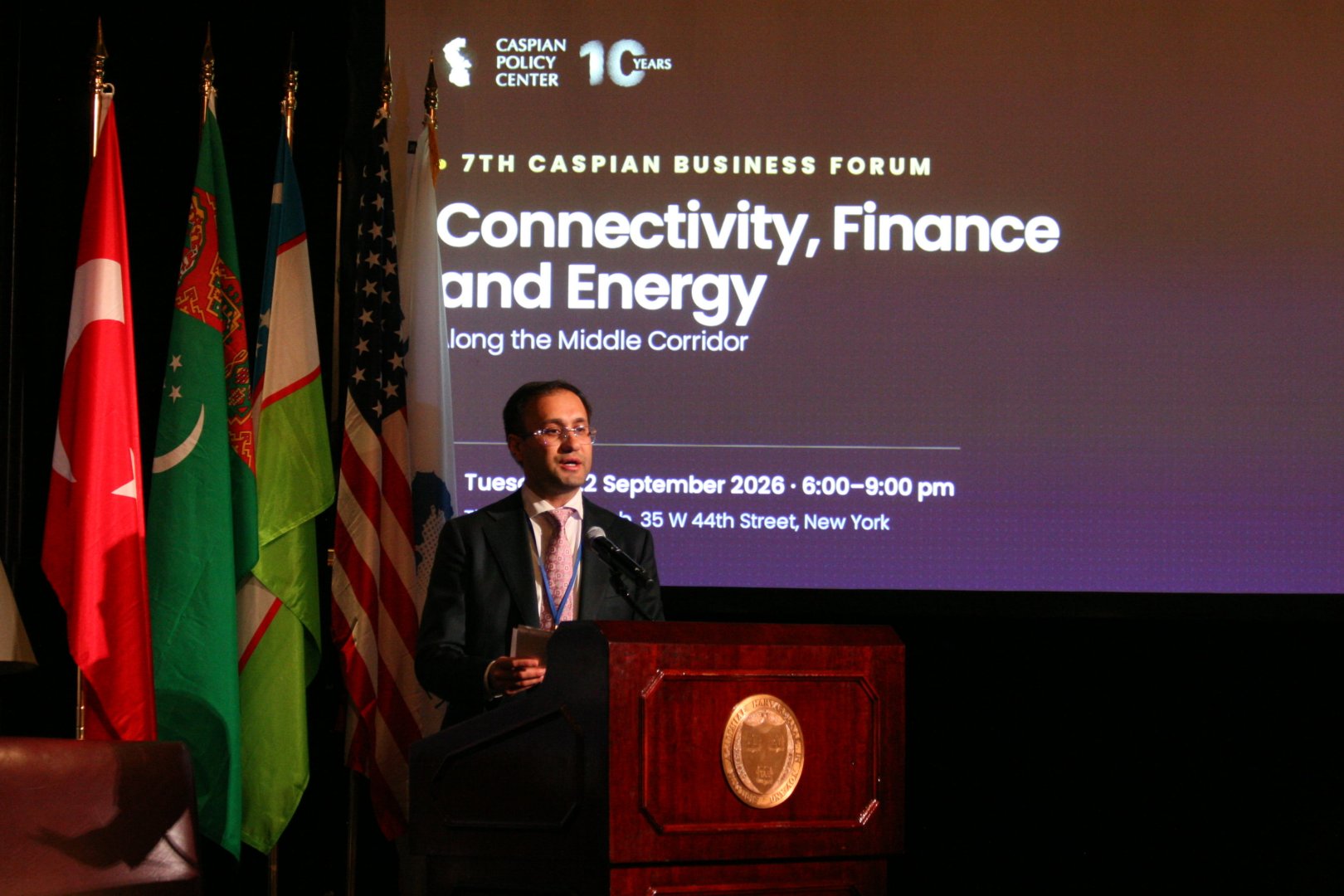

BAKU, Azerbaijan, September 23. The strategic and commercial case for the Middle Corridor has grown stronger, said Efgan Nifti, president of CPC.
He made the remarks during the seventh annual Caspian Business Forum held by the Caspian Policy Center (CPC) in New York.
Nifti highlighted the significant developments that have reshaped the Caspian region over the past year and the growing importance of the Middle Corridor as a trade and connectivity route linking Asia and Europe.
“With routes through Russia constrained by sanctions and maritime trade facing renewed instability in the Middle East, the strategic and commercial case for the corridor has only grown stronger,” Nifti said. “The question is no longer whether the Middle Corridor works, but how quickly it can scale.”
Nifti stressed that realizing the Corridor’s full
potential will require greater coordination alongside continued
investment in physical infrastructure. “For the Corridor to reach
its full potential, it must increasingly function as one integrated
system — with harmonized border procedures, coordinated ports and
railways, and digitalized documentation,” he said. “The challenge
now is not simply to build more infrastructure, but to make the
entire corridor faster, more reliable, and easier for businesses to
use.”
Nifti highlighted growing regional cooperation, pointing to Azerbaijan’s formal integration into the Central Asian Consultative Meetings at last year’s Tashkent Summit, expanding the regional format from C5 to C6. The development, he said, reflected “the growing reality that Central Asia and the South Caucasus are increasingly part of a single strategic and economic space.”
The CPC president also highlighted growing U.S. government and private-sector engagement in the region, pointing to increased attention to Trans-Caspian connectivity, investment, and commercial opportunities. “The United States has played an important role in these developments. Last November’s C5+1 Summit brought all five Central Asian leaders to Washington and was accompanied by more than $25 billion in announced commercial agreements between American companies and regional partners, spanning transportation, aviation, agriculture, technology, and critical minerals,” he said.
“Since then, that momentum has continued. Last month, Secretary of State Marco Rubio announced that the new Trans-Caspian Enterprise Fund is operational, backed by $201 million in U.S. government funding to support private-sector investment along the Middle Corridor. In the South Caucasus, the U.S.–Armenia TRIPP Development Company is intended to advance new rail, road, pipeline, and digital infrastructure.”
Concluding his remarks, Nifti said the convergence of greater regional cooperation, new connectivity initiatives, and increased international engagement had created a significant opportunity for the region. “Twenty years ago, the level of regional cooperation we see today would have been difficult to imagine. Now, the countries of the Caspian themselves want greater connectivity, trade, investment, and integration. At the same time, the current geopolitical landscape has opened a rare window to deliver this.... We cannot afford to let this window close,” Nifti said.



