


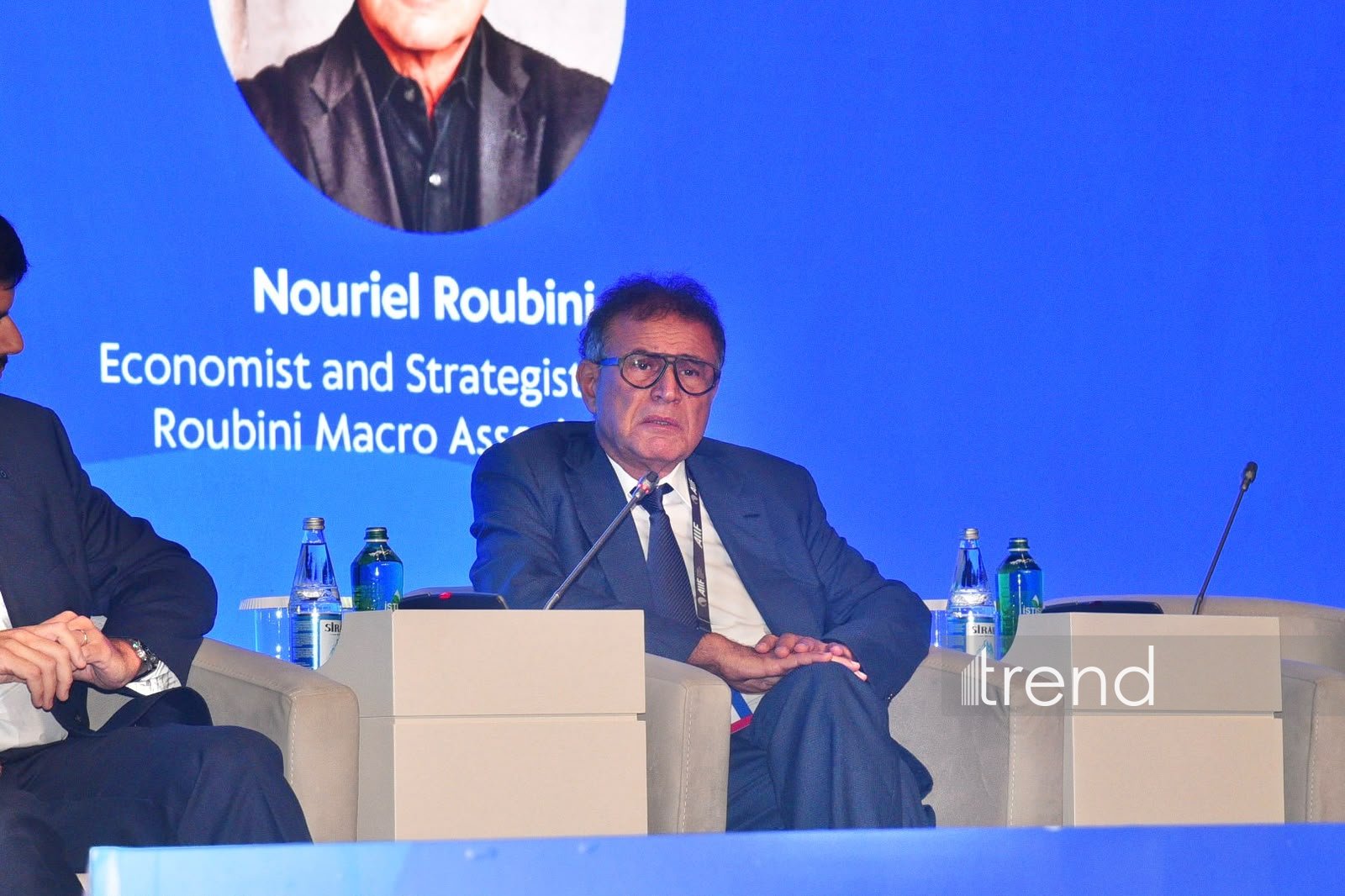

BAKU, Azerbaijan, September 25. The role of the U.S. dollar as the global reserve currency won't disappear, despite ongoing developments, Nouriel Roubini, Chairman and CEO of Roubini Macro Associates, LLC, a New York–based consultancy, said at the 2nd Azerbaijan International Investment Forum held in Baku today, Trend's correspondent reports from the event.
According to him, there is a perception that American exceptionalism has come to an end and that the U.S. dollar's role as the primary global reserve currency is being challenged.
"I disagree with that. I’m not saying I don't have criticisms regarding the trade policy or even the foreign policy pursued by Trump, but I would like to point out the following: the innovations we are witnessing now are linked not only to artificial intelligence but also to a dozen industries of the future connected to AI and hardware technologies," Roubini explained.
He noted that he disagrees with the view that American exceptionalism has ended or that the U.S. dollar's status as the leading global reserve currency is under threat; instead, he highlighted that current innovations span not just artificial intelligence but also a dozen other future-oriented sectors linked to AI and hardware technologies.
He identified these industries of the future as including semiconductors, robotic automation, humanoid robots, the green economy, fusion energy, green technologies, advanced materials, quantum computing, and space exploration.
"We also have defense technologies—a necessity in a world where everyone will have to spend more on defense. There are agritech, fintech, cybersecurity, and much more.
The U.S. and China are ahead of other countries in these sectors, with the US leading China in certain key areas," he said.
He also highlighted the role of Asian nations in hardware technology supply chains, specifically citing Japan, South Korea, Taiwan, Singapore, Malaysia, Thailand, India, and Israel. Roubini also mentioned that emerging market nations producing rare earth elements, "green" and industrial metals, and energy will benefit from the development of these sectors. This rising volume of capital expenditure requires significant amounts of capital, energy, and raw materials.
"The potential growth rate of the U.S. economy has been around 2% over the past 20 years, yet it could reach 4% by the end of this decade.
If 'American exceptionalism' existed when US growth was merely 2%—and U.S. stock market returns averaged 12% annually for the S&P and 16% for the Nasdaq over two decades—then that exceptionalism will not vanish with a potential growth rate of 3 or even 4%," he added.
The Second Azerbaijan International Investment Forum is taking place in Baku.
The two-day forum is organized by the Ministry of Economy and the Azerbaijan Export and Investment Promotion Agency (AZPROMO)—which operates under the Ministry—in strategic partnership with The European House – Ambrosetti.
Dedicated to the theme "Restoring Trust in a Fragmented World: The South Caucasus as an Anchor of Global Connectivity and Investment Stability," this year's forum brings together leading global investors, state and government officials, international financial institutions, and business leaders.



