


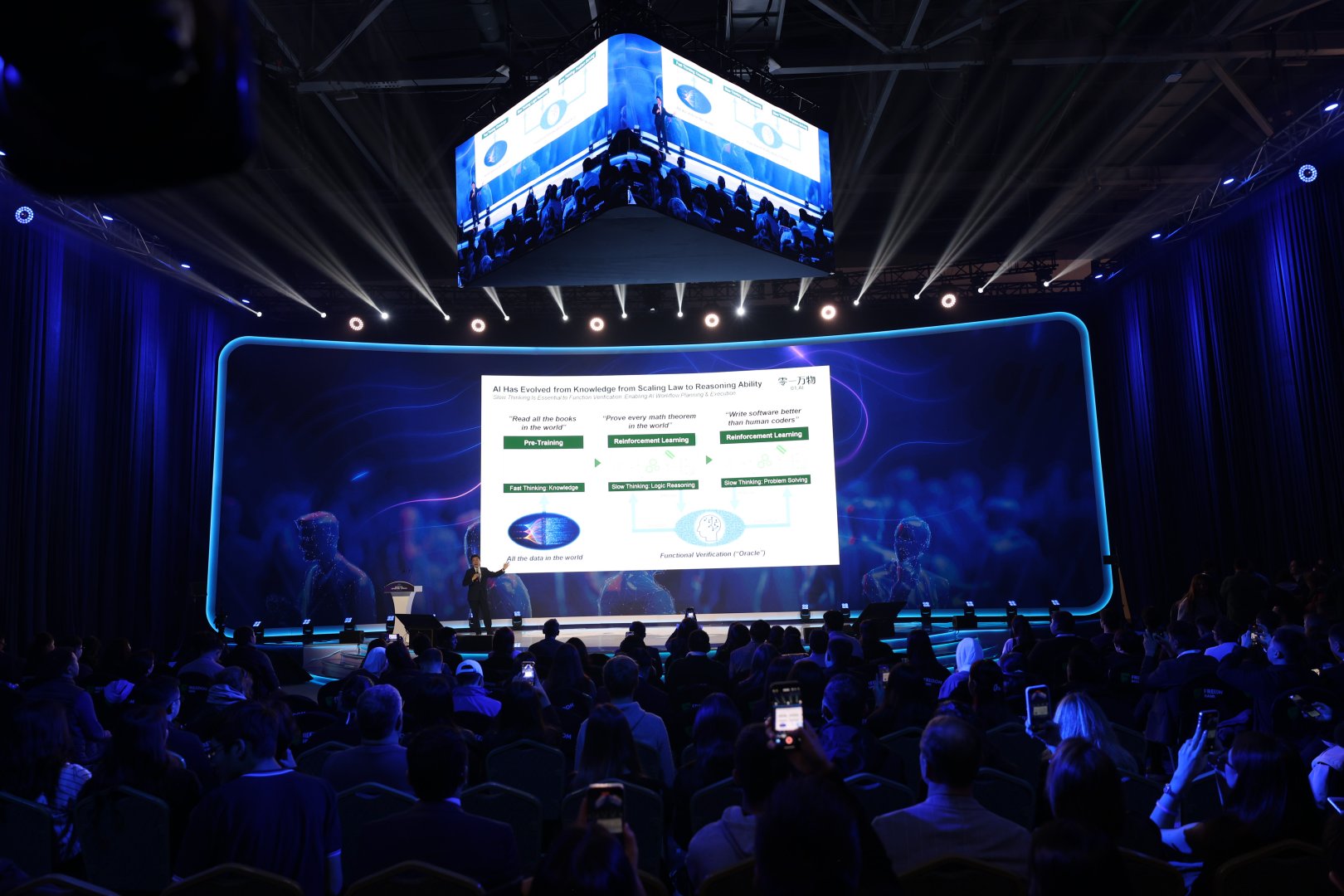
BAKU, Azerbaijan, September 24. AI & Digital Bridge 2026 will bring together more than 150 Kazakhstani and international speakers from the US, China, the UAE, Austria, New Zealand, Kazakhstan, and other countries.
However, the significance of the lineup is not determined by the number of names alone. The speakers represent different resources at the center of today’s global technology competition: artificial intelligence and computing power, investment capital, human capital, education, connectivity, cybersecurity, and digital infrastructure.
As part of the Year of Digitalization and Artificial Intelligence in Kazakhstan, AI MONTH, a month-long series of digital events, will take place from September 23 to October 23. Its centerpiece international event will be AI & Digital Bridge 2026, which will take place in Astana from October 1 to 3.
On One Stage: Global Technology Industry Leaders
Balaji Srinivasan: New Models of Digital Communities
Balaji Srinivasan is the Founder of The Network School, an entrepreneur, investor, and technologist. He previously served as CTO of Coinbase and was a General Partner at Andreessen Horowitz. He is the author of *The Network State*, a book exploring how technology can transform communities, entrepreneurship, and human interaction beyond geographical boundaries.
Today, this idea is also taking practical shape in Kazakhstan: The Network School is developing cooperation with the country in AI, education, technology entrepreneurship, and human capital. However, new technology hubs do not emerge only where international entrepreneurs establish a presence.
Increasingly, global companies are being built by engineers from regions that, until recently, were outside the traditional map of Silicon Valley.
Yerzat Dulat: A Global AI Product with Kazakhstani Roots
Yerzat Dulat is a Kazakhstani engineer, machine learning researcher, Co-Founder and CTO of Higgsfield AI.
The company develops generative AI tools for professional video and image production, emerging as one of the most prominent examples of a global technology business with Kazakhstani roots. In August 2026, Higgsfield raised $400 million at a $5.4 billion valuation.
Dulat’s story highlights a significant shift: a technology company’s origin and global potential are becoming increasingly less dependent on geography. However, technology and investment alone are not enough for such companies to emerge.
The next scarce resource in the global AI economy is the people capable of building these technologies.
Jamie Beaton: Human Capital as Technology Infrastructure
Jamie Beaton is the Co-Founder and CEO of Crimson Education, an international education company that helps students gain admission to the world’s leading universities and develops its own educational products, including the online school Crimson Global Academy.
Beaton is both an entrepreneur and an example of an unconventional educational path: he studied at Harvard, Stanford, Oxford, Yale, Princeton, the University of Pennsylvania, Tsinghua, and other universities, and was a Rhodes Scholar at Oxford. However, for AI & Digital Bridge, what matters more than the number of degrees is the business built around global competition for education.
Against the backdrop of AI development, the question of human capital is becoming even more pressing. As technology becomes capable of automating an increasing number of intellectual tasks, our understanding of what people need to learn, which skills retain their value, and how to prepare the next generation for professions that do not yet exist is changing.
The next phase of the AI revolution is about intelligence moving out of the computer and into the physical world.
Rev Lebaredian: From Generative AI to Robots
Rev Lebaredian is the Vice President of Physical AI and Simulation at NVIDIA. He has worked in the computer graphics industry for over 30 years and has been developing NVIDIA technologies since 2002.
Today, one of the key areas of his work is Physical AI and NVIDIA Omniverse: technologies that allow robots and autonomous systems to learn in virtual models of the physical world before entering real-world environments. If the current stage of AI is primarily associated with text, images, and video, the next stage may be defined by robots, autonomous machines, and industrial systems. However, scaling any new technology-driven economy requires another form of infrastructure—the financial one.
David Ripley: How the Digital Financial System Is Changing
David Ripley is the CEO of Kraken, one of the world’s largest cryptocurrency platforms. Before being appointed CEO, he spent six years as Chief Operating Officer, helping scale the company’s international infrastructure.
His participation broadens the discussion beyond artificial intelligence itself to the question of what the financial infrastructure of the digital economy will look like and how AI, blockchain, payments, and new digital assets will interact.
However, technologies cannot scale without capital.
William Ford: Capital for the Next Technology Cycle
William Ford is the Chairman and CEO of General Atlantic. He leads a global investment firm developing its Growth Equity, Credit, and Sustainable Infrastructure strategies.
His presence adds another critical question to the forum’s agenda: where is global capital heading today, and which technologies do investors consider the foundation of the next phase of economic growth? However, both capital and AI products require infrastructure capable of connecting billions of people and devices.
Greg Wyler: Digital Infrastructure Takes to Space
Greg Wyler is the Founder, CEO, and Chief Architect of E-Space. He is a technology entrepreneur and engineer specializing in satellite systems and global connectivity.
Previously, he founded O3b Networks and OneWeb and is currently developing the next generation of low-Earth-orbit satellite infrastructure. His experience shows how broad the concept of technology infrastructure is becoming: the next digital economy is built not only on the ground—its connectivity increasingly relies on space.
At the same time, the global race for intelligence itself continues—new models, algorithms, and research schools.
Kai-Fu Lee and Mérouane Debbah: Who Will Build the Next AI
Kai-Fu Lee is the Chairman and CEO of Sinovation Ventures and the Founder and CEO of 01.AI. He has worked at Apple and Microsoft, helped establish Microsoft Research China, and led Google China. Today, he is developing his own AI company focused on foundational models.
His experience brings together several worlds: the American and Chinese technology ecosystems, academic research, investment, and entrepreneurship.
Mérouane Debbah, a professor at Khalifa University and Director of the Digital Future Institute, works at the intersection of mathematics, machine learning, and telecommunications. His research focuses on 4G, 5G, and 6G, AI, and intelligent communication systems.
Together, these areas lead to the next question: what infrastructure will the world need when AI becomes part of virtually every sector of the economy?
And the more technology becomes integrated into critical infrastructure, the more vital its security becomes.
Sebastian Kurz: AI and the New Architecture of Cybersecurity
Sebastian Kurz is the Co-Founder and President of Dream. The former Federal Chancellor of Austria is now developing a technology company focused on AI, cybersecurity, and the protection of digital infrastructure.
His professional trajectory bridges public administration and the technology business—two worlds that will need to interact increasingly closely as AI becomes part of national infrastructure.
Another forum participant also represents the connection between government and global business.
Jon Huntsman: Technology at the Intersection of Business and Government
Jon Huntsman is the Vice Chairman and President of Strategic Growth at Mastercard. He is responsible for developing the company's strategic partnerships, including engagement with government and public institutions.
Before joining Mastercard, Huntsman served as Governor of Utah and as a U.S. diplomat, including as U.S. Ambassador to China and Russia.
His participation highlights another side of the ongoing transformation: technological competition has long ceased to be the exclusive domain of private companies. Governments are becoming direct participants in shaping the new digital economy.
This is where the global discussion turns back to Kazakhstan.
Kazakhstan: From Technology Adoption to Building Its Own Ecosystem
Kazakhstan will be represented at the forum by leaders from government, technology infrastructure, and business.
Zhaslan Madiyev is the Deputy Prime Minister and Minister of Artificial Intelligence and Digital Development of the Republic of Kazakhstan. His professional experience spans the financial sector, public administration, and the technology industry.
Bagdat Musin is the Chairman of the Management Board of Kazakhtelecom JSC, having previously served as Minister of Digital Development, Innovation and Aerospace Industry. Today, he leads the country's largest telecommunications operator at a time when connectivity, data centers, and computing infrastructure are becoming the foundation of the AI economy.
Timur Turlov is the Founder and CEO of Freedom Holding Corp. He has built an international financial group bringing together banking, brokerage, insurance, telecommunications, and digital services.
Thus, the international agenda of AI & Digital Bridge intersects with the very questions facing Kazakhstan today: where to secure computing power and capital, how to develop infrastructure, how to develop talent, how to build globally competitive products, and how to attract international technology companies.
Different Sectors, One Question
At first glance, the participants of AI & Digital Bridge operate in completely different sectors.
Balaji Srinivasan explores new models of digital communities. Yerzat Dulat is building a global AI product. Jamie Beaton works in education and talent development. Rev Lebaredian works with Physical AI and robotics. Greg Wyler is building satellite infrastructure. William Ford represents global capital. Kai-Fu Lee represents the global AI industry.
Yet all these sectors converge on a single question: where will the next technology-driven economy be built?
For Kazakhstan, it is no longer just about how to adopt technologies developed in other countries more quickly. The next stage is to build an environment where global AI products, technology companies, research teams, investment, and new educational models can emerge and scale from Kazakhstan.
It is precisely this conversation that will bring together international and Kazakhstani participants at AI & Digital Bridge 2026.
About the Forum
AI & Digital Bridge 2026 will take place as part of the Year of Digitalization and Artificial Intelligence in Kazakhstan and will serve as the centerpiece international event of AI MONTH—a large-scale month-long program dedicated to the development of artificial intelligence and digital technologies.
Over the years, AI & Digital Bridge has brought together more than 127,000 participants from over 100 countries, 1,500 speakers, 600 startups, and 500 investors.
AI & Digital Bridge is an opportunity to see technologies in action, meet companies and startups, connect with investors and experts, and experience several worlds of the technology industry in just two days. In 2026, the forum will take place in Astana from October 1 to 3.
October 1 — a special program with the participation of the Head of State, international delegations, and technology industry leaders. Access to events on this day is by special invitation only.
October 2–3 — the open days of AI & Digital Bridge 2026, available to ticket holders. The program will feature artificial intelligence, investment and technology entrepreneurship, talent development, Creative Industries, GameDev, a technology exhibition, Startup Alley, Astana Hub Battle, and other areas.
AI & Digital Bridge 2026 is organized by the Ministry of Artificial Intelligence and Digital Development of the Republic of Kazakhstan, Astana Hub, and the Akimat of Astana.
AI & Digital Bridge 2026 is made possible through the support of the forum’s partners and sponsors. All forum expenses are covered by sponsorship funds.
Gold Partners: Freedom Bank, Kaspi Bank, Samruk-Kazyna JSC, and Kazakhtelecom JSC. Silver Partner: Halyk Bank. Business Partner: Beeline Kazakhstan. Bronze Partner: Yandex Qazaqstan. Telecom Partner: Freedom Telecom Operations LLP. Technology Partner: Transtelecom JSC. Official Airline Partner: Air Astana.
Tickets are available on the official website: digitalbridge.ai.



