


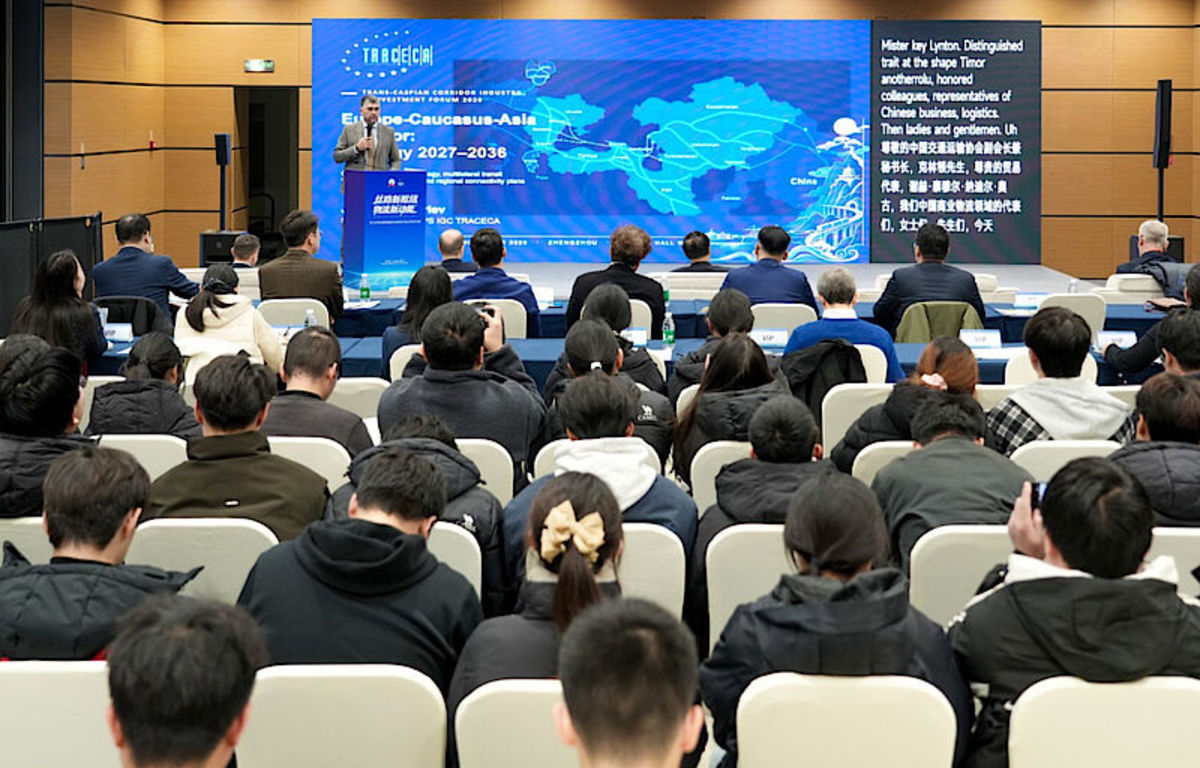

BAKU, Azerbaijan, November 27. TRACECA Secretary General Zhasurbek Choriyev presented the development strategy for the Europe-Caucasus-Asia transport corridor at the Trans-Caspian Corridor Industry & Investment Forum 2026, held in Zhengzhou, China.
According to TRACECA, the forum was held as part of the 23rd China International Transportation and Logistics Expo and Logistics Industry Week. It was organized by the China Communications and Transportation Association and Beijing Trans-Eurasia International Freight Forwarding Co., Ltd.
The event brought together representatives of government agencies, diplomatic missions, industry associations, and leading logistics, railway and technology companies from China and across Eurasia.
Choriyev delivered a presentation titled "A Unified Development Strategy for the Europe-Caucasus-Asia Corridor, Multilateral Transit Facilitation Mechanisms and Regional Connectivity Plans."
In his remarks, he noted that, amid the realignment of global supply chains, the Trans-Caspian route had evolved from an alternative transport option into a strategic necessity for Eurasian trade.
The secretary general also highlighted TRACECA's institutional status as an intergovernmental organization operating under the legally binding Basic Multilateral Agreement signed in 1998.
Particular attention was given to the Development Strategy for the Europe-Caucasus-Asia International Transport Corridor for 2027–2036, which is currently undergoing approval by member states.
The document envisages a shift in TRACECA's role from coordinating national efforts to actively managing corridor development through measurable performance indicators.
The strategy sets the following targets:
- Reduce border-crossing times to two hours or less by 2030;
- Cut overall cargo delivery times on selected routes by 30% by 2036;
- Digitize 80% of transport documents by 2032;
- Double the share of container traffic and increase the share of environmentally friendly transport to 20% by 2036.
To achieve these goals, TRACECA is introducing several tools, including a Corridor Performance Monitoring System, a Corridor Bottleneck and Capacity Matrix, and a Corridor Digital Ecosystem of Platforms.
The strategy also provides for mechanisms for attracting investment through the TRACECA Fund and TRACECA Business Council.
Other speakers at the forum included Trade Representative of the Azerbaijani Embassy in China Teymur Nadiroglu, Deputy Secretary General of the International Association of the Trans-Caspian International Transport Route Saut Shynybayev, and executives of major Chinese corporations operating in multimodal transport, the TIR system, electric transport and intelligent logistics equipment.
A separate part of Choriyev's presentation focused on prospects for expanding cooperation with China, the largest origin and destination market for cargo transported along the Middle Corridor.
The secretary general outlined opportunities for technological cooperation in smart logistics, Chinese business participation in TRACECA's priority infrastructure projects for 2027–2030, and the possibility of formalizing dialogue by granting China observer status under the TRACECA Basic Multilateral Agreement.


