


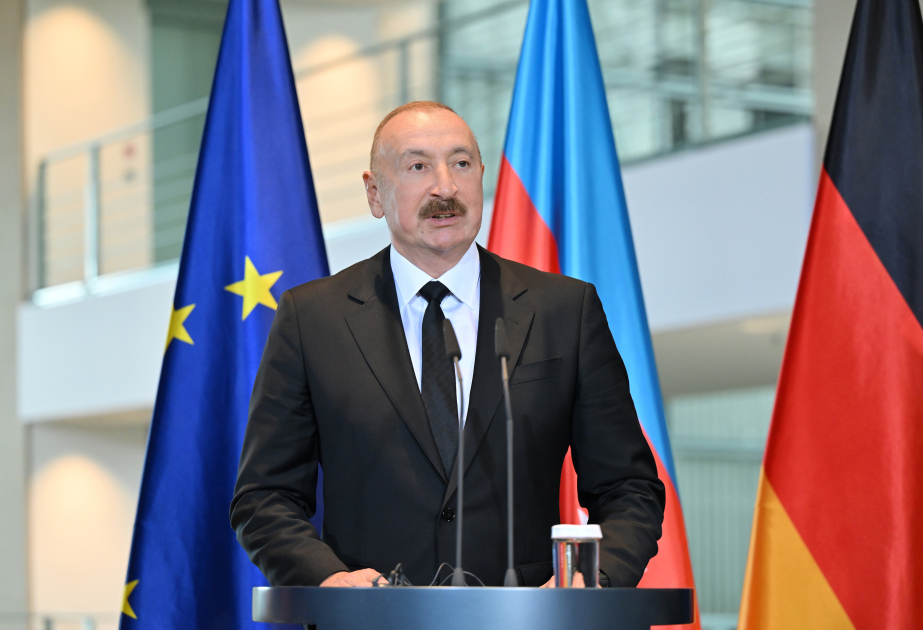

BERLIN, Germany, July 21. Germany, as a leading country in the European Union, is increasing its influence in the South Caucasus, said President Ilham Aliyev during a joint press conference with Federal Chancellor of Germany Friedrich Merz, Trend's special correspondent reports.
Statement by President Ilham Aliyev
- Thank you, Mr. Chancellor. First of all, I would like to express my gratitude to you for the hospitality extended to me and for the invitation to pay an official visit. I am very pleased to be in your country once again. I am confident that the documents signed today will elevate our relations to a new level. We have long wished to initiate a strategic dialogue, and we have now achieved this. At the same time, I am certain that the Joint Declaration signed today on expanding economic ties will function as an active framework and yield good results.
Our bilateral agenda is quite extensive. We exchanged views on this during both our one-on-one meeting and the meeting in an expanded format. As a leading country in the European Union, Germany is increasing its influence in the South Caucasus. Azerbaijan–Germany ties will contribute not only to bilateral relations but also to cooperation, peace, and stability across our entire region.
Many German companies operate successfully in Azerbaijan. The number of companies actively operating in the country exceeds 200. I am confident that following today's visit, their number will increase even further. Matters regarding mutual investment are being discussed, and concrete proposals have been put forward for German companies to operate on a broader scale in Azerbaijan.
You touched upon cooperation in the energy sector. There are positive results in this area as well. Starting this year, Azerbaijan has begun exporting its natural gas to Germany. Thus, our gas is currently delivered to 10 European Union member countries, which undoubtedly makes a major contribution to energy security. Considering that Azerbaijan also exports its oil to Germany and is determined to deliver its green energy to Europe in the future, cooperation in the energy field will be very large-scale.
Azerbaijan–Germany cooperation is also of paramount importance in terms of connectivity and transit opportunities, as German companies have achieved great success in this field. Azerbaijan continues to modernize its transport infrastructure. By becoming a full member of the Central Asian Consultative Meetings format last year, Azerbaijan serves as a bridge between Central Asia and Europe—a role that will steadily expand. Concrete action plans are envisaged across various areas. Specific proposals were put forward during our exchange of views on the implementation of the Declaration signed today. Several working groups will be established to ensure that the documents signed today are swiftly translated into practical results.
At the same time, I would like to express my gratitude to you for Germany's contribution to the peace process in the South Caucasus. After many years, the normalization of Armenia–Azerbaijan relations and the initialing of the peace treaty—along with the signing of the Joint Declaration at the White House in Washington with the participation and signature of President Trump—effectively brought an end to the 30-year-long conflict. Immediately after this agreement, Azerbaijan proceeded to take practical steps. Today, petrol and diesel fuel supplied by Azerbaijan are making a significant contribution to Armenia's energy security, particularly given the current difficulties affecting the export and import of petroleum products. At the same time, the transit of cargo to Armenia through the territory of Azerbaijan has also gathered momentum. To date, more than 40,000 tonnes of transit cargo have passed through Azerbaijani territory.
In other words, we are witnessing a truly historic era. Azerbaijan, whose territories remained under occupation for many years, ended the occupation through its own strength, restored its territorial integrity and sovereignty. It fulfilled four UN Security Council resolutions on its own, offered peace to Armenia, and received a positive response. Therefore, I reiterate that we highly appreciate the role of the German government in this domain. Meetings were also held in Germany at the level of foreign ministers during the negotiation process.
Finally, I would like to touch upon European Union–Azerbaijan relations. This year, we have witnessed visits to Azerbaijan by both the President of the European Council, Mr. Costa, and the President of the European Commission, Ms. von der Leyen. These visits carry profound political significance and will further strengthen ties between the European Union and Azerbaijan. As Germany is a leading nation among European Union member states, its role in this regard is naturally paramount, and I am confident that Germany will continue its efforts to foster future cooperation.
Once again, Mr. Chancellor, I would like to thank you for the invitation and hospitality, and I cordially invite you to pay an official visit to Azerbaijan at your convenience



