


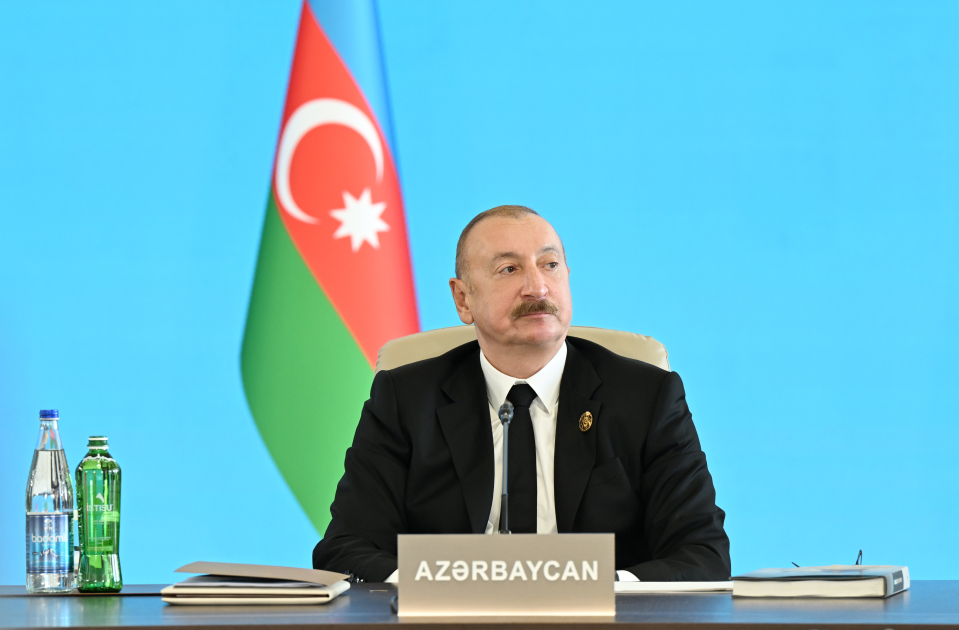
BAKU, Azerbaijan, October 30. The 13th Summit of the Organization of Turkic States (OTS) is taking place today in Ankara, where Azerbaijan is handing over the chairmanship to Türkiye. Foreign Minister Jeyhun Bayramov is representing Azerbaijan at the summit. President Ilham Aliyev’s absence has already given rise to various interpretations, not all of which are well-intentioned. To understand this move, it is helpful to recall the role the OTS plays in Ilham Aliyev’s own political agenda and the path the organization has taken under his leadership.
This journey began 17 years ago in Nakhchivan. On October 3, 2009, the presidents of Azerbaijan, Kazakhstan, Kyrgyzstan, and Türkiye signed an agreement there to establish the Cooperation Council of Turkic-Speaking States. Ilham Aliyev hosted the summit, and his name heads the list of signatories to the Nakhchivan Declaration, which the four countries subsequently submitted to the UN. Yes, the idea of a Turkic union did not originate in a single capital, but it took on its legal form precisely on Azerbaijani soil. And to this day, the organization’s founding document bears the name of Nakhchivan: it was this document that Uzbekistan ratified in 2019, and it was this document that was amended following the renaming.
Already in the early years, the President of Azerbaijan shifted the conversation from shared roots to practical action. When Gabala hosted the third summit of the Turkic Council in August 2013, Ilham Aliyev spoke not so much about linguistic kinship as about the Baku–Tbilisi–Ceyhan oil pipeline, the Baku–Tbilisi–Kars railway, and the expansion of the Port of Baku to 20 million metric tons. “For the first time in history, the Caspian Sea was connected to the Mediterranean,” he reminded his partners. What is now called the Middle Corridor was, in Gabala - AS FAR BACK AS 13 YEARS AGO - already being discussed as a strategy long before it became a trendy topic among experts.
Six years later, Baku hosted the summit marking the organization’s 10th anniversary, and it was there that Uzbekistan became a full member. Azerbaijan’s chairmanship, which began at that time, coincided with the most difficult years: the pandemic and the 44-day Second Karabakh War, and it was with this background that the Turkic Council arrived in Istanbul in November 2021, where it became the Organization of Turkic States and adopted the “Vision for the Turkic World 2040.”
That same summit awarded Ilham Aliyev the Supreme Order of the Turkic World. The liberation of Azerbaijani lands from occupation became a shared achievement of the Turkic world, and in July 2024, the leaders gathered in Shusha. The informal summit, hosted by the President of Azerbaijan, concluded with the Karabakh Declaration and a decision to strengthen the organization’s Secretariat.
At the same time, the agenda proposed by Baku was evolving. In 2023, in Astana, Ilham Aliyev called for the development of cooperation in defense and the defense industry, and in October 2025, Gabala once again hosted a summit, this time under the theme “Regional Peace and Security.” Ilham Aliyev stated there that the Turkic states should act as a unified center of power, and proposed holding joint exercises of the OTS member states in Azerbaijan in 2026, as well as commemorating the centennial of the First Turkic Congress, which took place in Baku in 1926.
These proposals were backed by figures. According to the head of state, cargo traffic along the Middle Corridor has grown by approximately 90% since 2022; Azerbaijan has invested more than $20 billion in the economies of its partner countries; and the capacity of the new port in Alat is expected to reach 25 million metric tons per year. Thirteen years ago, in the same city of Gabala, the talk was of 20 million metric tons for the old port. From cultural forums to infrastructure, from infrastructure to security: at each of these turning points, Baku was not so much a participant as the architect of the agenda.
That is precisely why Ilham Aliyev’s decision not to visit Ankara should be interpreted not as a distancing from the Turkic world, but as a reminder of the conditions under which this world was built. The official explanation is simple: a busy schedule and the final of the FIFA U-15 World Cup, which is being held in Baku for the first time. But one cannot fail to see the broader context. In October, a number of Turkish public figures, including an adviser to the Turkish president, made offensive remarks directed at the Azerbaijani leader over Azerbaijan’s domestic decision regarding school uniforms. The adviser was ultimately dismissed from his post. For Ilham Aliyev, Turkic unity has always been a union of equals. In this union, there are no seniors or juniors, and brotherhood grants no one the right to judge a partner’s internal decisions. Azerbaijan does not join the organization seeking patronage. It brings to the organization transport corridors, investments, victory in Karabakh, and the very idea of a Turkic center of power. The solidarity that Baku offers voluntarily expects the same respect in return.
And when this balance is disrupted, Ilham Aliyev refrains from making high-profile statements. He congratulates Recep Tayyip Erdoğan on the 103rd anniversary of the Republic of Türkiye, sends a minister to Ankara to hold talks with Hakan Fidan, and remains in Baku himself. The alliance is reaffirmed; the boundary is delineated.
This, incidentally, is not a special policy toward Türkiye or the OTS. Equality has long been the cornerstone of President Ilham Aliyev’s entire foreign policy. “Our foreign policy is completely independent and relies on national interests of Azerbaijani people,” he said back in 2014. Azerbaijan is not a member of any military-political bloc and for several years headed the Non-Aligned Movement, which unites countries that defend their right not to choose patrons.
Ilham Aliyev applies the same principle to all partners. He pressed Moscow to acknowledge responsibility for the crash of the AZAL aircraft. This month, Ramzan Kadyrov personally traveled to Baku to apologize for the offensive incident, while in Ankara, a presidential adviser lost his post. Different capitals and varying degrees of closeness, but the result is the same: disrespect toward Azerbaijan comes at a price, no matter who commits it.
Türkiye remains an ally of Azerbaijan, and this alliance is enshrined in the Shusha Declaration, but precisely because it is an alliance, it is built on a basis of equality. The organization that was founded in Nakhchivan and given a new agenda in Gabala remains, among other things, an Azerbaijani project, and Baku has no intention of abandoning it. And who built this Turkic house has the right to remind everyone that all who live in it are equal.


