


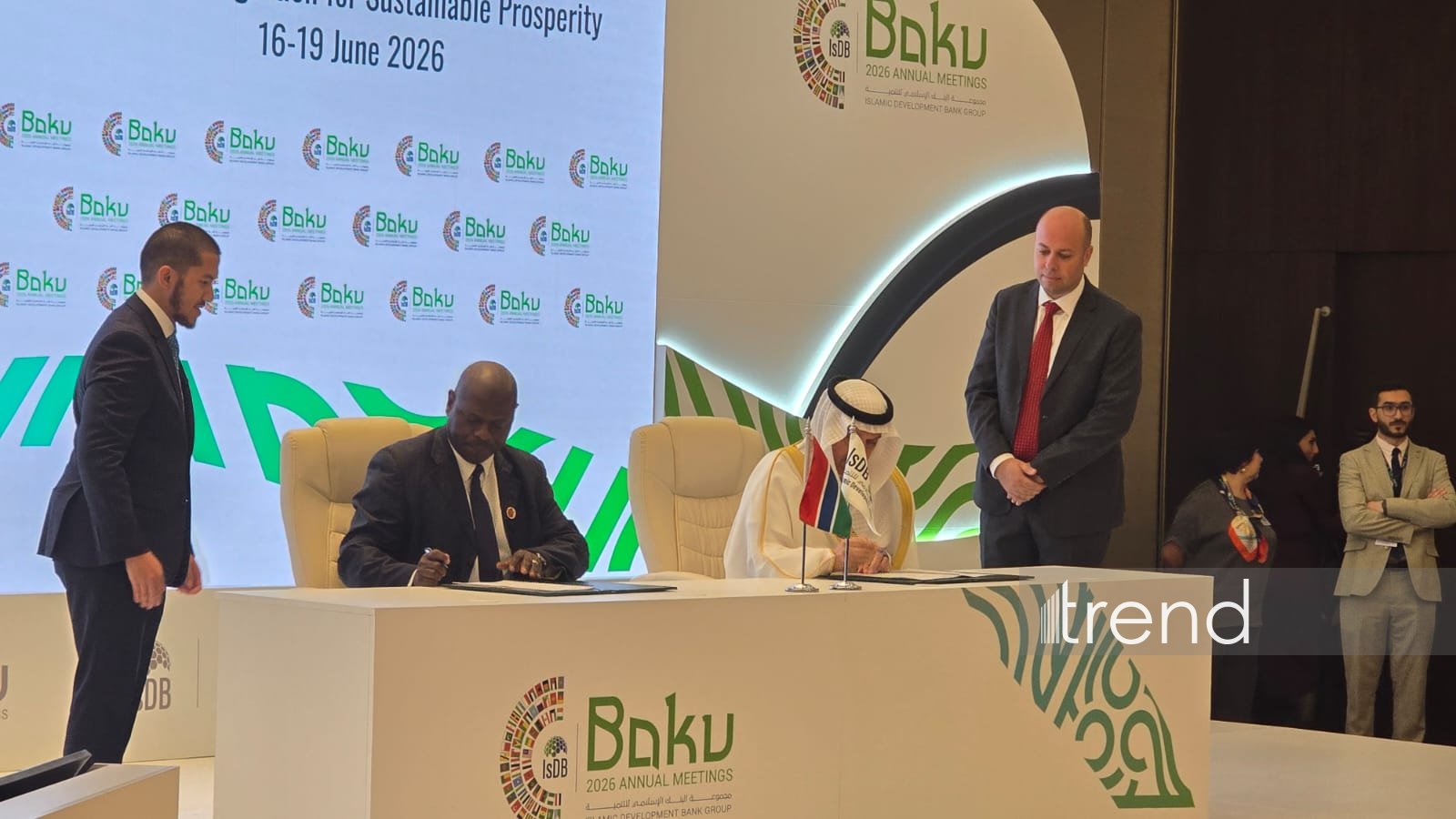
BAKU, Azerbaijan, June 19. The signing ceremony for projects and financial agreements took place within the framework of the 51st Annual Meeting of the Islamic Development Bank (IsDB) Group in Baku, Trend's correspondent reports from the event.
The signed agreements aim to promote sustainable development, strengthen resilience, and create new opportunities.
At the ceremony, it was announced that the signing of documents between member countries and international institutions is carried out in alphabetical order. First, an agreement was signed between the IsDB Group and the Republic of the Gambia. The document covers a project aimed at increasing livestock production and productivity. The project is financed by $19 million in ICF loans, a $15.5 million IsDB Ordinary Capital Resources (OCR) trade credit, and a $1.01 million grant.
Subsequently, an agreement was signed between the IsDB and Côte d'Ivoire. The agreement provides for the reconstruction and upgrade of the Dabou–San Pedro highway in the specified country. This strategic transport project, spanning 58 kilometers, is funded under a €218.7 million IsDB OCR credit line. The project aims to transform an economically vital corridor into a high-capacity, two-lane highway. As a result, travel times are expected to decrease, transport costs will drop, and the region's economic ties will strengthen.
Next, the Minister of Economy and Development of Mauritania, Abdessalam Ould Mohamed Saleh, took part in the signing of documents. The signed agreement covers a rural electrification project in remote areas of Mauritania. The project is implemented through $25.35 million in IsDB installment trade financing and $23.39 million in ICF financial resources. The program, with a total cost of $69.5 million, aims to expand energy supply in rural and remote regions. It is reported that the project's implementation will substantially improve access to electricity in remote settlements and mark significant progress in securing energy supplies.
Within the framework of the event, a commemorative record on the launch of the 2026–2028 Country Engagement Framework with Somalia was signed. The document, with a total value of $45 million, provides for strengthening resilience and supporting economic transformation in the country. The framework document aims to develop sustainable infrastructure, strengthen food security, and build human capital through integrated investments in challenging and fragile environments.
The State Secretary for Financial Affairs of the Kingdom of Bahrain, Yusuf Abdullah Ali Humood, participated in the signing of two agreements. The first agreement covers the Salman Industrial City expansion project. The project is implemented under IsDB OCR installment trade financing and is evaluated as one of the key directions of Bahrain's industrial sector development strategy, as well as its "Vision 2030" program. The project provides for the creation of modern, climate-resilient infrastructure and the expansion of industrial land areas.
Then, the Minister of Finance and Planning of the State of Palestine, Estefan Antwan Salameh, was invited to the stage to join the signing process. Within the framework of the event, an agreement was signed on a solar energy project concerning Palestine. The project is financed by a $37 million IsDB ICF loan. The solar power plant project, implemented under the document, provides for the production of 20 megawatts of energy capacity. This investment will help reduce the country's dependence on imported electricity, strengthen energy security, and expand the use of renewable energy sources.
Following this, a memorandum of understanding was signed between the Islamic Development Bank and the Federation of Contractors from Islamic Countries (FOCIC). The President of FOCIC, Engineer Zakaria Al-Abdulqader, along with the IsDB Vice President for Operations, Rami Ahmad, participated in the signing ceremony and official photo session. It was noted that this strategic partnership serves to strengthen private sector participation and increase competitiveness in the construction markets of OIC countries. The document provides for capacity building, market data exchange, expanding access to finance, and increasing preparedness for implementing major infrastructure projects.
An agreement on a donor contribution was then signed. The agreement involves support from Islamic Relief USA (IRUSA) for the IsDB's 3R Mechanism. This contribution is aimed at strengthening the platform that provides targeted grant financing for member countries affected by conflicts, natural disasters, and other crises.
The next agreement concerns cooperation between the IsDB and IRUSA on Sudan. The document provides for the implementation of comprehensive emergency assistance measures in the fields of healthcare, water supply, sanitation, and hygiene (WASH), as well as housing provision for the population affected by the conflict in Sudan.
Subsequently, a memorandum of understanding was signed between the IsDB and the International Organization for Migration (IOM). The head of the IOM headquarters, Mohammed Abdiker, was invited to sign the document. The memorandum provides for integrating humanitarian response measures in the context of migration and forced displacement with long-term development approaches. This cooperation aims to enhance support for highly vulnerable and crisis-affected communities.
A memorandum of understanding was also signed between the IsDB and the Islamic Organization for Food Security (IOFS). Within the framework of the document, the parties aim to expand cooperation in strengthening food security systems and promoting sustainable agricultural development in member countries.
During the ceremony, memorandums of understanding were also signed between the IsDB and the Belgian development agency, Enabel. The Managing Director of Enabel, Jean Van Wetter, participated in the ceremony alongside IsDB Vice President for Operations Rami Ahmad. The framework agreement aims for faster and more large-scale implementation of sustainable development projects in member countries. The document provides for increasing the efficiency of development initiatives through co-financing with European partners, utilizing delegated execution mechanisms, and pooling institutional expertise.
The portion of the signing ceremony for "Projects and Financing Agreements" pertaining to the Islamic Development Bank was thus concluded. In the next phase, the signing of documents for the Islamic Corporation for the Insurance of Investment and Export Credit (ICIEC) was organized first. To this end, the CEO of ICIEC and Acting CEO of the Islamic Corporation for the Development of the Private Sector (ICD), Khalid Khalafalla, was invited to the stage. He participated in the signing of the subsequent agreements on behalf of ICIEC.
At this stage, another project supported by ICIEC, worth $65 million and being implemented in the city of Lira in Uganda, was presented first. The project is reported to be executed by the Egyptian EPC contractor SAMCO. Ibrahim Mabrouk was invited to the ceremony to sign the project documents. It was noted that this initiative contributes to expanding investment flows across the OIC space, while also providing contracting companies with the opportunity to implement cross-border projects with greater confidence and reduced risks.
The next agreement was signed between ICIEC and Elsewedy Electric UAE for reinsurance worth $25 million. The document supports the construction of a main electrical substation and associated distribution networks in Saudi Arabia. The project will contribute to strengthening the country's electricity infrastructure, increasing power supply reliability, and developing the energy grid.
The final agreement was signed between ICIEC and the Arab Trade Financing Program (ATFP) on a master insurance policy. The agreement, valued at $50 million, serves to expand trade finance flows between member countries. The partnership will increase liquidity options for cross-border trade transactions and facilitate business entities' access to financial resources.



