


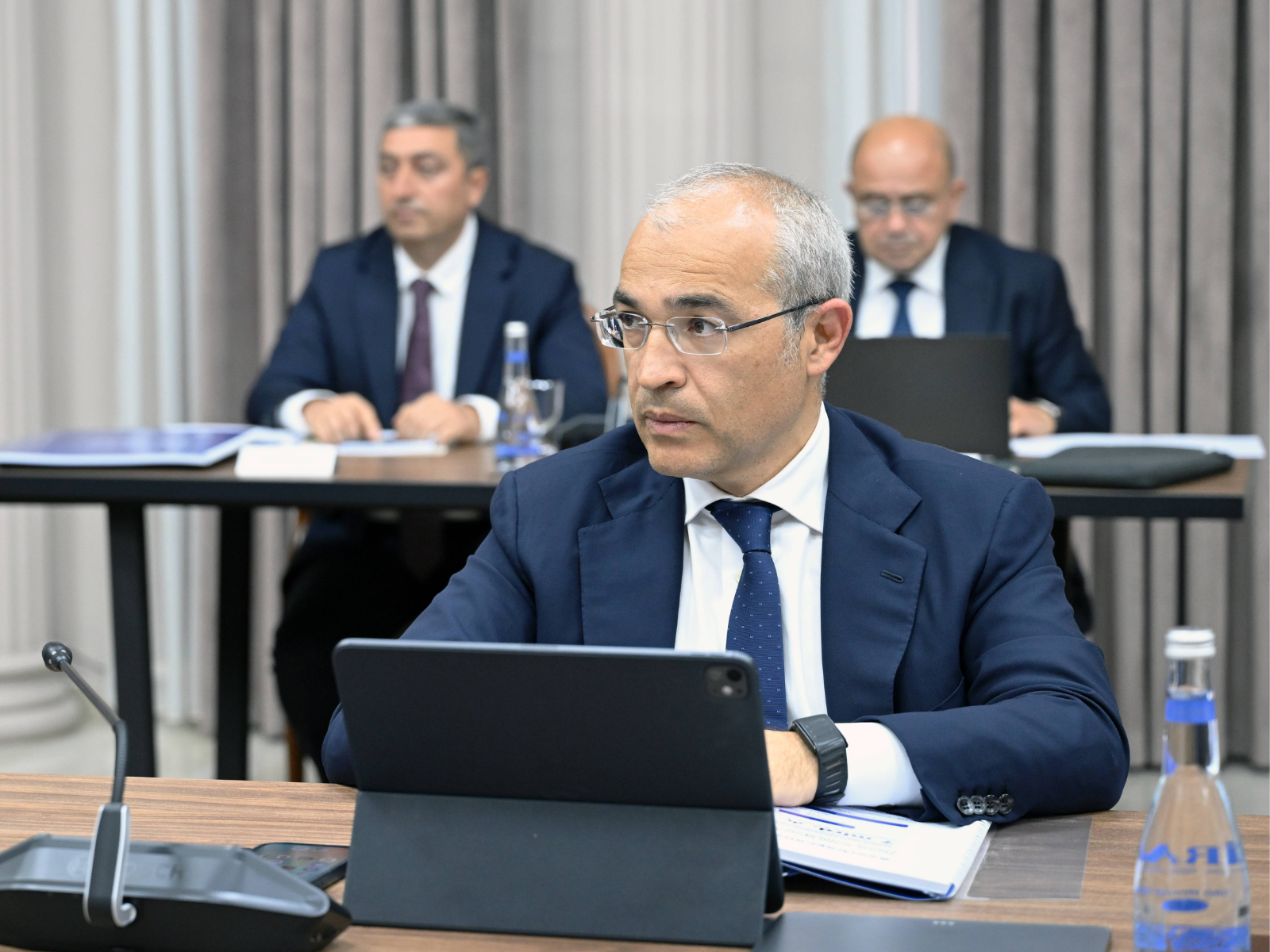
BAKU, Azerbaijan, September 22. Our main approach is not only to extract raw materials, but also to process them more actively within the country and create higher added value, Economy Minister Mikayil Jabbarov said at a meeting chaired by President Ilham Aliyev dedicated to the State Program on the development of the mining and metallurgical industry.
According to the minister, by 2030, the plan is to increase the mining and metallurgy sector’s contribution to gross domestic product from 700 million manat ($411.8 million) to 1.8 billion manat ($1.06 billion), and its annual export potential from 1.3 billion manat ($760 million) to 3.4 billion manat ($2 billion). Mikayil Jabbarov noted that a total of 5.3 billion manat ($3.1 billion) will be required between 2027 and 2030 to achieve these goals.
“The main objectives of the program are simple: it is not about extracting more raw materials, but about processing them more actively within the country and creating higher added value,” M. Jabbarov noted.
He stated that the main priorities of the State Program are expanding the mineral resource base, increasing existing production capacity, and implementing new projects. Iron ore, aluminum, copper, and gold have been identified as the key focus areas. At the same time, plans are in place to bring new deposits into economic use.
The minister noted that, as part of the program, in addition to the government’s regulatory and supportive role, investment opportunities from state-owned enterprises and the private sector will be utilized.
According to him, the program aims to establish, to the greatest extent possible, a domestic value chain from ore to the final product. This process will cover all stages: from exploration and mining to beneficiation, processing, and the production of semi-finished and finished products.
In the first phase, the plan is to realize the potential of local raw materials and increase production at existing deposits. There are plans to expand the raw material base by utilizing the “Demirli,” “Soyudlu,” and “Filizchay” deposits in Nakhchivan, as well as other promising regions.
As part of the “Dashkasan” iron ore mining project, plans include the creation of facilities for the mining, beneficiation, and production of iron ore pellets, as well as a plant for the production of hot-briquetted iron. The goal is to use the mined iron as raw material for domestic metallurgical enterprises, thereby establishing a local production chain. Plans call for increasing the annual production capacity of the aluminum electrolysis plant from 50,000 metric tons to 100,000 metric tons, and rolled steel production from 20,000 metric tons to 50,000 metric tons. In addition, there are plans to build a workshop for the calcination and firing of anodes, as well as to produce carbon anode blocks.
Jabbarov noted that Azeraluminium’s exports are expected to increase from 252 million manat ($148.2 million) in 2025 to 510 million manat ($300.04 million) in 2030.
The extraction and production of copper, gold, and silver are also planned to increase. Total exports in these sectors are projected to grow from 600 million manat ($352.9 million) in 2025 to 1.6 billion manat ($940 million) in 2030. This figure is based on average global prices for 2025.
The minister reported that the total investment requirement under the State Program for 2027–2030 is estimated at 5.3 billion manat ($3.1 billion). It is anticipated that 1.1 billion manat ($650 million) of this amount will be financed from the state budget, 2.2 billion manat ($1.2 billion) from state-owned enterprises, including loans, and 2 billion manat ($1.1 billion) from private sources, including borrowed capital. Thus, the plan is to attract approximately 80% of the total investment from non-budgetary sources.
M. Jabbarov emphasized that projects in the mining and metallurgical sectors require significant capital and long-term financing. He noted that for such projects, the period from decision-making to the start of production can be five years or more. In this regard, it is important to expand lending options with terms of 10 years or more, as well as to increase the participation of local banks in financing large-scale and long-term projects.
The minister stated that, to this end, it is proposed to develop policy measures for long-term financing and to establish appropriate mechanisms involving the Cabinet of Ministers, the Ministry of Finance, the Ministry of Economy, the Central Bank of Azerbaijan, the State Oil Fund, and other relevant institutions.
The state program also provides for the modernization of the legal and institutional framework, the drafting of a new bill “On Subsurface Resources,” the adoption of international reporting standards, and the creation of a unified electronic database of geological information.
In addition, there are plans to improve tax, customs, and investment incentives to attract large-scale projects, expand support for industrial and transportation infrastructure, support scientific research and development, and foster cooperation in the fields of education and industry.
According to the minister, the potential for transforming Azerbaijan into a regional hub for the processing of strategic minerals in the long term is also being evaluated. He noted that the Port of Baku, the Baku-Tbilisi-Kars railway, the Alat Free Economic Zone and other industrial zones, as well as energy and transportation capabilities, create additional potential in this direction.
Jabbarov noted that the program’s impact will not be limited to the mining and metallurgy sector. Increased production will boost demand for freight transportation and logistics services, create new opportunities for local contractors and suppliers, lay the groundwork for the development of new industries, and increase employment in the regions.
“Our main approach is not only to extract raw materials, but also to process them domestically and create higher added value,” the minister emphasized.



